
The aging population in Quebec is one of the most significant demographic challenges facing the province's healthcare system. By 2031, more than one in four Quebecers will be 65 or older – an unprecedented transformation that is creating a growing demand for care tailored to the realities of older adults. However, seniors are not simply older adults; their physiology, pharmacology, clinical needs, and health values present unique characteristics that warrant a specialized medical approach. Geriatric medicine recognizes these specificities and develops assessment and intervention tools that go far beyond treating individual chronic diseases.
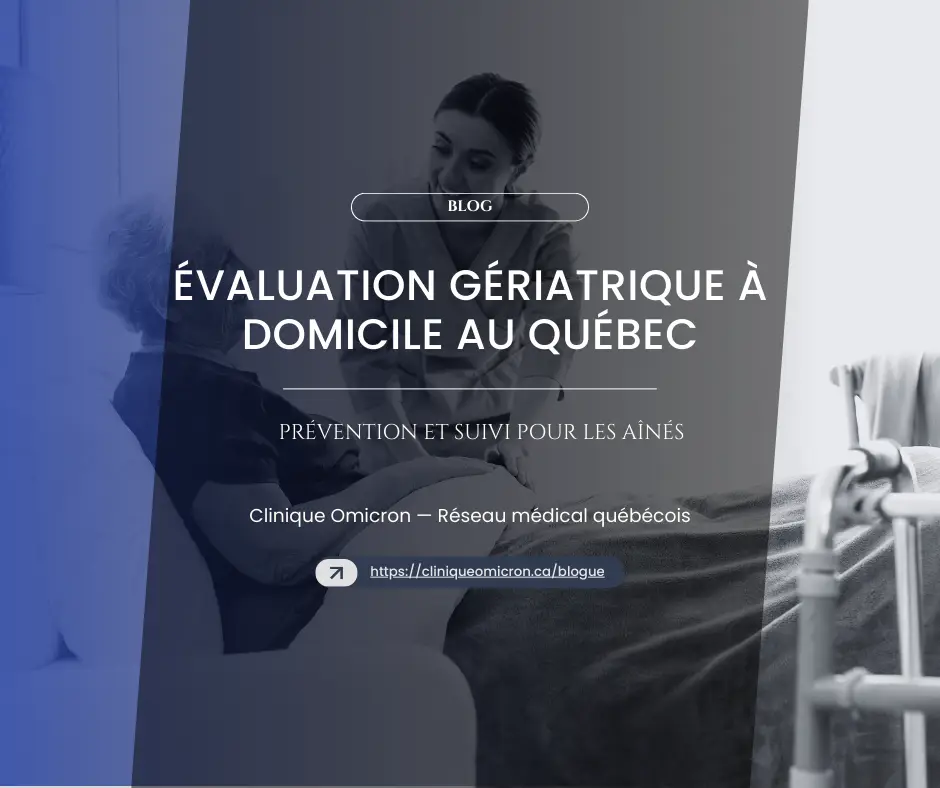
Clinique Omicron offers comprehensive geriatric assessments for seniors in the South Shore and Quebec, which can be done at home for those with reduced mobility or at the clinic for those who can travel. This multidimensional assessment, performed by physicians with training and expertise in geriatric medicine, helps identify risks of frailty, falls, cognitive decline, and medication complications, and develop a personalized preventive and therapeutic intervention plan. This article explains what this assessment entails, when to request it, and what concrete benefits it can offer your elderly loved one.
Fragility Syndrome: Understanding Elder Vulnerability Before Crisis
Frailty is a fundamental geriatric syndrome characterized by an increased vulnerability to physiological stressors, resulting from diminished functional reserves across multiple organ systems. The Fried frailty criteria, the most widely used in clinical practice, identify five components: significant unintentional weight loss, persistent exhaustion or fatigue, muscle weakness measurable by grip strength, slow walking speed, and reduced physical activity. The presence of three or more criteria defines established frailty, a state that doubles to quadruples the risk of hospitalization, falls, postoperative complications, and mortality in the following years. Pre-frailty, characterized by one or two criteria, represents a critical window of opportunity for preventive interventions that can reverse or stabilize the progression toward established frailty.
At Clinique Omicron, frailty is assessed using validated tools adapted to the clinical setting—the Clinical Frailty Scale, grip strength assessment, walking speed test, and a physical activity questionnaire. These objective measures, combined with a global clinical assessment, allow for patient risk stratification and guidance on priority interventions. Resistance exercise—light to moderate weight training—is the best-documented intervention for counteracting frailty: even in very elderly individuals, a supervised exercise program can increase muscle mass, improve balance, and reduce the risk of falls. Nutrition also plays a central role—protein malnutrition is common and often underdiagnosed in frail seniors.
Fall Prevention: Risk Assessment and Effective Interventions
Falls are the leading cause of traumatic injuries in older adults in Quebec — they are responsible for 90 % of hip fractures, a complication associated with a 1-year mortality rate of 20 to 30 % and permanent loss of autonomy in a significant proportion of survivors. However, falls are not an inevitable fatality of aging — up to 30 to 40 % of falls in at-risk seniors can be prevented by targeted multifactorial interventions. The geriatric assessment of fall risk at Clinique Omicron includes the analysis of the history of previous falls, assessment of static and dynamic balance, assessment of lower limb muscle strength, review of fall-risk medications, and assessment of environmental factors.
Among the most effective interventions for reducing the risk of falls, reviewing the medication list is paramount—benzodiazepines, hypnotics, tricyclic antidepressants, certain antihypertensives, and anticholinergic drugs significantly multiply the risk of falls and confusion. Deprescribing—reducing or stopping non-essential medications or those with an unfavorable benefit-risk balance in older adults—is a specific geriatric skill that can improve safety and quality of life without compromising overall therapeutic efficacy. Prescribing an exercise program for balance and muscle strengthening—such as Tai Chi or a geriatric physical therapy program—correcting vitamin D deficiency, and providing recommendations for home modifications complete the preventive approach.
Cognitive assessment and neurocognitive disorder screening
Major neurocognitive disorders — of which Alzheimer's disease accounts for 60-70 % of cases — affect approximately 15 % of Quebecers aged 65 and over, with a prevalence that doubles every five years after age 65 to reach nearly 30-40 % after age 85. Early diagnosis is crucial: it allows for the initiation of available treatments at a stage where they have the most impact, planning for the future while the person retains their decision-making capacity — will, protection mandate, end-of-life preferences — organizing necessary support for staying at home, and identifying potentially reversible causes of cognitive decline — hypothyroidism, vitamin B12 deficiency, depression, medication effects, chronic subdural hematoma.
Cognitive evaluation at Clinique Omicron includes the administration of age- and education-appropriate standardized neuropsychological tests – MoCA, MMSE – supplemented by an interview with a close relation who can describe observed changes in daily life. Biological investigations – TSH, B12, CBC, electrolyte panel, blood glucose – and brain imaging, if indicated, complete the evaluation. In the presence of signs suggestive of neurocognitive disorders, a referral to geriatrics or specialized neurology is arranged to confirm the diagnosis and initiate management. The diagnosis is communicated within a supportive context, involving close relations according to the patient's wishes, and with particular attention to available resources – Alzheimer's Society, day centers, respite services for caregivers.
Frequently Asked Questions about Geriatric Assessment
When should you request a geriatric assessment for an elderly parent?
Several situations should prompt a geriatric assessment without delay: one or more falls in the past year, especially if they resulted in injuries or a fear of falling that limits activities; concerns about memory or cognitive abilities—frequent forgetfulness, difficulty managing finances or medications, repetitions, disorientation—; significant unintentional weight loss; unusual fatigue or shortness of breath limiting activities; complex polypharmacy whose relevance has not been recently reviewed; increasing social isolation or signs of depression; and preparation for scheduled surgery in a frail elderly person to assess perioperative risk. A geriatric assessment is also helpful when a family has questions about the safety of remaining at home and the necessary support services.
Is home geriatric assessment covered by the RAMQ?
Geriatric medical consultations, whether conducted in a clinic or at home, are covered by RAMQ for patients holding a valid health insurance card, when performed by a participating physician. Home visits generally have a specific billing code that takes into account the physician's travel. Formal neuropsychological assessments performed by a neuropsychologist for a comprehensive cognitive evaluation may be subject to separate billing depending on the professional's practice method. It is recommended to confirm coverage details when making an appointment.
My parent refuses to see a doctor about their memory issues or falls—how can I get them to go?
Resistance to consulting a doctor for cognitive difficulties or falls is common among seniors. It can stem from fear of diagnosis, a desire not to worry family, denial of difficulties, or distrust of the medical system. Several approaches can facilitate the process: presenting the consultation as a routine annual health check-up rather than an investigation into specific problems; involving a trusted loved one to accompany the person during the consultation; starting with less threatening concerns such as fatigue or sleep disturbances, rather than memory issues directly; and reassuring them that an evaluation does not automatically lead to loss of autonomy or placement in a long-term care facility. If refusal persists despite serious safety concerns, a consultation with loved ones (without the patient) may be useful to clarify available options and plan a suitable approach.
Omicron Clinic
Need to consult a doctor?
Treatment within 24-48 hours. In-clinic or telemedicine, anywhere in Quebec.
Insurance receipts. 7j/7. No family doctor required.