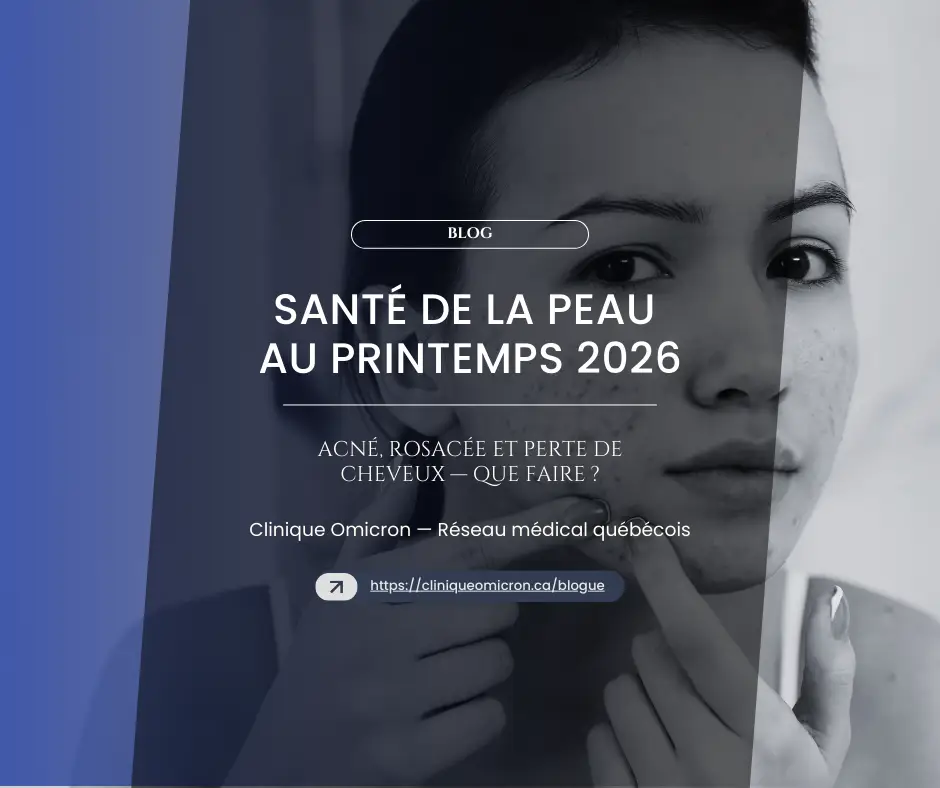

Le printemps québécois marque un tournant important pour la peau : après des mois d’air sec et froid qui assèchent et fragilisent la barrière cutanée, le retour de la chaleur, de l’humidité et du soleil modifie radicalement l’environnement cutané. Cette transition saisonnière peut déclencher ou aggraver plusieurs affections dermatologiques fréquentes — les poussées d’acné liées à l’augmentation de la séborrhée avec la chaleur, les flambées de rosacée provoquées par le soleil et les variations thermiques, la perte de cheveux saisonnière plus prononcée à l’automne mais dont les déclencheurs remontent souvent au printemps et à l’été. Ces conditions sont fréquentes, souvent mal prises en charge par automédication, et répondent bien à des traitements médicaux appropriés.
Clinique Omicron offers medical consultations for common skin conditions at several of its Quebec locations, with referrals to a dermatologist or a physician specializing in aesthetic medicine when the clinical situation requires it. This article presents the mechanisms of the main spring skin conditions, available treatments, and the signs that warrant an immediate medical consultation.
Acné au printemps : pourquoi les poussées s’aggravent et comment les traiter
L’acné vulgaire est la dermatose la plus répandue, touchant jusqu’à 85 % des adolescents et une proportion croissante d’adultes — particulièrement les femmes entre 25 et 40 ans, pour qui l’acné hormonale représente une source significative de détresse psychologique et de diminution de la qualité de vie. Au printemps, plusieurs facteurs contribuent à l’aggravation de l’acné : la chaleur augmente la production de sébum et favorise la prolifération de Cutibacterium acnes dans les follicules pileux obstrués, la transpiration aggrave l’obstruction des pores, et l’exposition solaire — si elle améliore transitoirement l’aspect de la peau par son effet anti-inflammatoire — entraîne souvent un rebond d’acné comédonnienne et inflammatoire à l’arrêt de l’exposition, phénomène connu sous le nom d’« acné estivale ».
Les traitements topiques de première ligne comprennent les rétinoïdes — trétinoïne, adapalène — qui normalisent la kératinisation folliculaire et préviennent la formation des comédons, le peroxyde de benzoyle qui a un effet antibactérien et anti-inflammatoire, et les antibiotiques topiques — clindamycine — en combinaison avec le peroxyde de benzoyle pour limiter les résistances bactériennes. Pour les acnés modérées à sévères ou résistantes aux traitements topiques, les antibiotiques oraux — doxycycline —, les contraceptifs oraux combinés chez la femme — notamment ceux à effet antiandrogénique —, et en cas d’acné sévère nodulokystique, l’isotrétinoïne orale (Accutane) représentent les options thérapeutiques de référence. L’isotrétinoïne est un tératogène puissant nécessitant une contraception efficace et un suivi médical rigoureux. La protection solaire quotidienne est indispensable sous rétinoïdes et sous isotrétinoïne, qui augmentent la photosensibilité cutanée.
Rosacea: Spring Triggers and Medical Management
La rosacée est une dermatose chronique inflammatoire touchant principalement le visage — nez, joues, front, menton —, caractérisée par des rougeurs persistantes ou épisodiques, des télangiectasies (petits vaisseaux dilatés visibles), des papules et des pustules ressemblant à de l’acné, et parfois une hyperplasie des glandes sébacées nasales (rhinophyma). Elle touche environ 5 % de la population adulte, avec une prédilection pour les phototypes clairs et les personnes d’ascendance nord-européenne. Le printemps est une période de flambée typique : le soleil est le déclencheur le plus fréquemment rapporté, suivi des variations thermiques brusques — sortir d’un environnement chaud vers le froid printanier et vice-versa —, de l’exercice physique, de l’alcool, des épices, et du stress émotionnel.
La prise en charge de la rosacée associe des mesures de protection et d’évitement des déclencheurs avec des traitements médicaux ciblés. La photoprotection solaire quotidienne avec un écran solaire minéral — oxyde de zinc ou dioxyde de titane, moins irritants que les filtres chimiques pour une peau réactive — est fondamentale. Les traitements topiques de référence comprennent le métronidazole gel ou crème — efficace sur les papulo-pustules —, l’acide azélaïque, et l’ivermectine crème — particulièrement efficace pour les formes papulo-pustuleuses en ciblant Demodex folliculorum, un acarien folliculaire surreprésenté dans la rosacée. La brimonidine gel et l’oxymétazoline crème agissent sur les rougeurs persistantes en induisant une vasoconstriction cutanée. Les formes modérées à sévères bénéficient de la doxycycline orale à doses anti-inflammatoires sub-antimicrobiennes. Le laser vasculaire et la lumière pulsée intense (IPL) sont des options efficaces pour réduire les télangiectasies et les rougeurs persistantes, disponibles en médecine esthétique.
Hair loss: telogen effluvium, androgenetic alopecia, and medical causes
La perte de cheveux — alopécie — est un motif de consultation médicale fréquent qui génère une anxiété importante, particulièrement chez les femmes. L’automne est la période de chute saisonnière la plus importante chez l’être humain — ce phénomène physiologique résulte d’une synchronisation circadienne des cycles folliculaires, avec une entrée en phase télogène (repos) de nombreux follicules au printemps et une chute effective 3 à 6 mois plus tard, en automne. Une chute saisonnière modérée est donc normale et ne nécessite pas de consultation médicale. En revanche, une perte diffuse et brutale survenant 2 à 4 mois après un événement déclencheur — stress intense, maladie fébrile, chirurgie, accouchement (effluvium post-partum), régime restrictif, carence martiale ou thyroïdienne — correspond à un effluvium télogène réactionnel qui mérite une évaluation médicale pour identifier et corriger la cause.
L’alopécie androgénétique — ou alopécie de type masculin ou féminin — est la forme la plus fréquente de perte de cheveux chronique et progressive, touchant 50 % des hommes avant 50 ans et une proportion significative de femmes après la ménopause. Elle résulte de la sensibilité génétique des follicules pileux à la dihydrotestostérone (DHT). Chez l’homme, elle se manifeste typiquement par un recul du front et un amincissement au vertex ; chez la femme, par un éclaircissement diffus du vertex avec conservation de la ligne frontale. Les traitements médicaux disponibles au Canada comprennent le minoxidil topique — en vente libre, efficace pour ralentir la chute et stimuler modestement la repousse — et le finastéride oral chez l’homme (inhibiteur de la 5-alpha-réductase, contre-indiqué chez la femme en âge de procréer). Une consultation médicale permet d’établir le diagnostic, d’exclure des causes traitables par un bilan sanguin ciblé (TSH, ferritine, FSH, testostérone libre), et de discuter les options thérapeutiques.
Frequently Asked Questions About Spring Skin Health
La crème solaire aggrave-t-elle l’acné ? Comment choisir sa protection solaire avec une peau acnéique ?
C’est une préoccupation légitime et fréquente — certaines formulations de crèmes solaires, particulièrement celles à base d’huiles minérales lourdes ou de filtres occlusifs, peuvent effectivement aggraver l’acné en obstruant les pores. Cependant, la protection solaire reste indispensable pour les personnes sous traitement antiacnéique — rétinoïdes, doxycycline, isotrétinoïne — qui augmentent considérablement la photosensibilité, et pour prévenir l’hyperpigmentation post-inflammatoire qui laisse des taches sombres persistantes après les boutons. La solution est de choisir une formulation adaptée à la peau acnéique : les textures gel, fluide ou sérum non comédogènes sont préférées aux crèmes épaisses ; les filtres minéraux — oxyde de zinc, dioxyde de titane — sont généralement mieux tolérés que les filtres chimiques pour les peaux à tendance acnéique ; les formulations testées dermatologiquement et portant la mention « non comédogène » sur l’emballage sont plus adaptées. De nombreuses marques proposent des crèmes solaires spécifiquement formulées pour les peaux acnéiques — consulter un médecin ou un pharmacien pour des recommandations personnalisées selon votre type de peau et votre traitement actuel.
Ma chute de cheveux après accouchement est-elle normale et va-t-elle s’arrêter ?
L’effluvium télogène post-partum est une condition extrêmement fréquente et normale qui touche la grande majorité des femmes dans les 2 à 6 mois suivant l’accouchement. Pendant la grossesse, les niveaux élevés d’estrogènes prolongent la phase anagène (croissance) des follicules pileux, réduisant la chute normale et donnant l’impression de cheveux plus épais et abondants. Après l’accouchement, la chute brutale des estrogènes entraîne une entrée synchronisée de nombreux follicules en phase télogène (repos), avec une chute diffuse et parfois impressionnante 2 à 4 mois plus tard. Cette chute est temporaire et les cheveux repoussent généralement spontanément sur une période de 6 à 12 mois sans traitement. Il est cependant important de s’assurer qu’il n’y a pas de carence en fer — fréquente en post-partum — ou en thyroïde, qui peuvent aggraver et prolonger l’effluvium. Si la chute est particulièrement sévère, si elle persiste au-delà de 12 mois post-partum, ou si vous remarquez un éclaircissement persistant au vertex plutôt qu’une chute diffuse, une consultation médicale avec bilan biologique est recommandée.
At what age can one start using tretinoin, and what are the risks?
La trétinoïne topique est un rétinoïde prescrit sur ordonnance utilisé pour deux indications principales : le traitement de l’acné et la correction des signes du vieillissement cutané — rides fines, taches pigmentaires, texture irrégulière. Pour l’acné, elle peut être prescrite dès l’adolescence — généralement à partir de 12 ans — sous supervision médicale. Pour le vieillissement, son utilisation est typiquement initiée à partir de la fin de la vingtaine ou de la trentaine à titre préventif-correctif. Les effets indésirables les plus courants en début de traitement sont la sécheresse cutanée, les rougeurs, les desquamations et une irritation transitoire — la « purge » initiale, qui correspond à l’accélération du renouvellement cellulaire et peut faire apparaître temporairement plus de boutons dans les premières semaines d’utilisation de l’acné. Ces effets diminuent avec l’adaptation de la peau et l’utilisation appropriée : démarrer avec une fréquence d’application faible (2 à 3 fois par semaine) et une concentration basse (0,025 %), augmenter progressivement, appliquer le soir sur peau sèche, et utiliser une crème hydratante le matin associée à une protection solaire systématique. La trétinoïne est formellement contre-indiquée pendant la grossesse et l’allaitement en raison du risque tératogène des rétinoïdes systémiques, bien que l’absorption cutanée de la trétinoïne topique soit très faible.
Omicron Clinic
Need to consult a doctor?
En clinique ou en télémédecine, partout au Québec.
Reçus pour assurances. Téléconsultation 7 j/7. Sans médecin de famille requis.