
La pénurie de médecins de famille au Québec est une réalité bien documentée — on estimait en 2024 que plus d’un million de Québécois n’avaient pas de médecin de famille, et les délais pour obtenir un rendez-vous chez un omnipraticien peuvent atteindre plusieurs semaines, voire plusieurs mois, pour de nombreux résidents de la province. Face à ce défi d’accès aux soins de première ligne, le Québec a progressivement élargi le champ de pratique des infirmières praticiennes spécialisées (IPS) depuis la création de ce titre professionnel en 2007 — une tendance qui s’est accélérée avec les réformes législatives récentes, notamment la Loi 67 adoptée en 2021, qui a considérablement étendu l’autonomie de pratique des IPS au Québec.
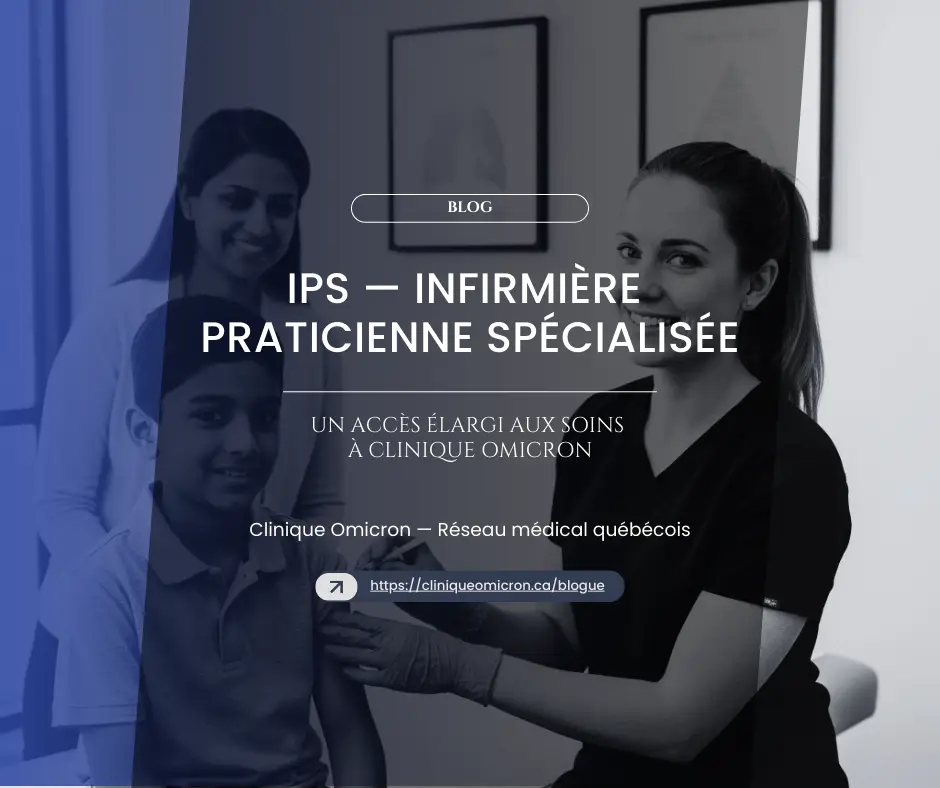
L’infirmière praticienne spécialisée est une infirmière ayant complété une formation universitaire de deuxième cycle (maîtrise) spécialisée — généralement 3 à 4 ans de formation avancée après un baccalauréat en sciences infirmières — qui lui confère des compétences cliniques avancées permettant de diagnostiquer des maladies, prescrire des médicaments et des examens, et traiter des patients de façon autonome dans son champ de compétence. Clinique Omicron intègre des IPS dans son modèle de soins dans plusieurs de ses succursales au Québec, travaillant en collaboration interprofessionnelle avec les médecins pour offrir un accès élargi aux soins de première ligne.
What can a GPI do? Scope of practice and clinical skills
L’infirmière praticienne spécialisée en soins de première ligne (IPSPL) — la spécialité la plus répandue au Québec — est habilitée à exercer un large éventail d’activités cliniques qui constituaient traditionnellement le domaine exclusif des médecins. Elle peut évaluer l’état de santé d’une personne à travers l’anamnèse complète et l’examen physique, poser un diagnostic pour de nombreuses conditions médicales aiguës et chroniques, prescrire des médicaments — incluant des médicaments d’ordonnance, des substances contrôlées dans certains contextes, et des médicaments utilisés en maladies chroniques —, demander et interpréter des examens diagnostiques (analyses sanguines, examens d’imagerie, ECG), effectuer certaines procédures cliniques, et assurer le suivi longitudinal de patients atteints de maladies chroniques.
En pratique, les consultations courantes prises en charge par une IPSPL à Clinique Omicron incluent notamment : le suivi et l’ajustement du traitement des maladies chroniques comme le diabète de type 2, l’hypertension artérielle, la dyslipidémie et l’hypothyroïdie ; la gestion des infections courantes (infections urinaires, infections respiratoires, infections cutanées) avec prescription d’antibiotiques si indiqué ; la contraception — prescription, renouvellement et suivi des contraceptifs hormonaux, pose et retrait de DIU en collaboration avec le médecin ; le dépistage des cancers (Pap test, référence pour mammographie et coloscopie) ; la prescription et administration de vaccins ; les bilans de santé préventifs et les examens médicaux périodiques ; la gestion des problèmes de santé mentale courants (anxiété, dépression légère à modérée) incluant la prescription d’antidépresseurs et de suivi.
The IPS-physician collaborative model: safety and quality of care
La pratique des IPS au Québec s’inscrit dans un modèle de collaboration interprofessionnelle avec les médecins — un aspect fondamental du cadre réglementaire québécois et une condition de la qualité et de la sécurité des soins. Loin d’être une approche de substitution inférieure, la pratique en équipe IPS-médecin représente une organisation des soins qui optimise les compétences complémentaires des deux professions. L’IPS gère de façon autonome les situations qui relèvent de son champ de compétence — soins primaires courants, maladies chroniques stables, prévention — et consulte ou réfère au médecin pour les situations plus complexes, les conditions sortant de son champ de pratique, ou les cas nécessitant une expertise médicale spécialisée.
Les données scientifiques sur la qualité des soins prodigués par les IPS sont rassurantes et cohérentes à travers les décennies de recherche en Amérique du Nord : les études comparatives entre soins IPS et soins médicaux pour des conditions de première ligne comparables montrent des résultats cliniques équivalents en termes de contrôle des maladies chroniques, de satisfaction des patients, d’utilisation appropriée des services d’urgence et de sécurité globale. Les IPS accordent souvent plus de temps par consultation — favorisant l’éducation thérapeutique, la prévention et le counseling — ce que les patients apprécient particulièrement. À Clinique Omicron, les IPS travaillent en étroite collaboration avec l’équipe médicale, avec accès à la consultation médicale selon les besoins cliniques, garantissant la continuité et la sécurité des soins.
Questions fréquentes sur les IPS et l’accès aux soins
Can an IPS be my family doctor? Does RAMQ cover consultations with an IPS?
Oui — depuis les réformes législatives québécoises et l’élargissement du rôle des IPS, une infirmière praticienne spécialisée en soins de première ligne peut assumer le rôle de professionnel de santé principal (« médecin de famille » fonctionnel) pour de nombreux patients sans médecin de famille attitré. L’IPS peut assurer le suivi longitudinal, les bilans de santé annuels, le renouvellement des médicaments, la gestion des maladies chroniques et la coordination des soins spécialisés — toutes les fonctions centrales d’un suivi de première ligne. Concernant la couverture RAMQ : les actes réalisés par les IPS dans les établissements du réseau public et dans certains contextes sont couverts par la RAMQ, mais la structure de rémunération et de couverture peut varier selon le contexte de pratique (clinique médicale privée, GMF, CLSC, pratique autonome). Clinique Omicron peut vous informer des modalités de couverture spécifiques applicables lors de votre consultation.
Quelles sont les limites du champ de pratique d’une IPS ? Dans quels cas faut-il absolument voir un médecin ?
Bien que le champ de pratique des IPS au Québec soit très étendu et couvre la grande majorité des besoins de soins de première ligne, certaines situations nécessitent une consultation médicale ou une prise en charge par un médecin spécialiste. Les principales situations qui dépassent le champ de pratique autonome de l’IPSPL incluent : la gestion des urgences médicales ou des situations cliniques instables ou complexes requérant une évaluation médicale immédiate ; la prescription de certains médicaments spécifiques réservés aux médecins ou aux spécialistes (certains immunosuppresseurs, chimiothérapies, médicaments de spécialité) ; la réalisation de procédures chirurgicales ou invasives hors de son champ de compétence ; les conditions médicales rares ou complexes nécessitant une expertise spécialisée (maladies rhumatologiques complexes, hématologiques, oncologiques, neurologiques complexes) ; l’initiation de traitements dans des situations sortant du champ de pratique IPSPL, comme certaines maladies psychiatriques sévères. Dans ces situations, l’IPS de Clinique Omicron vous orientera vers le médecin approprié, qu’il s’agisse du médecin de la clinique ou d’un spécialiste, assurant la continuité et la fluidité de votre parcours de soins.
How do I get an appointment with an IPS at Clinique Omicron? Do I need a medical referral?
Non — une référence médicale n’est généralement pas nécessaire pour consulter une IPS à Clinique Omicron pour des soins de première ligne courants. Les patients peuvent prendre rendez-vous directement, comme pour une consultation médicale habituelle, pour une grande variété de motifs : renouvellement de médicaments, suivi de maladie chronique, problème de santé aigu, bilan préventif, contraception, et bien d’autres. L’accessibilité est précisément l’un des avantages du modèle intégrant des IPS — offrir des rendez-vous avec des délais réduits pour des soins de qualité équivalente à ceux d’un médecin de famille pour les besoins de première ligne. Clinique Omicron dispose de plusieurs points de service sur la Rive-Sud et au Québec, avec prise de rendez-vous en ligne ou par téléphone. Pour les situations d’urgence ou semi-urgence, des plages de consultation sans rendez-vous peuvent être disponibles selon les succursales — renseignez-vous auprès de la clinique de votre choix pour connaître les disponibilités actuelles.
Omicron Clinic
Need to consult a doctor?
In-person or via telemedicine, anywhere in Quebec.
We accept insurance. Telemedicine consultations available 7 days a week. No family doctor required.