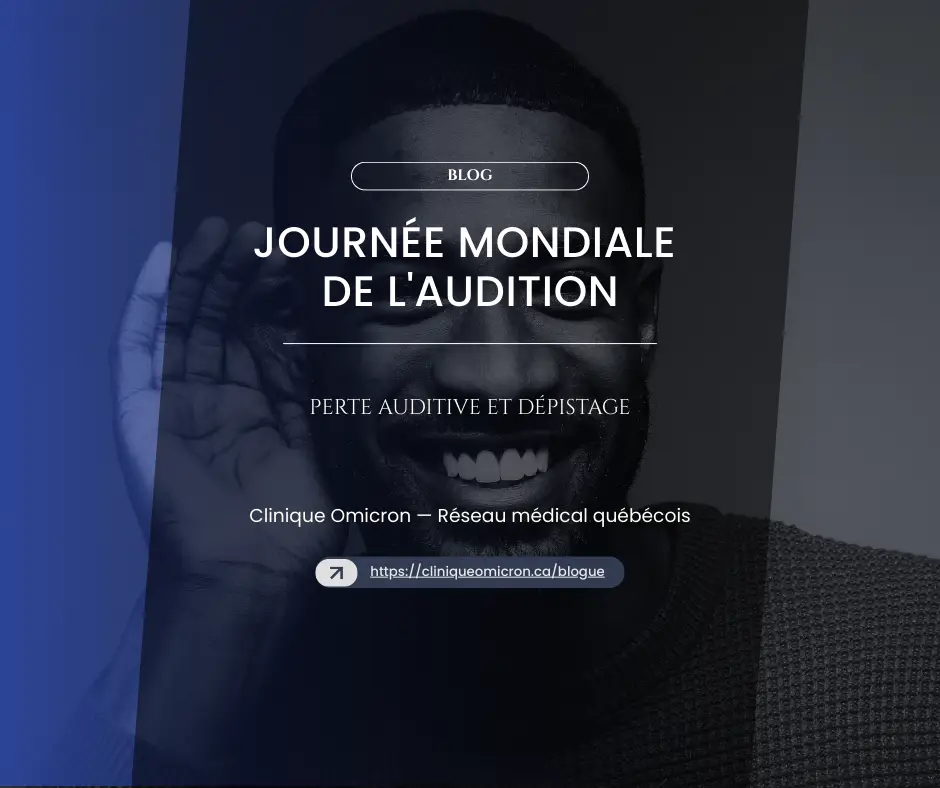

Le 3 mars marque la Journée mondiale de l’audition, une initiative de l’Organisation mondiale de la santé pour sensibiliser à la prévention de la surdité et promouvoir l’accès aux soins auditifs. Le constat est alarmant : selon l’OMS, 1,5 milliard de personnes dans le monde vivent avec une forme de perte auditive, et ce chiffre devrait atteindre 2,5 milliards d’ici 2050. Pourtant, la grande majorité des cas de déficience auditive pourraient être prévenus ou traités efficacement si l’on agissait à temps.
Au Québec, on estime que près d’un adulte sur cinq souffre d’une perte auditive significative, et la moyenne d’attente avant de consulter un professionnel dépasse sept ans après l’apparition des premiers signes. Ce délai a des conséquences importantes non seulement sur la qualité de vie, mais aussi sur la santé cognitive et la santé mentale.
Comment fonctionne l’audition et pourquoi elle se dégrade
L’oreille humaine est un organe d’une précision extraordinaire. Le son voyage sous forme d’ondes qui font vibrer le tympan, transmettent l’énergie aux trois osselets de l’oreille moyenne — marteau, enclume et étrier — puis génèrent des mouvements dans la cochlée, remplie de liquide. Des milliers de cellules ciliées transforment ces vibrations en signaux électriques acheminés au cerveau via le nerf auditif. Ces cellules ciliées sont l’élément le plus vulnérable du système auditif : contrairement à d’autres cellules du corps, elles ne se régénèrent pas une fois endommagées.
La perte auditive peut être de transmission — liée à un problème dans l’oreille externe ou moyenne, souvent traitable médicalement — ou de perception, liée à des dommages aux cellules ciliées de la cochlée ou au nerf auditif. Cette dernière forme, appelée surdité neurosensorielle, est généralement permanente mais peut être compensée efficacement par des aides auditives ou des implants cochléaires selon la sévérité.
The main causes of hearing loss
Le vieillissement est la cause la plus fréquente de perte auditive. La presbyacousie — la perte auditive liée à l’âge — affecte progressivement les fréquences aiguës et touche la majorité des personnes de plus de 65 ans à des degrés variables. L’exposition au bruit est la deuxième cause principale : bruit au travail, concerts, écouteurs à volume élevé, ou environnements urbains bruyants endommagent les cellules ciliées de façon cumulative et irréversible. Selon l’OMS, plus d’un milliard de jeunes adultes sont à risque en raison de leurs habitudes d’écoute.
D’autres causes incluent les infections de l’oreille moyenne répétées ou mal traitées, certains médicaments ototoxiques comme des antibiotiques de la famille des aminoglycosides ou certains diurétiques, les traumatismes crâniens, les maladies auto-immunes, la maladie de Ménière, et les tumeurs bénignes du nerf auditif appelées schwannomes vestibulaires ou neuromes acoustiques.
Warning Signs You Shouldn't Ignore
La perte auditive s’installe souvent progressivement, ce qui la rend difficile à percevoir soi-même. Les proches remarquent fréquemment les signes avant la personne concernée. Parmi les signaux qui justifient une consultation : devoir demander fréquemment aux interlocuteurs de répéter ou de parler plus fort, avoir de la difficulté à suivre une conversation dans un environnement bruyant comme un restaurant, monter le volume de la télévision à un niveau inconfortable pour les autres, avoir du mal à comprendre les conversations téléphoniques, ou percevoir les sons de façon déformée ou étouffée.
Les acouphènes — ces bourdonnements, sifflements ou sonneries dans les oreilles sans source sonore externe — peuvent également être un signe précoce d’atteinte auditive ou de stress excessif sur le système auditif. Bien que souvent bénins, des acouphènes persistants méritent une évaluation médicale, notamment pour exclure des causes traitables.
Hearing loss and cognitive health: an underestimated link
La recherche des dernières années a mis en évidence un lien significatif entre la perte auditive non traitée et le déclin cognitif. Une étude publiée dans The Lancet a identifié la perte auditive comme le facteur de risque modifiable le plus important de démence, devant le tabagisme, la dépression et l’hypertension. L’hypothèse principale est double : d’une part, la privation sensorielle réduit la stimulation cérébrale et accélère l’atrophie de certaines régions comme le cortex auditif ; d’autre part, l’effort cognitif constant pour déchiffrer les sons dans un contexte de mauvaise audition épuise les ressources mentales disponibles pour d’autres fonctions.
Plusieurs études suggèrent que le port d’aides auditives pourrait réduire significativement ce risque de déclin cognitif. Ce lien renforce l’importance d’un dépistage et d’une prise en charge précoces, bien au-delà du simple confort communicationnel.
Le dépistage et l’évaluation auditive : par où commencer
Un dépistage auditif de première ligne peut être réalisé lors d’une consultation médicale. Le médecin procède à un examen otoscopique des oreilles pour détecter une obstruction par du cérumen, une infection ou une anomalie du tympan. Un test de dépistage simple peut être effectué en cabinet pour évaluer la perception des sons. Si une perte auditive est suspectée, une orientation vers un audiologiste pour un bilan audiométrique complet est recommandée. Ce bilan mesure précisément les seuils auditifs pour différentes fréquences et permet de qualifier et quantifier la perte auditive.
Une cause fréquente et facilement traitée de diminution auditive est l’accumulation excessive de cérumen dans le canal auditif. L’extraction du cérumen par un professionnel de santé — par irrigation ou par aspiration — peut restaurer rapidement une audition normale et est disponible dans plusieurs de nos succursales au Québec.
Questions fréquentes sur l’audition et le dépistage auditif au Québec
At what age should you have your hearing assessed for the first time?
Il n’existe pas d’âge universel pour un premier bilan auditif chez l’adulte sans symptôme. Cependant, à partir de 50 ans, une évaluation de base est généralement recommandée pour établir un point de référence. En cas de symptômes — difficulté à entendre, acouphènes, sensation d’oreille bouchée — il est conseillé de consulter sans attendre, quel que soit l’âge. Pour les personnes exposées au bruit de façon professionnelle, un suivi audiologique régulier est recommandé dès le début de l’exposition.
Can earwax really cause hearing loss?
Oui. Un bouchon de cérumen obstruant le canal auditif peut réduire de 40 décibels la perception des sons — l’équivalent d’une perte auditive légère à modérée. Cette situation est fréquente et entièrement réversible par un nettoyage professionnel. Il est cependant déconseillé d’utiliser des cotons-tiges pour nettoyer ses oreilles : ils ont tendance à tasser le cérumen plus profondément dans le canal plutôt qu’à l’éliminer. En cas de sensation d’oreille bouchée ou de diminution auditive soudaine, une consultation médicale est recommandée avant d’utiliser des gouttes ou d’autres remèdes maison.
Are hearing aids reimbursed in Quebec?
Au Québec, le Programme d’aides auditives de la Régie de l’assurance maladie du Québec (RAMQ) couvre en partie le coût des aides auditives pour les personnes admissibles — notamment les enfants, les adultes de moins de 55 ans ayant une perte auditive significative et certaines clientèles spécifiques. Pour les adultes de plus de 55 ans, des subventions partielles peuvent être disponibles selon la situation. Certains régimes d’assurance collective couvrent également une partie des coûts. Un audiologiste peut vous orienter vers les programmes d’aide disponibles selon votre profil.
Can tinnitus be treated?
Il n’existe pas de traitement universel qui fait disparaître les acouphènes, mais plusieurs approches peuvent réduire leur impact sur la qualité de vie. La thérapie sonore — qui consiste à masquer les acouphènes avec un son de fond agréable — peut réduire leur perception. La thérapie cognitivo-comportementale aide à modifier la réaction émotionnelle aux acouphènes et est l’approche la mieux documentée pour améliorer la qualité de vie. Lorsque les acouphènes sont associés à une perte auditive, les aides auditives réduisent souvent leur intensité perçue en enrichissant l’environnement sonore. Une première consultation médicale permet d’exclure des causes traitables et d’orienter vers les ressources appropriées.
ENT (Ear, Nose and Throat) - Nose, Throat | Clinique Omicron
Omicron Clinic
Need to consult a doctor?
In-person or via telemedicine, anywhere in Quebec.
We accept insurance. Telemedicine consultations available 7 days a week. No family doctor required.