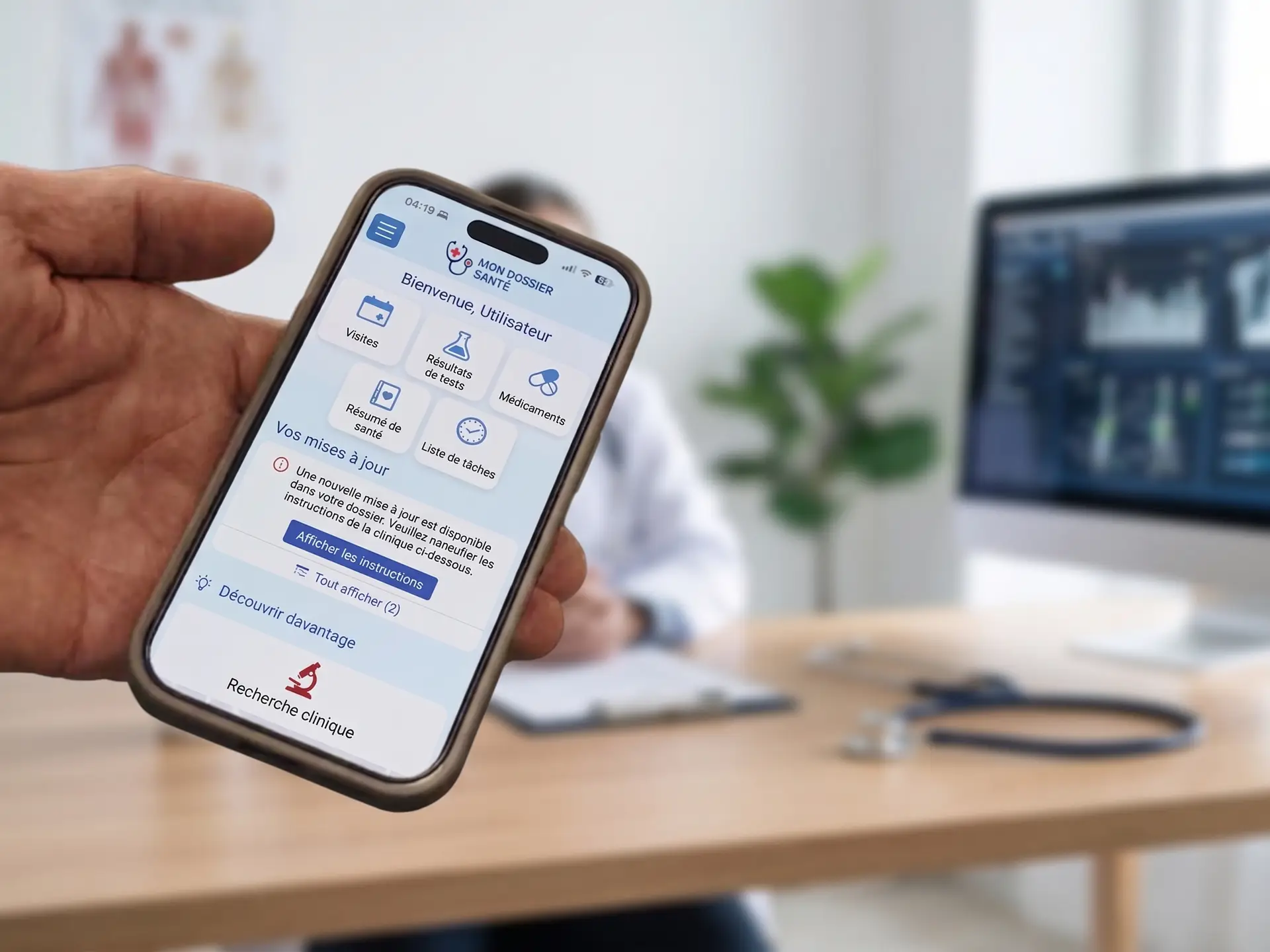

Visit Digital Health Record (DSN) begins its rollout in Quebec. Two pilot locations kicked things off on May 9, 2026 — the CIUSSS of Northern Montreal Island and the Mauricie-et-Centre-du-Québec Health and Social Services Integration Group (CIUSSS) — and the project will gradually be expanded to the entire public health care system [1]. For patients, this is a major change which raises a lot of questions. What exactly do healthcare providers see? Can I access my own medical records? And if I see a provider outside the public healthcare system, is my information in the DSN? This article provides a clear overview, without jargon, and examines how the DSN coexists with the medical file provided by your regular clinic.
On this page
- The DSN, Explained
- DSN and «My Health Record»: Two Different Things
- What This Means for You, the Patient
- A transition that takes time
- And what about the private sector in all of this?
- Privacy and Access to Your Record
- Your Rights as a Patient
- Why Regular Follow-Up Visits at the Clinic Are Still Important
- How to Prepare as a Patient
- Myths and misconceptions
- Frequently asked questions
- Sources
The DSN, Explained
According to the official description of the Quebec network, the DSN aims to to consolidate all of a person's health information in a secure space. Three Objectives The following goals are highlighted: facilitating access to clinical information, improving information sharing among healthcare providers, and ensuring better continuity of care throughout the patient's care journey [1].
What the DSN Includes
- Tours in hospitals and CLSCs
- Imaging Tests (X-rays, ultrasounds, CT scans, MRIs)
- Laboratory Results (blood tests, urinalysis, pathology)
- Orders current and past
- Minutes surgical and hospital
- Notes the healthcare team (doctors, nurses, other professionals)
- Allergies, relevant medical history
- Vaccinations listed in the public network
Reported Profits
- Avoid duplication of tests (lab tests, imaging)
- Speed up the exchange of information among healthcare providers
- Reduce errors resulting from manual transcription
- Improve Coordination when a patient is cared for by multiple teams
- Support Clinical Decisions in Emergency Situations
- Improve the overall quality of the patient experience
- Facilitate Healthcare When Seeking Treatment Outside Your Usual Region
To remember
- Visit DSN is a clinical tool for professionals in the public health system; My Health Record is an app designed for citizens to view their own information
- Visit deployment began on May 9, 2026, in two pilot CIUSSSs (Nord-de-l’Île-de-Montréal and Mauricie-et-Centre-du-Québec) and will gradually be expanded to the entire public health care system
- For patients, the expected benefits include fewer duplicate tests, easier sharing of information between healthcare facilities, and real-time access to results through My Health Record
- Visit private sector is not automatically integrated: some information is transmitted to the public network depending on the tools used, while other information remains in the private clinic’s records
- Visit privacy is governed by Act 25 and the public health network’s regulations; only authorized professionals with a legitimate clinical reason may access the record, and each access is logged
- Visit patient rights include access to one's own file and the ability to request corrections
- Best practices : Keep a copy of your important test results and inform each healthcare provider about any recent tests you've had done elsewhere
- Visit regular clinical follow-up One thing remains essential: Information technology consolidates information, but it is the medical conversation that transforms that information into useful decisions
DSN and «My Health Record»: Two Different Things
A distinction significant appears in the official documentation, and many people confuse.
The DSN — For Professionals
- Clinical Tool intended for healthcare professionals in the public healthcare system
- Used for the daily work with patients
- Allows you to view and document health care
- Accessible via the workstations institutions
- Secure, with authentication and access logging
- The patient cannot not be able to access it directly
My Health Record — for Citizens
- Application Government Services for Citizens
- Allows to view their own health information
- Accessible at all times from a phone, tablet, or computer
- Allows you to see test results, prescriptions, vaccinations, appointments (depending on the deployment)
- Authentication via clicSÉQUR
- The patient may consult, but does not change clinical information directly
Comparison table
| Characteristic | DSN | My Health Record |
|---|---|---|
| User | Public Sector Professionals | Citizens (patients) |
| Objective | Daily Clinical Care | Patient Consultation |
| Access | Workstations at Educational Institutions | Mobile app, web |
| Authentication | Professional Authentication | clicSÉQUR |
| Content Changes | Yes, by licensed healthcare providers | No (for reference only; corrections may be requested) |
What This Means for You, the Patient
More Accessible Information for Healthcare Providers
- When an authorized professional in the public health system opens your file, they can now see what their colleagues from another institution noted
- If you arrive at the’Urgency Outside your region, the team theoretically has access to your medical history relevant
- Acceleration the diagnostic potential, especially in an emergency setting
- Best coordination between family doctors, specialists, and the hospital
- Lower risk of’drug interactions thanks to a more comprehensive list of medications
Fewer duplicate tests
- One of the main advantages is more tangible
- Avoid redoing a blood test or a imaging already available elsewhere
- Less than travel and shorter wait times
- Usage more effective public network resources
- Reduction in deadlines diagnostics
- Cost savings for the system and for the patient (time, travel)
Real-time access to your results
- Among the announced benefits: real-time access test results—laboratory and imaging—for the healthcare team
- From the patient's perspective, the app My Health Record allows you to view your own results without having to call a secretary or wait for an appointment
- Possibility of prepare his appointment to review his case file
- Reduction in calls phone calls to follow up on results
- More discussion enlightened with the doctor during appointments
Improved continuity across healthcare settings
- Transition hospital → home better supported
- Coordination between teams hospital, family doctor, home care
- Information available for emergencies outside the region
- Follow-up chronic illnesses more consistent over several years
- Reduction in omissions Information during transfers
A transition that takes time
Let's be realistic. Any IT deployment of this extent is accompanied by a adjustment period.
The Deployment Schedule
- May 9, 2026 : Launch in two pilot CIUSSSs (North of the Island of Montreal, Mauricie and Central Quebec)
- Gradual expansion to other CISSSs and CIUSSSs over the next few months
- Deadline full-scale deployment over several years
- Gradual integration of medical clinics front-line
- The DSN lives with alongside existing systems during the transition
- Visit pilot schools have planned temporary service adjustments (between April 27 and May 23, 2026), with potential delays and reduced availability of non-urgent appointments
The Foreseeable Challenges
- Training professionals using the new tool
- Adaptation of the process clinics
- Integration with existing systems
- Coordination among the institutions at various stages of deployment
- Communication clear with patients
- Cybersecurity and data protection
- Maintenance of the quality of care during the transition
What to Expect as a Patient
- Possible deadlines on an ad hoc basis during local deployments
- Notice through the relevant institutions in the event of service adjustments
- The app My Health Record available for download and accessible with clicSÉQUR authentication
- Ask your doctor or at the facility where you are receiving care, if your information is stored in the DSN
- Maintain your appointment and scheduled exams
- Report All problem access issue or error in the file
And what about the private sector in all of this?
That's a question legitimate that we’re often asked. The care provided outside the public network are recorded in the file of the institution hosting you, in accordance with the professional requirements of the Collège des médecins du Québec.
What information is transmitted to the public network?
- Laboratory Results referred to a family doctor in the public health care system, for example
- Some prescriptions through the Quebec Pharmaceutical Record
- Communications between a public family physician and a private clinic, depending on the agreements
- Information provided during’guidelines to the public network
- Vaccinations reported in the provincial registry
- Visit rules are evolving as the DSN is rolled out
What Remains in the Private Clinic's File
- Notes private consultation
- Some results privately ordered tests
- Minutes private interventions
- History private clinic visits
- File preserved in accordance with the CMQ's retention policies
- Accessible to the patient upon request
Best Practices for Patients
- Request a copy of your key results, no matter where they were generated
- Preserve it yourself relevant medical records
- Inform each caregiver recent tests performed elsewhere, especially during a follow-up visit
- Bring a up-to-date list your medications
- List the professionals that you visit regularly
- Maintain a digital copy or a printout of your key results
- By the time the digital tools Even as the reality of the patient journey catches up, your vigilance remains important
Privacy and Access to Your Record
Visit protection of health information is overseen by the Private Sector Privacy Protection Act (the Law 25) and by the rules specific to the public network [2,3].
Who can access your file
- Only the licensed professionals Those with a legitimate clinical reason may access the file
- Each Access leaves a trace (audit log)
- Access options include verified in the event of a complaint or investigation
- The’identification The speakers' remarks are recorded
- The « right to know »The patient has the right to access his or her medical records"
- Penalties professional, civil, or criminal in the event of unauthorized access
Legal Framework
- Law 25 (Modernization of privacy protection in Quebec, phased in since 2022)
- Health and Social Services Act for the public network
- Code of Ethics the Collège des médecins du Québec and other professional associations
- Supervision by the Quebec Commission on Access to Information
- Monitoring by the curators complaints and service quality
- Measures to cybersecurity imposed by the ministry
Security Measures
- Strong Authentication professionals
- Encryption data in transit and at rest
- Logging all access points
- Monitoring of permissions depending on the role
- Backups secure
- Plans for continuity in the event of a breakdown
- Updates to safety continues
- Policies on report in the event of an incident
Your Rights as a Patient
Key Rights
- Right to view your own medical records (in person, through My Health Record, or by requesting them from the facility)
- Right to request corrections in case of an error
- Right to Know who viewed your file (upon request)
- Right to privacy your information
- Right to refuse certain communications, depending on the context
- Right to file a complaint in the event of a breach
- Right to obtain a copy from your file
How to Exercise Your Rights
- For public institutions: please contact Information Access Officer of the institution
- For private clinics: Contact the clinic according to its internal procedures (often at the RPRP, Privacy Officer)
- Requests written recommended
- Response time required by law (generally 30 days)
- Possible uses of the Commission on Access to Information
- Use of Commissioner complaints and service quality at public institutions
- Help may be available through the’OPHQ, advocacy groups, the Ombudsman
My Health Record: Practical Steps
- Download the "My Health Record" app on the App Store or Google Play
- Create or use your clicSÉQUR account
- Authentication secure
- View test results, medications, vaccinations, appointments depending on the deployment
- Update your contact information
- Option to share certain information with family and friends, depending on the settings
- Reporting errors through the app
Do you have questions about how Clinique Omicron stores your information, or would you like to exercise your rights regarding your medical record? Omicron Clinic complies with the requirements of Act 25 and the CMQ Code of Ethics. If you have any questions about privacy or wish to exercise your rights, please contact the Privacy Officer (RPRP) at rprp@cliniqueomicron.ca. Make an appointment you can consult the list of services.
Why Regular Follow-Up Visits at the Clinic Are Still Important
A computer tool, no matter how effective it may be, does not replace the relationship between a patient and their healthcare team. The DSN strengthens the’information, but it's the medical consultation which converts this information into useful clinical decisions.
The Benefits of Regular Medical Checkups
- Interpret test results in the context of your personal history
- Adjust medications when new information is added to the medical record
- Do the sort between what warrants an investigation and what can wait
- Ensure a human continuity that information technology alone cannot guarantee
- Support the decisions health information shared between patients and healthcare providers
- Customize Recommendations based on lifestyle and preferences
- Maintain a vigilance in the face of gradual changes
The Balance Between Technology and People
- The DSN frees up time potentially devoted to conversation
- But the’listen, the physical examination and the medical decision remain human
- Visit teleconsultation can be used to get a quick overview
- Visit in-person meeting It is still advisable to determine when a physical examination or an in-depth discussion is necessary
- The important thing is to have a team to contact when something isn't quite right—or simply for a preventive checkup
- Whether you're browsing the public network or in private clinic, the continuity of the relationship remains valuable
How to Prepare as a Patient
Before full deployment
- Download the "My Health Record" app
- Check your clicSÉQUR account
- Update your contact information through the RAMQ
- To have a up-to-date list your medications
- Maintain a copy of your recent significant results
- Rate the name and the contact information for the healthcare professionals you see
- Registration at the Family Doctor Access Desk (GAMF), if you haven't already done so
During a consultation
- Inform the healthcare provider regarding recent tests performed elsewhere (public or private)
- Bring your list of medications up to date
- List the allergies, medical history relevant
- Ask questions about the results whether or not they are shared with the DSN
- Ask if your institution has already rolled out the DSN
- Request a abstract or a written report, if applicable
If you have any questions or problems
- View your institution or your clinic to explain the local procedures
- Contact the complaints commissioner of the CISSS/CIUSSS in the event of an incident
- Contact the Quebec Commission on Access to Information in the event of a breach of confidentiality
- For private clinics: please contact RPRP of the clinic
- Store written records steps
- Possible appeals to the Ombudsman
Myths and misconceptions
«With the DSN, anyone can see my file»
False. Only the licensed professionals having a legitimate clinical reason can view your file. Each time it is accessed leaves a mark (audit log) that may be subject to an audit. Some sanctions Severe penalties apply in the event of unauthorized access. The DSN is more secure rather than a paper file or faxes.
«The DSN replaces my family doctor»
False. The DSN is a computer tool which consolidates the information. It does not replace your relationship with your family doctor, your primary care provider, or your healthcare team. On the contrary, it may improve their work by giving them faster access to relevant information. The clinical conversation remains essential for transforming information into useful medical decisions.
«My private practice appointments are automatically entered into the DSN.»
Not exactly. Certain information pass through to the public healthcare system (lab results sent to your public family doctor, prescriptions via the pharmaceutical record). Others remain in the private clinic's file. The rules are changing as the rollout progresses. Best practice : Keep a copy of your important test results and inform each healthcare provider.
«I can edit my file myself»
Not directly. You can view your file and request corrections if you notice an error. Changes to clinical information are made by the professionals who are responsible for them, in accordance with established procedures. This is a balance between transparency for the patient and the accuracy of clinical information.
«If I don't use My Health Record, I don't have access to my information.»
False. Visit right of access Your file remains intact independently of the app. You can request in writing a copy of your medical records to a facility or clinic. The application is a convenience which is an addition, not a condition. For the people If you do not have digital access, traditional methods are still available.
Frequently asked questions
What is the Digital Health Record?
Visit DSN is a secure IT environment which compiles a person's health information to make it accessible to licensed professionals of the public network, with the goal of improving the continuity of care. It brings together the following in a single tool: hospital visits, imaging tests, lab results, prescriptions, reports, and team notes.
What is the difference between the DSN and «My Health Record»?
Visit DSN is a clinical tool Intended for healthcare professionals in the public healthcare system, to be used in their daily work. My Health Record is a government application which allows citizens to access their own health information at any time, using a phone or tablet. The two are complementary.
Are my private practice appointments included in the DSN?
That depends on the tools used and the agreements in effect. Some results may be transmitted to the public network (laboratory, prescriptions via the pharmaceutical record). Others remain in the private clinic's file. It is recommended that you preserve it yourself a copy of his major achievements and’inform each healthcare provider's recent test results.
Who can view my file?
Only the licensed professionals having a legitimate clinical reason can access the file. Each Access is logged and may be subject to an audit. Penalties professional, civil, or criminal apply in the event of unauthorized access.
Can I view my own file?
Yes. Quebec law gives you the right to view your medical records and request corrections if any information is incorrect. The app My Health Record is designed to make it easier for citizens to access this information directly. For people without digital access, traditional methods (such as submitting a written request to the institution) are still available.
How long will the full deployment take?
Visit deployment will span several years. Following the two pilot facilities (May 2026), the program will be expanded to other CISSSs and CIUSSSs gradually. The integration of primary care clinics and the optimization of features will follow. The specific timeline is press release by the Ministry of Health and Social Services as the rollout progresses.
How can you avoid mistakes in your application?
Check Check your file regularly via My Health Record. Report any error Report any issues (missed medication, incorrect allergy information, missed test) to your doctor or the relevant healthcare facility. Store your own copies of important results. Inform every healthcare provider in your current situation. The vigilance Shared decision-making between patients and caregivers is essential to the quality of information.
Sources
- CIUSSS du Nord-de-l’Île-de-Montréal — Digital Health Record, one of the two pilot showcase institutions for the Quebec rollout (public information as of May 9, 2026).
- Ministry of Health and Social Services of Quebec. Official Information on the Digital Health Record and My Health Record.
- Quebec Commission on Access to Information (CAI). Bill 25 and the Protection of Personal Health Information.
- Quebec College of Physicians (CMQ). Maintenance of Medical Records and Ethical Obligations.
- Health and Social Services Act and Supplementary Rules for the Public System.
- Ombudsman. Appeals in Public Services Matters.
- CIUSSS de la Mauricie-et-Centre-du-Québec — Information on the local rollout of the DSN (May 2026).
Medical consultation | Clinique Omicron
Omicron Clinic
Need to consult a doctor?
In-person or via telemedicine, anywhere in Quebec.
We accept insurance. Telemedicine consultations available 7 days a week. No family doctor required.