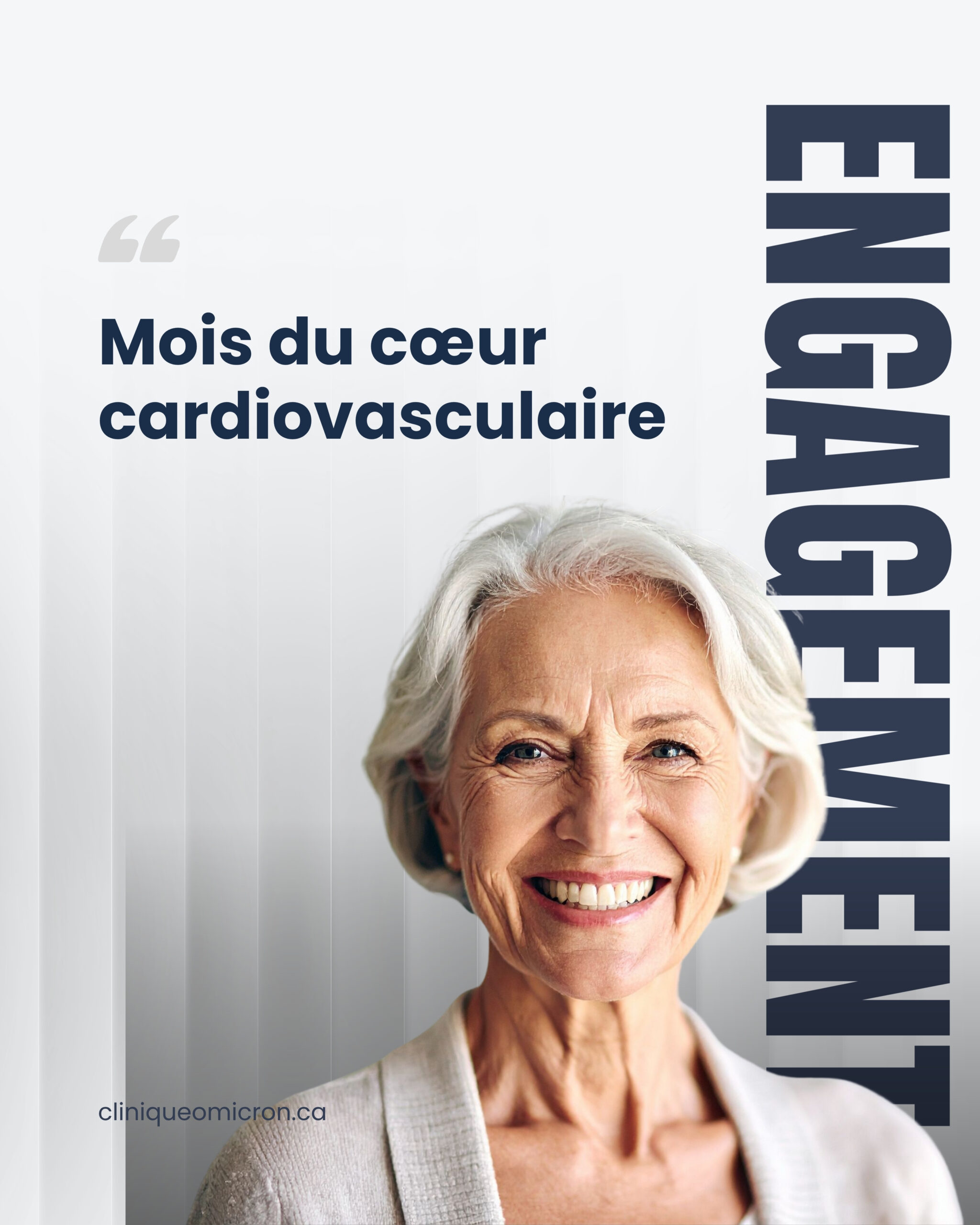

Les maladies cardiovasculaires demeurent l’une des principales causes de mortalité au Canada. Chaque mois de février, le Heart Month mobilizing healthcare professionals to inform the population about prevention. Because many risk factors can be reduced, the Clinique Omicron network is actively participating in this campaign in Quebec, through conferences, educational tools, and personalized support, at its service points as well as via teleconsultation.
On this page
- Why is cardiovascular disease prevention crucial?
- Heart Month Activities at Clinique Omicron Network
- Le rôle de l’équipe infirmière
- An annual commitment
- Quebec Resources
- Are you a healthcare professional?
Why is cardiovascular disease prevention crucial?
Several cardiovascular risk factors sont modifiables. La détection précoce et l’accompagnement médical permettent de réduire significativement le risque d’événement cardiaque majeur.
Modifiable risk factors
- L’hypertension artérielle
- Dyslipidemia (blood lipid imbalance)
- Smoking
- Sedentary lifestyle
- An unbalanced diet
- Chronic stress
- Type 2 diabetes
To remember
- Cardiovascular diseases are a major cause of mortality in Canada.
- Heart Month is held every year in February.
- Many cardiovascular risk factors are modifiable.
- Early detection helps prevent major cardiac events.
- L’accompagnement médical joue un rôle déterminant dans la prévention.
- The Omicron Clinic network is intensifying its activities during this campaign.
Heart Month Activities at Clinique Omicron Network
During the month of February, the network is deploying several activities to make the Cardiovascular prevention plus accessible et plus concrète. L’objectif est d’aider chacun à mieux connaître son risque et les habitudes qui protègent le cœur.
Cardiovascular Health Check
Le réseau met de l’avant ses services d’évaluation cardiovasculaire : prise de tension artérielle, bilan lipidique, évaluation du risque selon l’échelle de Framingham et conseils personnalisés.
Educational conferences
Open conferences for the public will discuss protective lifestyle habits: regular physical activity, a Mediterranean diet adapted to the Quebec context, stress management, and sleep quality.
Awareness space
Un coin documentation est aménagé dans les points de service du réseau pour offrir des ressources fiables sur la santé du cœur, en partenariat avec la Fondation des maladies du cœur et de l’AVC.
To remember
- Cardiovascular assessments combine blood pressure, lipid panel, and risk evaluation.
- L’échelle de Framingham aide à estimer le risque cardiaque.
- The conferences are about lifestyle habits that protect the heart.
- A documentation corner makes reliable resources easily accessible.
- Le réseau s’appuie sur un partenariat avec la Fondation des maladies du cœur et de l’AVC.
- Activities complement, without replacing, individual medical monitoring.
Would you like to know more about the services offered or discover our other initiatives? Visit the page Services, explore our options for teleconsultation or you take one appointment in a few clicks.
Le rôle de l’équipe infirmière
Visit nurse clinicians du réseau jouent un rôle clé dans l’éducation des patients à risque. Leur accompagnement aide les patients à comprendre leurs indicateurs et à adopter de bonnes habitudes de surveillance.
Ce que fait l’équipe infirmière
- Monitor indicators: blood pressure, blood sugar, weight
- Enseigner l’auto-prise de tension à domicile
- Soutenir les patients dans l’adoption d’habitudes protectrices
- Refer to specialized Quebec resources as needed
This local support helps patients better understand their cardiovascular health and become active participants in their own follow-up.
An annual commitment
Le Mois du cœur s’inscrit dans l’wider engagement du réseau Clinique Omicron envers la prévention en santé au Québec. Ce n’est pas une action isolée, mais un volet d’une mission communautaire continue, présentée dans la section Community involvement from the site.
En facilitant l’accès à l’évaluation et à l’information, le réseau contribue, à son échelle, aux efforts de santé publique du Québec. Pour une évaluation personnalisée de votre risque cardiovasculaire, parlez-en à votre professionnel de la santé.
Are you a healthcare professional?
Les bilans, les conférences et les espaces de sensibilisation du Mois du cœur reposent sur l’engagement de professionnels qui partagent notre vision d’une santé de proximité. Les professionnels de la santé qui souhaitent contribuer à ces activités peuvent nous écrire à l’adresse engagement@cliniqueomicron.ca en présentant leur domaine d’expertise. Notre équipe se fera un plaisir d’échanger sur les modalités de collaboration.
Frequently asked questions
When is Heart Month?
Heart Month is held every year in February. This campaign mobilizes health professionals to raise public awareness about the prevention of cardiovascular diseases.
What are the main cardiovascular risk factors?
Several factors are modifiable: hypertension, dyslipidemia, smoking, sedentary lifestyle, unbalanced diet, chronic stress, and type 2 diabetes. A health professional can assess each person's individual situation.
Qu’est-ce qu’un bilan de santé cardiovasculaire ?
Il s’agit d’une évaluation qui peut comprendre la prise de tension artérielle, un bilan lipidique et une estimation du risque selon l’échelle de Framingham. Il permet d’orienter les conseils de prévention et le suivi.
Why learn to check your blood pressure at home?
L’auto-prise de tension permet de suivre cet indicateur de façon régulière entre les rendez-vous. Les infirmières cliniciennes du réseau peuvent enseigner la bonne méthode pour obtenir des mesures fiables.
Are the Heart Month activities open to everyone?
Les conférences et les espaces de sensibilisation organisés dans le cadre du Mois du cœur sont ouverts au public. Les modalités de participation, notamment pour les bilans, sont précisées lors de l’inscription.
How can a healthcare professional contribute?
Les professionnels de la santé intéressés peuvent écrire à l’équipe de la Clinique Omicron à l’adresse engagement@cliniqueomicron.ca afin d’échanger sur les modalités de collaboration aux activités du Mois du cœur.
Sources
- Fondation des maladies du cœur et de l’AVC — Heart Health and Prevention
- Montreal Heart Institute — Research and Prevention
- Ministry of Health and Social Services of Quebec — Heart Disease
- National Institute of Public Health of Quebec (INSPQ) — Chronic Diseases
- Institut national d’excellence en santé et en services sociaux (INESSS) — Santé cardiovasculaire
Omicron Clinic
Need to consult a doctor?
En clinique ou en télémédecine, partout au Québec.
Reçus pour assurances. Téléconsultation 7 j/7. Sans médecin de famille requis.