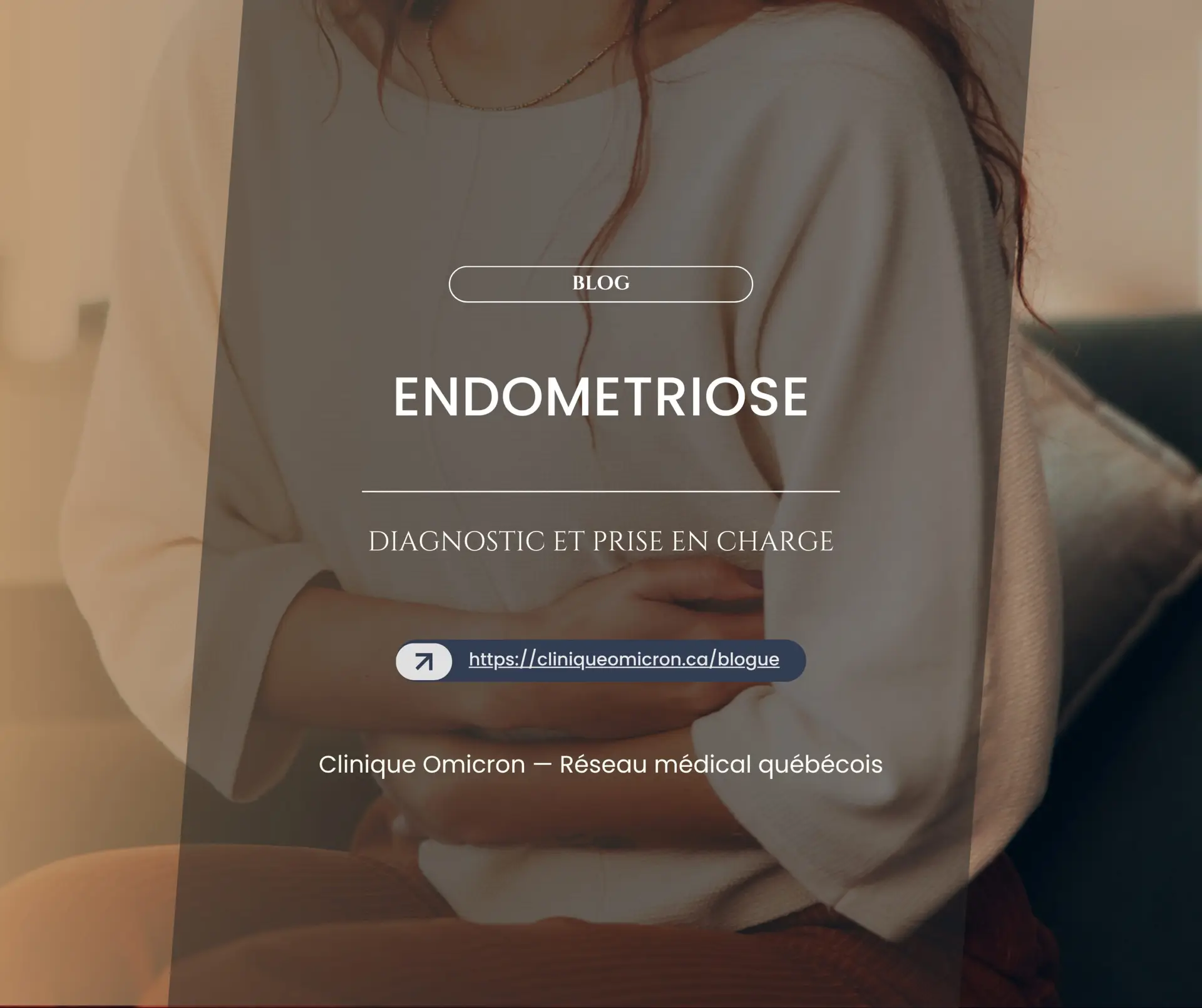

L’endométriose est une condition gynécologique chronique qui touche environ une femme sur dix en âge de procréer. Malgré sa fréquence, elle reste trop souvent diagnostiquée tardivement — parfois après des années de douleurs banalisées. Comprendre ce qu’est l’endométriose, reconnaître ses symptômes et connaître les options disponibles au Québec peut faire une différence réelle dans la qualité de vie des personnes atteintes.
Cette information est fournie à titre éducatif uniquement et ne remplace pas l’avis d’un professionnel de la santé. Consultez un médecin pour toute question concernant votre santé.
Qu’est-ce que l’endométriose ?
L’endométriose survient quand des tissus semblables à la muqueuse utérine (l’endomètre) se développent en dehors de l’utérus — sur les ovaires, les trompes de Fallope, le péritoine ou d’autres organes abdominaux. Ces tissus réagissent aux hormones du cycle menstruel, s’épaississent et saignent chaque mois, mais sans voie de sortie. Cette inflammation chronique provoque des douleurs, des adhérences et parfois des complications sur la fertilité.
La condition est bénigne (non cancéreuse), mais son impact sur la qualité de vie peut être important. Elle est classée en quatre stades selon l’étendue des lésions, du stade I (minimal) au stade IV (sévère), bien que le stade ne corresponde pas nécessairement à l’intensité des symptômes ressentis.
Symptoms to recognize
Les manifestations de l’endométriose varient beaucoup d’une personne à l’autre. Certaines personnes présentent des symptômes sévères avec peu de lésions, tandis que d’autres ont des atteintes étendues sans douleur marquée. Voici les signes les plus fréquemment rapportés :
Des douleurs menstruelles intenses (dysménorrhée) qui ne répondent pas bien aux analgésiques courants constituent souvent le signal d’alarme principal. Ces douleurs peuvent survenir avant, pendant et après les règles. Elles peuvent aussi être présentes tout au long du cycle sous forme de douleurs pelviennes chroniques.
La dyspareunie — douleur ressentie lors des rapports sexuels, particulièrement lors de pénétration profonde — est un symptôme fréquent et souvent peu évoqué en consultation. Il est important d’en parler à son médecin.
During menstruation, some people report pain during bowel movements, constipation, diarrhea, or pain during urination. These symptoms, sometimes mistaken for irritable bowel syndrome, can indicate involvement of adjacent organs.
Des menstruations abondantes, prolongées ou des saignements en dehors des règles (métrorragies) peuvent accompagner l’endométriose.
Difficulty conceiving
L’endométriose est associée à des problèmes de fertilité dans une proportion significative de cas. Elle est identifiée chez une part importante des femmes qui consultent pour infertilité, bien que beaucoup de personnes atteintes parviennent à concevoir sans aide médicale.
Why is it so long to get a diagnosis?
Le délai entre l’apparition des premiers symptômes et le diagnostic formel d’endométriose peut être de plusieurs années. Plusieurs facteurs expliquent cette réalité :
- Les douleurs menstruelles sont longtemps minimisées, par les patientes elles-mêmes autant que par l’entourage médical
- Les symptômes se chevauchent avec d’autres conditions (côlon irritable, douleurs pelviennes fonctionnelles)
- L’absence d’examen de dépistage simple et non invasif
- The definitive diagnosis traditionally requires a laparoscopy (surgical procedure).
Les lignes directrices cliniques évoluent. Un diagnostic clinique basé sur les symptômes, l’histoire médicale et l’imagerie (échographie ou IRM spécialisée) est de plus en plus accepté pour initier un traitement, sans attendre la confirmation chirurgicale systématique.
Comment l’endométriose est-elle diagnostiquée ?
La première étape est une consultation détaillée avec un médecin, qui inclut une description précise des symptômes, de leur chronologie par rapport au cycle menstruel et de leur impact sur la vie quotidienne. Un examen gynécologique peut révéler des signes suggestifs, comme une douleur à la mobilisation de l’utérus ou la présence d’un nodule.
L’échographie pelvienne transvaginale réalisée par un échographiste expérimenté peut détecter certains types de lésions, notamment les kystes ovariens endométriosiques (endométriomes). L’IRM pelvienne offre une cartographie plus complète des lésions profondes et des atteintes des organes adjacents.
La coelioscopie reste le seul moyen de confirmer avec certitude le diagnostic d’endométriose. C’est une intervention réalisée sous anesthésie générale qui permet de visualiser les lésions et, si nécessaire, de les traiter dans la même procédure. Elle n’est pas systématiquement requise pour débuter un traitement.
Available treatment options
Il n’existe pas de traitement curatif de l’endométriose — la condition est chronique. L’objectif du traitement est de soulager les douleurs, de préserver la fertilité si désiré et d’améliorer la qualité de vie. La prise en charge est personnalisée selon les symptômes, les projets de grossesse et les préférences de la patiente.
Les anti-inflammatoires non stéroïdiens (AINS) peuvent atténuer les douleurs menstruelles. La contraception hormonale — pilule combinée, pilule progestative, dispositif intra-utérin hormonal, timbre contraceptif — représente souvent la première ligne de traitement hormonal. Elle vise à réduire la stimulation hormonale des lésions et l’intensité des règles.
More powerful treatments like GnRH analogues may be prescribed in certain cases, under close medical supervision, due to their side effects.
Laparoscopic surgery can remove endometriosis lesions, excise adhesions, and treat ovarian endometriomas. It improves pain and, in some cases, fertility. The risk of recurrence exists after surgery, and postoperative medical treatment is often recommended.
La physiothérapie pelvienne, l’acupuncture et certaines modifications alimentaires sont parfois intégrées dans la prise en charge globale. Ces approches ne remplacent pas le traitement médical, mais peuvent contribuer au mieux-être. Un suivi en santé mentale peut également être bénéfique, compte tenu de l’impact psychologique d’une douleur chronique.
L’endométriose et la santé mentale
Vivre avec une condition douloureuse chronique, souvent peu reconnue, a un effet réel sur le bien-être psychologique. Les personnes atteintes d’endométriose présentent un risque accru de dépression et d’anxiété. La douleur interfère avec le travail, les relations et les activités quotidiennes. Le fait d’être peu écoutée ou de devoir justifier sa souffrance ajoute une charge émotionnelle supplémentaire.
Un suivi psychologique ou en santé mentale fait partie d’une prise en charge complète. Si vous traversez une période difficile liée à votre condition, parlez-en à votre médecin — des ressources existent au Québec pour vous accompagner.
Endométriose et fertilité : ce qu’il faut savoir
L’endométriose peut affecter la fertilité de plusieurs façons : distorsion anatomique des trompes ou des ovaires, inflammation de l’environnement pelvien, réduction de la réserve ovarienne dans le cas de kystes endométriosiques traités chirurgicalement. Cela dit, beaucoup de personnes atteintes parviennent à concevoir naturellement.
Si vous souhaitez une grossesse et avez reçu un diagnostic d’endométriose, une discussion avec un médecin spécialisé en fertilité est recommandée pour évaluer votre situation individuelle et planifier la meilleure approche.
When to see a doctor
Consult a healthcare professional if you experience:
- Menstrual pain that limits your daily activities
- Persistent pelvic pain between periods
- Pain during sexual intercourse
- Des difficultés à concevoir après plusieurs mois d’essais
- Recurring digestive or urinary symptoms related to the cycle
Do not normalize pain that disrupts your quality of life. A doctor can assess your symptoms, order appropriate tests, and refer you to a gynecologist if necessary.
Nos médecins prennent en charge les symptômes gynécologiques, incluant l’évaluation initiale de l’endométriose et l’orientation vers des spécialistes. Que vous souhaitiez une première consultation en personne ou une téléconsultation depuis chez vous, nos points de service au Québec offrent un accès aux soins adapté à votre situation.
We offer services covered by the RAMQ as well as private services to meet your needs outside of usual public system wait times. Book an appointment online or by phone — a doctor can listen to you and guide you through the next steps.
Teleconsultation in Quebec — Private Online Doctor | Omicron Clinic
Omicron Clinic
Need to consult a doctor?
En clinique ou en télémédecine, partout au Québec.
Reçus pour assurances. Téléconsultation 7 j/7. Sans médecin de famille requis.