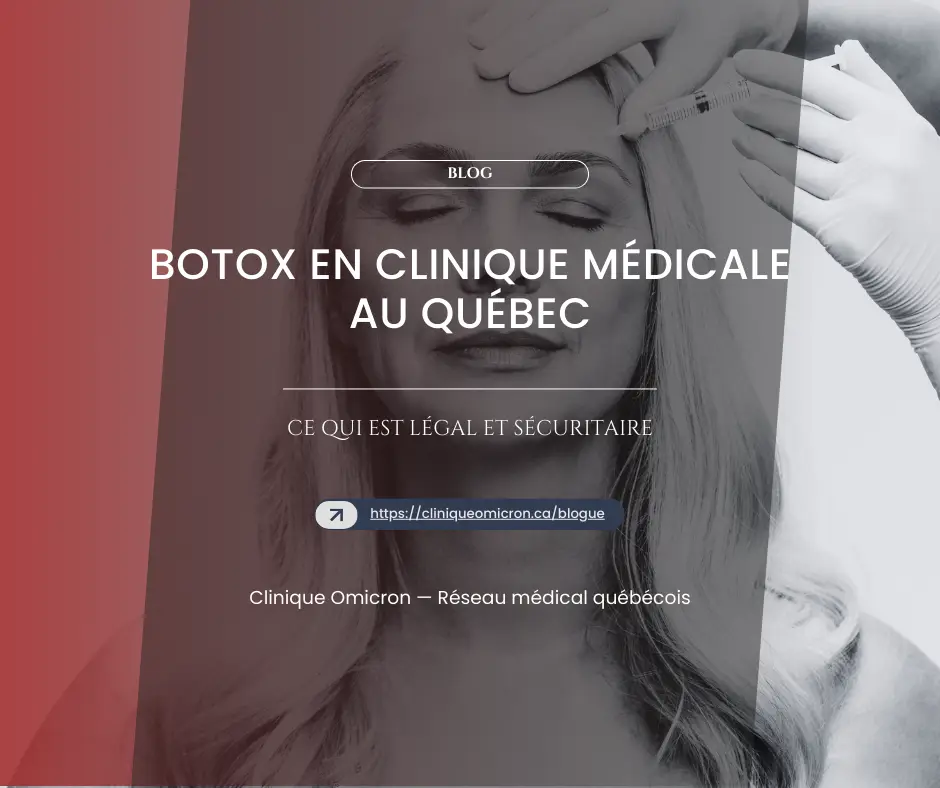

Le Botox est l’un des traitements médicaux les plus réalisés au monde — et l’un des plus mal compris. On en parle comme d’un produit de beauté, on en voit la publicité dans des spas et des centres d’esthétique, on entend des prix qui varient du simple au triple sans comprendre pourquoi. Et dans ce flou, beaucoup de personnes hésitent — soit parce qu’elles ne savent pas si c’est fait pour elles, soit parce qu’elles ne savent pas à qui faire confiance.
Ce guide démêle l’essentiel. Qui peut légalement injecter du Botox au Québec — et pourquoi c’est une question médicale, pas commerciale. La différence entre le Botox cosmétique et thérapeutique. Pourquoi la consultation médicale préalable n’est pas une formalité. Ce que ça coûte réellement dans une clinique médicale sérieuse. Et les effets secondaires réels — les fréquents, les rares, et les signaux d’alarme à connaître.
Clinique Omicron offers cosmetic and therapeutic Botox injections in Brossard and Saint-Hubert. The information in this guide reflects our approach - medical, transparent, without excessive promises.
Who can legally inject Botox in Quebec?
C’est la question fondamentale — et la réponse a des implications directes sur votre sécurité.
Quebec's legal framework
Botulinum toxin - the active ingredient of Botox - is a prescription drug au Canada. Ce statut n’est pas anodin : il signifie que son administration est réservée à des professionnels habilités à prescrire ou à administrer des médicaments sous ordonnance, dans un cadre réglementé.
In Quebec, the professionals legally authorized to inject Botox are doctors - general practitioners and specialists - the specialized nurse practitioners (IPS) in their field of practice, and the nurse clinicians acting under an individual or collective medical prescription issued by a supervising physician. In the latter case, medical supervision must be real and documented - not nominal.
Ce qui est interdit dans les spas et centres d’esthétique
Aesthetic technicians, cosmeticians, spa therapists and alternative medicine practitioners are not not allowed à injecter du Botox au Québec, quelle que soit leur formation complémentaire en injections. Cette interdiction n’est pas une question de compétence technique — c’est une question d’habilitation légale à administrer des médicaments sur ordonnance et de capacité à gérer les complications médicales.
L’Ordre des infirmières et infirmiers du Québec (OIIQ) et le Collège des médecins du Québec (CMQ) ont publié des mises en garde explicites sur ce point. Des établissements non médicaux offrent des injections de Botox au Québec en contravention de la réglementation — en l’absence de cadre légal clair, c’est le patient qui porte le risque d’une complication sans filet de sécurité médical.
Why the medical framework provides concrete protection
Ce n’est pas du corporatisme professionnel — c’est de la gestion de risque. Le Botox mal injecté peut entraîner des complications sérieuses : ptose palpébrale (paupière tombante), ptose du sourcil, diffusion non souhaitée à des muscles adjacents, dysphagie en cas d’injection cervicale, et dans de rares cas des réactions systémiques. Ces complications nécessitent une reconnaissance rapide et une prise en charge médicale — pas une crème apaisante et un rappel de rendez-vous.
Un médecin ou une infirmière qui injecte sous supervision médicale a les outils pour reconnaître une complication, la gérer, et documenter l’intervention dans un dossier médical. Un technicien en esthétique n’a aucun de ces outils.
What this means for your choice of service provider
Avant de réserver un traitement Botox, vérifiez que l’établissement est une clinique médicale ou une clinique infirmière supervisée par un médecin — pas un spa, un salon, ou un centre d’esthétique. Demandez le nom du médecin superviseur si vous consultez une infirmière. Vérifiez que la personne qui injecte est identifiable sur le registre de son ordre professionnel. Si l’établissement ne peut pas répondre clairement à ces questions, cherchez ailleurs.
At Clinique Omicron, Botox injections are performed by licensed medical professionals, in a documented clinical setting with medical records for each patient.
Botox cosmetic vs. Botox therapeutic
Le terme « Botox » est une marque déposée — il désigne en réalité une toxine botulinique de type A produite par Allergan. D’autres marques existent au Canada — Dysport, Xeomin, Nuceiva — avec des profils légèrement différents, mais le mécanisme d’action est identique : la toxine bloque temporairement la transmission neuromusculaire, empêchant le muscle ciblé de se contracter.
Ce mécanisme, selon la zone injectée et la dose utilisée, produit des effets très différents — et c’est ce qui explique la diversité des applications.
Le Botox cosmétique — les rides d’expression
L’application cosmétique la plus connue cible les rides d’expression — les rides qui se forment par la contraction répétée des muscles du visage au fil des années. Les principales zones traitées sont les rides du front (rides horizontales liées au muscle frontal), les rides intersourcilières ou rides du lion (entre les sourcils, liées aux muscles corrugateurs et procerus), et les rides de la patte d’oie (aux coins externes des yeux, liées à l’orbiculaire de l’œil).
D’autres applications cosmétiques moins connues mais cliniquement validées incluent le levage subtil des sourcils par injection ciblée, la correction d’un sourcil asymétrique, le traitement des bandes du cou platysma chez les patients appropriés, la correction d’un sourire gingival excessif, et le traitement des rides péribuccales chez certains candidats.
Botox cosmetics does not treat static wrinkles — les rides visibles au repos, qui résultent de la perte de volume et d’élasticité cutanée plutôt que de la contraction musculaire. Ces rides relèvent des agents de remplissage (fillers) — acide hyaluronique principalement — et non du Botox. Confondre les deux est fréquent et source de résultats décevants : une injection de Botox ne comblera pas une ride creuse au repos.
Botox therapy - medical applications
Le Botox a des applications thérapeutiques solides, documentées par des décennies de recherche clinique, reconnues par Santé Canada, et parfois couvertes par les régimes d’assurance.
L’hyperhidrose — transpiration excessive. L’injection de toxine botulinique dans les aisselles, les paumes des mains ou la plante des pieds bloque temporairement les glandes sudoripares eccrines dans la zone traitée. C’est l’une des applications thérapeutiques les plus efficaces du Botox — les études montrent une réduction de la transpiration de 80 à 90 % dans les zones traitées, avec une durée d’effet de quatre à huit mois. Pour les patients qui souffrent d’hyperhidrose sévère affectant leur vie professionnelle et sociale, c’est souvent un traitement transformateur.
Chronic migraines. Le Botox est approuvé par Santé Canada pour la prévention des migraines chroniques — définies comme 15 jours ou plus de céphalées par mois dont au moins 8 migraines. Le protocole validé — PREEMPT — implique 31 injections dans des sites standardisés du crâne, du cou et des épaules, réalisées tous les trois mois. L’efficacité est bien documentée : chez les patients appropriés, le nombre de jours de migraine est réduit en moyenne de 8 à 9 jours par mois. Ce traitement nécessite une évaluation médicale rigoureuse pour confirmer le diagnostic de migraine chronique et l’absence de contre-indications.
Bruxism - teeth grinding and clenching. L’injection de toxine botulinique dans les muscles masséters — les muscles masticateurs puissants situés de chaque côté de la mâchoire — réduit la force de contraction involontaire nocturne. C’est une application en expansion dans les cliniques médicales québécoises, particulièrement prisée pour ses effets doubles : amélioration des symptômes du bruxisme (douleur temporomandibulaire, céphalées matinales, usure dentaire) et amincissement visuel du bas du visage chez les patients présentant une hypertrophie massétérique marquée.
D’autres applications thérapeutiques reconnues médicalement incluent le torticolis spasmodique (dystonie cervicale), le blépharospasme, et certaines spasticités musculaires — typiquement prises en charge par des neurologues spécialisés plutôt qu’en clinique de médecine esthétique.
The practical distinction for patients
Si vous consultez pour une ride visible au repos, le Botox n’est probablement pas la solution principale — une consultation médicale permettra d’identifier si un filler, une stimulation cutanée, ou une combinaison de traitements est plus appropriée. Si vous consultez pour des rides d’expression, de la transpiration excessive, des migraines chroniques ou du bruxisme, le Botox a une indication médicale solide et votre médecin peut évaluer si vous êtes un bon candidat.
La consultation médicale préalable — pourquoi c’est crucial
La consultation médicale avant les injections de Botox n’est pas un exercice de style — c’est ce qui détermine si le traitement est approprié pour vous, sécuritaire dans votre contexte clinique, et susceptible de produire les résultats que vous recherchez.
Health check and contraindications
Certain medical conditions formally contraindicate botulinum toxin injections. Neuromuscular diseases - amyotrophic lateral sclerosis (ALS), myasthenia gravis, Lambert-Eaton syndrome - are absolute contraindications, as botulinum toxin potentiates the neuromuscular transmission failure already present in these pathologies. The consequences can be serious and potentially irreversible.
La grossesse et l’allaitement sont des contre-indications de précaution — les données sur la toxicité fœtale sont insuffisantes pour établir la sécurité, et l’abstention est la position prudente.
Certains médicaments potentialisent l’effet de la toxine botulinique et augmentent le risque de diffusion non souhaitée : aminoglycosides, chloroquine, certains bloqueurs neuromusculaires. Une revue médicale de votre liste de médicaments est indispensable avant les injections.
Allergies and history of reactions
Les réactions allergiques au Botox sont rares mais documentées. Une allergie à la toxine botulinique de type A, à l’albumine humaine (qui sert de stabilisant dans certaines formulations) ou aux excipients de la préparation contre-indique le produit. Si vous avez déjà eu une réaction lors d’une injection précédente de Botox ou d’un produit similaire, mentionnez-le explicitement lors de la consultation.
L’évaluation des attentes et la planification du résultat
La consultation médicale est aussi le moment où le médecin évalue si vos attentes sont réalistes et alignées avec ce que le Botox peut accomplir pour votre anatomie spécifique. L’anatomie faciale varie considérablement d’un patient à l’autre — la localisation et l’activité des muscles, l’épaisseur de la peau, la position de base des sourcils et des paupières, la présence ou l’absence de ptose préexistante. Ces variations déterminent la technique d’injection, les zones à traiter, les doses appropriées, et les précautions particulières à prendre pour éviter les complications.
Un médecin expérimenté en médecine esthétique sait qu’un résultat naturel n’est pas une question de dose minimale — c’est une question de précision anatomique et de personnalisation. Les résultats figés ou asymétriques que les gens craignent résultent le plus souvent d’une technique inadaptée à l’anatomie individuelle, pas du Botox lui-même.
What happens during the consultation
Le médecin prend l’historique médical pertinent, recense vos médicaments actuels, documente les allergies connues, évalue les zones à traiter visuellement — souvent en vous demandant de réaliser des expressions faciales pour voir l’activité musculaire en dynamique — et discute avec vous des résultats attendus, des zones qu’il recommande de traiter ou d’éviter, et du plan de traitement.
Cette consultation est aussi le moment de poser toutes vos questions — sur la technique, la durée des effets, les signes à surveiller après les injections, et le suivi prévu. Un médecin qui se dépêche de passer à l’injection sans consultation substantielle est un signal d’alarme.
How much does Botox cost in a Quebec medical clinic?
La fourchette de prix du Botox au Québec est large — et cette variation n’est pas arbitraire. Comprendre ce qui la détermine vous permet de comparer des offres comparables et d’éviter les pièges.
Le mode de tarification — à l’unité ou à la zone
Two pricing systems coexist in Quebec. The tarification à l’unité facture chaque unité de toxine injectée — typiquement entre 9 $ et 15 $ l’unité en clinique médicale en 2026, avec des variations selon l’établissement, la région, et le professionnel. Le front-end treatment nécessite généralement 10 à 20 unités selon l’anatomie et l’objectif, le traitement des pattes d’oie 10 to 15 units per side, and the treatment of frown lines 20 to 30 units. A standard treatment of the three zones can represent 50 to 70 units, depending on the patient.
Visit zone pricing facture un forfait par région traitée — front, pattes d’oie, rides du lion — indépendamment du nombre d’unités utilisé. Cette formule est plus simple pour le patient, mais peut être moins avantageuse si votre anatomie nécessite peu d’unités.
La tarification à l’unité est généralement plus transparente et plus équitable — elle correspond à la quantité réelle de produit utilisée pour votre traitement.
Price ranges by indication in 2026
For the Botox cosmetics dans les grandes régions urbaines du Québec, les fourchettes réalistes en clinique médicale se situent généralement entre 300 $ et 800 $ pour un traitement standard des trois zones principales (front, rides du lion, pattes d’oie), avec des variations significatives selon l’étendue du traitement et les besoins individuels.
For the traitement de l’hyperhidrose axillaire, les prix varient généralement entre 700 $ et 1 200 $ pour les deux aisselles, selon le nombre d’unités nécessaires — qui varie d’un patient à l’autre — et les tarifs de l’établissement.
For injections for chronic migraines selon le protocole PREEMPT, le coût par séance est plus élevé en raison du nombre de sites d’injection et du volume de produit utilisé — les fourchettes se situent généralement entre 900 $ et 1 800 $ par séance trimestrielle selon l’établissement.
For the treatment of bruxism by masseteric injection, prices generally vary between 400 $ and 900 $ depending on the volume required and the establishment.
Clinique Omicron's specific rates for each of these indications are available on cliniqueomicron.ca - they are also clearly communicated to you during the preliminary medical consultation.
What justifies the price variation
Le prix d’un traitement Botox en clinique médicale reflète plusieurs variables réelles. La qualification of the professional injector — un médecin avec formation spécialisée en médecine esthétique n’est pas tarifé au même niveau qu’une infirmière débutante, et cette différence est justifiée. La qualité et l’origine du produit — le Botox authentique d’Allergan, le Dysport de Galderma ou le Nuceiva de Evolus ont des profils légèrement différents et des coûts d’acquisition différents pour la clinique. L’inclusion or exclusion of medical consultation dans le tarif — certaines cliniques facturent la consultation séparément, d’autres l’intègrent dans le traitement. Le post-treatment follow-up - is a two-week correction touch-up included?
What you shouldn't buy
Méfiez-vous des prix anormalement bas — inférieurs à 8 $ l’unité pour un Botox en clinique médicale — qui peuvent indiquer un produit non homologué, une dilution excessive du produit, ou une prestation réalisée hors cadre légal. La toxine botulinique vendue à des prix nettement inférieurs au marché provient parfois de sources non homologuées par Santé Canada.
Méfiez-vous aussi des promotions de type « Botox à moitié prix pour les 10 premières clientes » dans des contextes non médicaux — ce type d’offre est caractéristique des établissements qui n’opèrent pas dans le cadre légal approprié.
Side effects and complications - the real facts
Le Botox a un excellent profil de sécurité lorsqu’il est administré par un professionnel qualifié dans un cadre médical approprié. Ce n’est pas une raison de minimiser les effets secondaires possibles — un patient bien informé reconnaît plus vite un problème et sait quoi faire.
Frequent and temporary side effects
Visit bruises au site d’injection sont l’effet secondaire le plus fréquent — elles surviennent chez 10 à 25 % des patients selon les zones traitées et la technique du professionnel. Elles disparaissent en 5 à 10 jours. Pour les minimiser, évitez les anticoagulants naturels — aspirine, ibuprofène, vitamine E, oméga-3, alcool — dans les 48 à 72 heures précédant les injections, sauf contre-indication médicale à les arrêter.
Visit headaches dans les 24 à 48 heures suivant les injections du front ou des rides du lion surviennent chez une minorité de patients — ils sont généralement légers et répondent aux analgésiques en vente libre. Paradoxalement, les patients traités pour migraines chroniques rapportent souvent une amélioration plutôt qu’une aggravation.
Visit redness and swelling locaux aux sites d’injection sont attendus et disparaissent en quelques heures. Un gonflement plus marqué persistant au-delà de 24 heures mérite d’être signalé à la clinique.
More rare but important complications
Visit palpebral ptosis — paupière tombante — est la complication la plus redoutée des injections du front et des rides du lion. Elle résulte d’une diffusion non souhaitée de la toxine vers le muscle releveur de la paupière. Son incidence est estimée à moins de 1 % des patients dans les mains d’un professionnel expérimenté, mais elle augmente avec l’inexpérience de l’injecteur et les variations anatomiques non anticipées. Elle est temporaire — disparaît en 2 à 8 semaines selon la dose et la localisation — mais peut être visuellement significative pendant cette période.
Visit eyebrow ptosis est plus fréquente que la ptose palpébrale et résulte d’un affaiblissement excessif du muscle frontal sans compensation adéquate par rapport à l’anatomie du patient. Elle est plus marquée chez les patients présentant un ptosis sous-jacent non diagnostiqué ou chez les patients plus âgés dont la position des sourcils dépend davantage de la contraction frontale. Elle est également temporaire.
L’asymétrie est la complication esthétique la plus courante — résultat d’une asymétrie musculaire préexistante non prise en compte, ou d’une distribution inégale du produit. Une légère asymétrie peut être corrigée lors de la retouche à deux semaines.
Les signaux d’alarme — quoi faire et quand
Some signs after Botox injections require prompt medical consultation, not just waiting. From difficulty swallowinga generalized muscle weakness, or breathing difficulties occurring in the days following an injection - especially in the neck or upper back - may indicate systemic diffusion of the toxin, and require urgent evaluation. These complications are rare with standard cosmetic doses, but prompt recognition is essential.
A increasing redness, heat, swelling and pain autour d’un site d’injection plusieurs jours après le traitement peuvent indiquer une infection locale — rare mais possible — qui nécessite une évaluation médicale rapide.
A allergic reaction - generalized hives, swelling of the face or throat, difficulty breathing - is a medical emergency. Call 911 immediately.
For any worrying side effects following injections at Clinique Omicron, you can contact the clinic directly - the doctor who performed the treatment is available for post-injection follow-up.
What happens at the two-week touch-up
La retouche de contrôle deux semaines après les injections est une pratique standard en médecine esthétique sérieuse — et une bonne indication que la clinique que vous consultez a une approche médicale rigoureuse. À cette consultation, le médecin évalue la distribution et l’intensité du résultat, identifie les asymétries à corriger, et réalise des ajustements mineurs si nécessaire. Cette retouche est incluse dans le tarif de traitement à Clinique Omicron — ce n’est pas une consultation supplémentaire à payer.
Frequently asked questions
Is Botox cosmetic covered by RAMQ or my private insurance?
Le Botox à visée cosmétique — rides d’expression, rajeunissement facial — n’est pas couvert par la RAMQ. Certaines assurances privées couvrent partiellement ou totalement le Botox thérapeutique pour des indications médicales reconnues — hyperhidrose sévère, migraines chroniques, bruxisme — sous réserve d’une prescription médicale documentant l’indication. Vérifiez les détails de votre couverture auprès de votre assureur avant le traitement. Un reçu médical détaillé avec le code de diagnostic vous est remis à chaque consultation à Clinique Omicron.
How long do the effects of Botox last?
The effects of Botox cosmetics generally last between 3 and 6 months selon la zone traitée, la dose utilisée, le métabolisme individuel, et l’activité musculaire de la région. Les zones à forte activité musculaire — pattes d’oie chez les patients expressifs — tendent à métaboliser la toxine plus rapidement. Avec des traitements répétés réguliers sur plusieurs années, l’activité musculaire diminue progressivement et la durée des effets peut s’allonger. Pour l’hyperhidrose, les effets durent généralement 4 à 8 mois.
Puis-je continuer mon traitement régulier si je suis enceinte ou si j’allaite?
Non. La grossesse et l’allaitement sont des contre-indications de précaution aux injections de toxine botulinique — cosmétiques ou thérapeutiques. Les données disponibles ne permettent pas d’établir la sécurité pour le fœtus ou le nourrisson, et le principe de précaution s’applique. Si vous êtes enceinte ou allaitez, informez-en votre médecin lors de la consultation — un plan de traitement post-grossesse peut être planifié.
Can I have Botox if I'm taking anticoagulant medication?
Les anticoagulants — warfarine, rivaroxaban, apixaban, dabigatran — augmentent le risque d’ecchymoses aux sites d’injection. Cette situation n’est pas une contre-indication absolue, mais elle nécessite une discussion avec le médecin prescripteur de votre anticoagulant avant toute décision d’arrêt ou de modification. Never stop taking anticoagulants without consulting your doctor. — les raisons pour lesquelles vous le prenez peuvent rendre l’interruption dangereuse. Votre médecin de Clinique Omicron évaluera le rapport risque-bénéfice et prendra la décision appropriée avec vous.
What is the difference between Botox and fillers - can I have both at the same visit?
Le Botox et les fillers (acide hyaluronique principalement) sont des traitements complémentaires qui ciblent des problèmes différents. Le Botox relâche les muscles pour réduire les rides dynamiques. Les fillers restaurent le volume perdu et comblent les rides statiques — sillons naso-labiaux, perte de volume des joues, lèvres. Ils peuvent être combinés lors de la même consultation — c’est d’ailleurs souvent la combinaison qui produit les résultats les plus naturels et complets. Le médecin évalue lors de la consultation initiale quelle combinaison est appropriée pour votre anatomie et vos objectifs.
Je n’ai jamais fait de Botox — est-ce que je commence par un résultat conservateur?
C’est l’approche que Clinique Omicron recommande systématiquement pour les nouveaux patients, et c’est la démarche médicalement prudente. Partir d’une dose conservatrice, évaluer le résultat à deux semaines, et ajuster lors des traitements suivants permet de trouver la dose optimale pour votre anatomie spécifique sans risque de sous-traiter ni de sur-traiter. Le résultat naturel que la plupart des patients recherchent vient de cette personnalisation progressive — pas d’une formule fixe appliquée uniformément.
Aesthetic medicine - Medical aesthetic care | Clinique Omicron
Omicron Clinic
Need to consult a doctor?
En clinique ou en télémédecine, partout au Québec.
Reçus pour assurances. Téléconsultation 7 j/7. Sans médecin de famille requis.