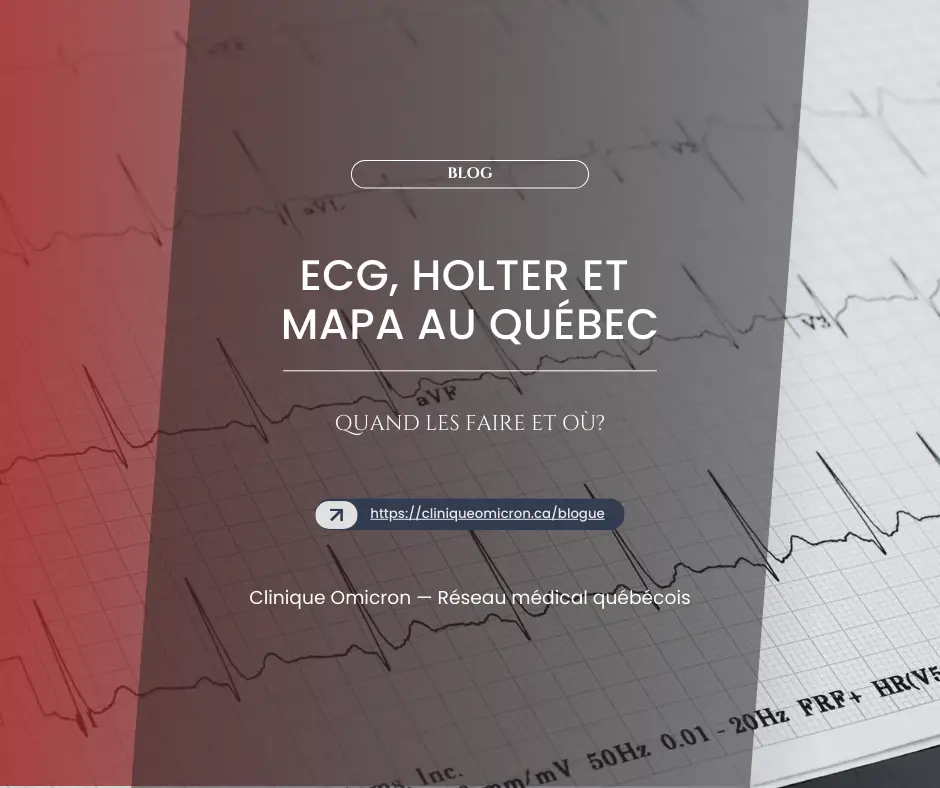

L’électrocardiogramme (ECG), le moniteur Holter et la mesure ambulatoire de la pression artérielle (MAPA) sont trois des examens diagnostiques les plus fréquemment prescrits en cardiologie et en médecine générale au Québec. Pourtant, leur indication, leur déroulement et leur accessibilité restent souvent méconnus des patients. Certains attendent des semaines pour obtenir ces examens à l’hôpital, sans savoir qu’ils peuvent y accéder rapidement en clinique médicale privée ou mixte. Cet article explique ce que mesure chacun de ces examens, dans quelles situations cliniques ils sont indiqués, comment ils se déroulent et comment les obtenir au Québec.
L’ECG au repos — l’électrocardiogramme standard : rôle et indications
L’électrocardiogramme (ECG) au repos est l’un des examens diagnostiques les plus utilisés en médecine. Il mesure l’activité électrique du cœur à un instant précis, en captant les signaux transmis par les cellules cardiaques à travers 10 électrodes placées sur la peau (poitrine, bras, jambes). Le tracé produit — composé de 12 dérivations standard — permet au médecin d’analyser le rythme cardiaque, la fréquence, la conduction électrique entre les différentes chambres du cœur, et de détecter certaines anomalies structurelles ou fonctionnelles.
Ce que l’ECG peut détecter
Un ECG au repos peut identifier une fibrillation auriculaire (FA), un bloc auriculo-ventriculaire (BAV), une tachycardie ou bradycardie sinusale, un syndrome de Wolff-Parkinson-White (WPW), des signes d’ischémie ou d’infarctus du myocarde (sus-décalage ou sous-décalage du segment ST), des troubles de la repolarisation ventriculaire, ou encore un allongement de l’intervalle QT — un facteur de risque d’arythmie grave pertinent notamment lors de l’initiation de certains médicaments.
When does a doctor order a resting ECG?
Les indications cliniques les plus fréquentes incluent : palpitations, douleur thoracique, dyspnée inexpliquée, syncope ou pré-syncope, dépistage avant la prescription de médicaments cardioactifs (antidépresseurs, antipsychotiques, antibiotiques comme l’azithromycine), bilan préopératoire chez un patient de plus de 40 ans ou à risque cardiovasculaire, suivi d’un patient avec cardiopathie connue, examen d’aptitude au travail ou à la pratique sportive de compétition, et bilan annuel chez les personnes avec diabète, hypertension ou dyslipidémie.
Limites de l’ECG standard
L’ECG au repos ne capture qu’un instantané de 10 à 30 secondes d’activité cardiaque. Il peut être normal même en présence d’arythmies intermittentes — c’est précisément là qu’intervient le Holter cardiaque. Par ailleurs, un ECG normal n’exclut pas une maladie coronarienne ni une insuffisance cardiaque débutante. L’interprétation doit toujours être réalisée dans le contexte clinique global du patient.
Duration and procedure
L’examen dure environ cinq à dix minutes. Il est indolore et ne nécessite aucune préparation particulière. Le patient doit rester immobile et respirer normalement pendant l’acquisition du tracé. Le résultat est disponible immédiatement après interprétation par le médecin.
The 24-48 hour cardiac Holter - ambulatory rhythm monitoring
Le moniteur Holter est un appareil d’enregistrement continu de l’électrocardiogramme porté par le patient pendant 24 à 48 heures — parfois jusqu’à 7 à 14 jours selon le type d’appareil utilisé. Contrairement à l’ECG au repos, il permet de capter l’activité cardiaque dans les conditions réelles de vie du patient : pendant le sommeil, les repas, l’activité physique, le stress ou les moments où les symptômes apparaissent.
Ce que le Holter permet d’identifier
Le Holter est particulièrement utile pour détecter des arythmies intermittentes qui n’apparaissent pas lors d’un ECG standard : fibrillation auriculaire paroxystique (par épisodes), flutter auriculaire, extrasystoles auriculaires ou ventriculaires fréquentes ou en salves, tachycardie supraventriculaire paroxystique (TSVP), dysfonction sinusale (pauses, bradycardie nocturne), et blocs de conduction intermittents. Il permet également d’évaluer l’efficacité d’un traitement antiarythmique ou de vérifier le fonctionnement d’un stimulateur cardiaque (pacemaker).
Main clinical indications
Le Holter est indiqué en présence de palpitations récurrentes non expliquées, de syncope ou lipothymie d’étiologie indéterminée, de tachycardie ou bradycardie documentée sans cause identifiée, de suspicion de fibrillation auriculaire paroxystique, de suivi post-ablation d’arythmie, et dans le cadre de bilans cardiologiques approfondis chez des patients avec antécédents d’AVC cryptogénique (pour détecter une FA silencieuse). Il est parfois prescrit dans le bilan d’aptitude pour certaines professions réglementées (pilotes, conducteurs de transport en commun, plongeurs professionnels).
Déroulement de l’examen
Le patient se présente à la clinique pour l’installation des électrodes (généralement trois à cinq), qui sont fixées sur la peau du thorax avec un adhésif médical. L’appareil enregistreur — de la taille d’un téléphone cellulaire — est porté à la ceinture ou en bandoulière. Le patient reçoit un journal de bord dans lequel il note ses symptômes, ses activités et ses heures de sommeil. Après la période d’enregistrement, il retourne à la clinique pour le retrait de l’appareil et l’envoi des données au médecin ou au cardiologue pour analyse. Aucune préparation n’est requise, mais la douche doit être évitée pendant l’enregistrement si l’appareil n’est pas étanche.
ABPM - 24-hour ambulatory blood pressure measurement
La mesure ambulatoire de la pression artérielle (MAPA) est l’examen de référence pour le diagnostic et la surveillance de l’hypertension artérielle. Contrairement à une simple mesure en cabinet — qui peut être influencée par le stress ou l’effet «blouse blanche» —, la MAPA enregistre la pression artérielle automatiquement toutes les 15 à 30 minutes pendant une période de 24 à 48 heures, dans les conditions réelles de vie du patient.
Why MAPA is superior to in-office measurement
Les lignes directrices de Hypertension Canada recommandent la MAPA comme examen de référence pour confirmer un diagnostic d’hypertension, car elle permet d’identifier : l’hypertension de la blouse blanche (pression élevée en cabinet, normale en dehors), l’hypertension masquée (pression normale en cabinet mais élevée en ambulatoire), l’absence de baisse nocturne physiologique de la pression («non-dipper»), et la variabilité tensionnelle sur 24 heures. Ces données sont corrélées au risque cardiovasculaire à long terme de façon plus précise que les mesures ponctuelles en bureau.
Clinical indications for ABPM
La MAPA est prescrite pour confirmer un diagnostic d’hypertension artérielle avant d’initier un traitement médicamenteux, pour évaluer l’efficacité d’un traitement antihypertenseur, pour investiguer une hypertension résistante (pression non contrôlée malgré 3 antihypertenseurs), pour le bilan d’aptitude chez certains professionnels (aviation, transport), ou en présence d’une variabilité marquée de la pression entre différentes mesures. Elle est également recommandée chez les patients diabétiques et les patients avec atteinte rénale chronique, populations chez qui le contrôle tensionnel a un impact particulièrement important.
Déroulement de l’examen
Un brassard gonflable est placé autour du bras non dominant du patient. Relié à un petit appareil enregistreur porté à la ceinture, il se gonfle automatiquement à intervalles préprogrammés. Le patient doit garder le bras immobile lors des mesures, noter ses activités dans un journal de bord, et éviter les efforts intenses pendant l’enregistrement. Le sommeil est possible normalement. Après la période d’enregistrement, les données sont analysées pour produire un rapport détaillé incluant les moyennes diurnes, nocturnes et globales, ainsi que les profils de variabilité tensionnelle.
ECG, Holter et MAPA au Québec — délais d’accès et alternatives au réseau public
L’accès à ces examens dans le réseau public québécois peut varier considérablement selon la région, l’établissement et la priorité clinique assignée. Comprendre les circuits disponibles aide à obtenir ces examens dans les meilleurs délais.
Public network - lead times vary according to priority
Dans le réseau public (CLSC, hôpital, GMF), ces examens sont accessibles sur prescription médicale et couverts par la RAMQ. L’ECG au repos est généralement réalisable rapidement, souvent le jour même ou sous 48 heures dans un contexte de médecine familiale ou aux urgences. Le Holter et la MAPA, en revanche, impliquent des délais pouvant aller de quelques semaines à plusieurs mois selon la région et la disponibilité des appareils, notamment dans les zones à faible densité médicale.
Private and mixed medical clinics - no-long-wait access
Les cliniques médicales privées ou mixtes offrent ces examens avec des délais beaucoup plus courts, souvent sous 24 à 72 heures. L’ECG est dans la grande majorité des cas réalisable le jour même de la consultation. Le Holter et la MAPA sont disponibles sur rendez-vous rapide, l’installation étant réalisée en clinique par un professionnel de la santé. Ces examens peuvent être facturés selon les tarifs du secteur privé lorsqu’ils ne font pas l’objet d’une couverture RAMQ directe, ou inclus dans une consultation médicale selon le contexte clinique.
Ce qu’il faut apporter — conseils pratiques
Pour un ECG : aucune préparation particulière. Éviter les crèmes ou lotions sur la peau du thorax le jour de l’examen. Porter des vêtements faciles à ouvrir ou à retirer (pour accéder au thorax). Pour un Holter : apporter des vêtements confortables, informer le médecin de tous les médicaments en cours. Éviter la douche pendant l’enregistrement si l’appareil n’est pas étanche — ou utiliser un sac étanche si disponible. Pour une MAPA : éviter les efforts intenses, garder le bras détendu lors des mesures, noter les activités dans le journal fourni avec l’appareil.
Accès à l’ECG, au Holter et à la MAPA en clinique — prise en charge intégrée
Ces trois examens diagnostiques sont disponibles dans les points de service de Clinique Omicron, dans le cadre d’une prise en charge médicale complète. Une consultation avec un médecin permet de déterminer quel examen est indiqué selon le tableau clinique du patient, puis de procéder à son installation ou à sa réalisation sans délai excessif.
Resting ECG - available during consultation
L’électrocardiogramme au repos est disponible directement lors de la consultation médicale. Les professionnels de Clinique Omicron procèdent à l’acquisition du tracé, à son interprétation clinique et à la remise du résultat au patient dans le cadre de la même visite, sans qu’une référence préalable soit nécessaire.
24-48 h Holter and ABPM - in-clinic installation, easy return
L’installation des appareils Holter et MAPA est réalisée par l’équipe médicale disponible dans ses plusieurs points de service. Le patient reçoit les instructions détaillées sur le port de l’appareil et le journal de bord. Au terme de la période d’enregistrement, il retourne à la clinique pour le retrait et la transmission des données. Les résultats sont analysés et communiqués dans les meilleurs délais, avec un suivi médical intégré selon les conclusions de l’examen.
Without a family doctor - no referral required
Les personnes sans médecin de famille peuvent obtenir ces examens à Clinique Omicron sans passer par une référence préalable. La consultation médicale, la prescription de l’examen et l’installation de l’appareil peuvent être coordonnées lors d’une même démarche, accessible dans les différents points de service de la clinique.
FAQ - ECG, Holter and ABPM in Quebec
Les réponses aux questions les plus fréquentes sur ce sujet.
R : L’ECG au repos est un enregistrement instantané de l’activité électrique du cœur, réalisé en cabinet en 5 à 10 minutes. Il capture un instantané qui peut être normal même en présence d’arythmies intermittentes. Le Holter est un enregistrement continu de 24 à 48 heures (parfois plus), porté dans les conditions réelles de vie du patient. Il permet de détecter des anomalies du rythme qui n’apparaissent qu’épisodiquement, lors d’activités spécifiques ou pendant le sommeil.
R : La MAPA est couverte par la RAMQ lorsqu’elle est prescrite par un médecin dans un contexte clinique justifié — notamment pour confirmer un diagnostic d’hypertension artérielle avant d’initier un traitement. En dehors des indications couvertes, ou dans le cadre d’une clinique privée, des frais peuvent s’appliquer. Il est recommandé de vérifier les modalités avec le médecin prescripteur.
R : Oui, et c’est même souhaitable. Les données nocturnes sont particulièrement importantes pour détecter certaines arythmies (comme les pauses ou la dysfonction sinusale nocturne) et pour évaluer la baisse physiologique de la pression artérielle pendant le sommeil. Le patient doit adopter ses habitudes normales de sommeil pendant l’enregistrement.
R : En règle générale, un ECG préopératoire est recommandé chez les patients de plus de 40 ans (certains protocoles disent 50 ans), chez les personnes avec des antécédents cardiovasculaires, ou en présence de facteurs de risque (diabète, hypertension, dyslipidémie, tabagisme). Certains anesthésistes peuvent le demander systématiquement selon le type de chirurgie. Les exigences varient selon l’établissement — il est préférable de vérifier les critères spécifiques avec le chirurgien ou l’anesthésiste.
A: The timeframe varies depending on the context. In the public sector, data must be analyzed by a technician and then interpreted by a cardiologist, which can take from a few days to a few weeks. In private or mixed medical clinics, the lead times are generally shorter, and medical follow-up can be planned quickly after receipt of the results.
Omicron Clinic
Need to consult a doctor?
In-person or via telemedicine, anywhere in Quebec.
We accept insurance. Telemedicine consultations available 7 days a week. No family doctor required.