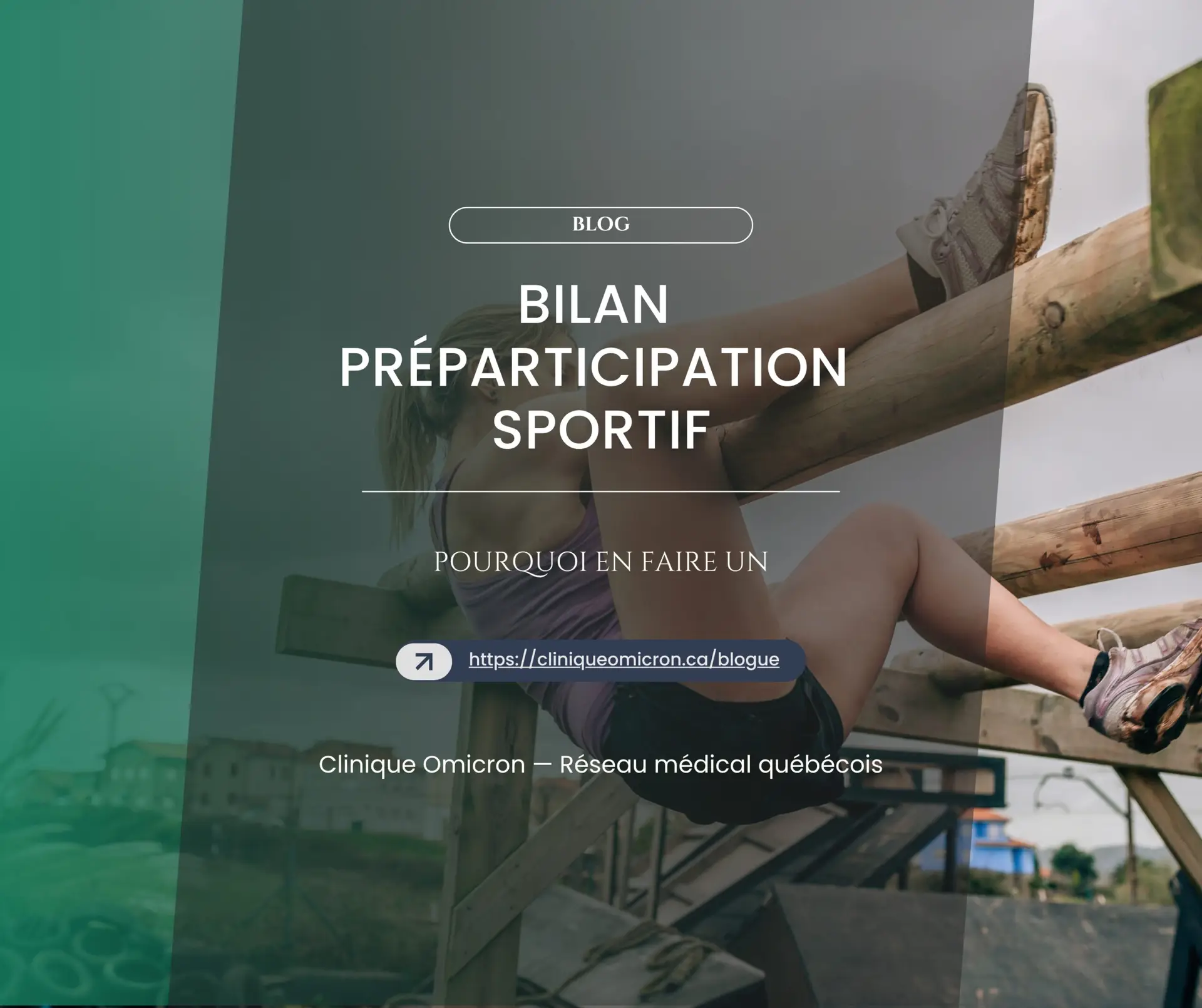

Reprendre l’entraînement après une longue pause, passer à un Sport Plus Intense, running a first marathon or enrolling a child in a competitive team: situations where a Pre-participation medical evaluation a sa place. Il ne s’agit pas d’un obstacle, mais d’un outil pour move more calmly. Cet article explique à qui s’adresse le bilan, ce qu’il contient, ce qu’il cherche à dépister, et ce qui change chez le jeune athlète au Québec.
On this page
- À qui s’adresse le bilan
- What a typical balance sheet contains
- Ce qu’on cherche à dépister
- Characteristics of the young athlete
- Sportifs d’endurance et sports à risque particulier
- Reprise de l’activité après blessure ou hospitalisation
- Myths and misconceptions
- Frequently asked questions
- Sources
À qui s’adresse le bilan
Visit pre-participation evaluation n’est pas obligatoire pour tout le monde, mais il est particularly useful dans certains contextes. L’objectif est de repérer les conditions qui pourraient rendre l’effort risqué et d’orienter une reprise progressive et sécuritaire.
The profiles that benefit most
- Adults over 40 resuming intense activity after a long break
- People with cardiovascular risk factors (hypertension, diabetes, dyslipidemia, smoking, family history)
- Competitive athletes of all ages
- Children and adolescents s’inscrivant à un programme sport-études ou en compétition encadrée
- Anyone who has experienced symptômes à l’effort (chest pain, palpitations, abnormal shortness of breath, syncope)
- Adults Sedentary individuals starting moderate or intense training
- People qui veulent participer à un événement physique exigeant (marathon, ultra, triathlon, randonnée d’altitude)
- Patients in cardiac rehabilitation after a coronary event, in collaboration with their cardiologist
Symptoms that should always trigger an evaluation
- Pain ou serrement thoracique pendant ou après l’effort
- Palpitations with dizziness or loss of consciousness
- Dizziness ou syncope à l’effort
- Shortness of breath disproportionné par rapport à l’intensité
- Fatigue brutale et inhabituelle à l’entraînement
- Background family history of sudden death before age 50
- Background de cardiomyopathie, d’arythmie ou de chirurgie cardiaque dans la famille proche
To remember
- Visit pre-participation evaluation is a security tool, not a hindrance to practicing sports
- Visit questionnaire and the’physical exam are the basis of every balance sheet [1]
- The’Resting ECG may be recommended depending on the profile and the sport practiced [2]
- At the house of young athlete, l’objectif est surtout de dépister les causes cardiaques rares mais sérieuses de mort subite à l’effort
- A Musculoskeletal assessment also allows for the correction of imbalances that predispose to injuries
- Visit RAMQ covers clinical-based evaluations, but not systematically purely preventative sports assessments
What a typical balance sheet contains
A pre-participation evaluation ne se résume pas à un test d’effort. Il combine plusieurs éléments cliniques, ajustés au profil et au sport visé [1].
The main steps
- Health Questionnaire : antécédents personnels et familiaux, médicaments, symptômes à l’effort, niveau actuel d’activité, objectifs sportifs
- Physical examination : blood pressure, cardiac and pulmonary auscultation, musculoskeletal examination, postural analysis, general examination
- Electrocardiogram (ECG) at rest according to recommendations and profile
- Blood tests ciblé selon le profil (glycémie, profil lipidique, ferritine et fer chez les sportifs d’endurance, parfois TSH et fonction rénale)
- Épreuve d’effort en cas de haut risque cardiovasculaire, de symptômes à l’effort ou d’objectif sportif intense
- Musculoskeletal assessment detailed (asymmetries, mobility, imbalances, sequelae of previous injuries)
- Advice personnalisés sur l’intensité, la progression et la récupération
À quoi sert l’ECG au repos
- Spot certaines anomalies évocatrices de cardiomyopathies ou d’arythmies
- Detect conduction disorders
- Provide a base plot to compare in the long term
- According to several learned societies, its usefulness is more pronounced in competitive young athletes [2]
- The’interpretation chez les sportifs requiert une expertise particulière, car le « cœur d’athlète » présente des particularités normales
Quand fait-on une épreuve d’effort
- Presence of several cardiovascular risk factors in an adult resuming intense activity
- Symptoms à l’effort (douleur, syncope, palpitations, essoufflement disproportionné)
- Background of coronary heart disease or heart surgery
- Profile Private (high intensity expected, sports in a difficult environment)
- L’épreuve est prescribed by a doctor and interpreted by a trained doctor (often in cardiology or sports medicine)
Ce qu’on cherche à dépister
Several Silent conditions can compromise the safety of sporting practice. The assessment aims to early identifier to adapt the sports project without necessarily eliminating it.
The main conditions to look out for
- Silent cardiovascular diseases Cardiomyopathies, arrhythmias, valvulopathies, coronary artery disease
- Undiagnosed hypertension
- Asthme d’effort
- Anemia ou carence martiale chez les sportifs d’endurance
- Diabetes or undiagnosed prediabetes
- Hypothyroidism or other endocrine abnormalities
- Muscle imbalances postural asymmetries predisposing to injuries
- Background from not fully rehabilitated injuries
- Signs Overtraining, chronic fatigue, sleep disorders
- Signs relative energy deficiency in sport (RED-S) or disordered eating associated with sport
Anémie et fer chez les sportifs d’endurance
- Visit Iron deficiency is common in runners, cyclists, and triathletes, especially among women
- It manifests as exhaustion, of performances down, sometimes a shortness of breath unusual
- The dosage of ferritin est l’élément clé du bilan
- The’Anemia proprement dite est plus rare, mais sa correction améliore nettement la tolérance à l’effort
- The’power supply, la perte sanguine menstruelle, l’inflammation et les pertes intestinales sont les principaux facteurs à explorer
Musculoskeletal assessment
- Locate the asymmetries of force or mobility between the left and right sides
- Evaluate the after-effects previous injuries (sprains, tendinopathies, fractures)
- Identifier areas of weakness to strengthen
- Counselor on progression, exercise selection, and returning to sport
- A physiotherapy reference may be recommended to supplement clinical work
Characteristics of the young athlete
Among the children and adolescents, the check-up aims mainly to detect silent heart conditions leading to a mort subite à l’effort (rare but serious) [2]. Several Quebec sports federations encourage a Annual report for competitive athletes.
Why this focus on the heart?
- Visit mort subite à l’effort is rare in young athletes but can occur in seemingly perfectly healthy individuals
- The main causes are Cardiomyopathies (hypertrophic cardiomyopathy, for example) and Arrhythmias congenital or acquired
- Visit questionnaire, the’physical exam and the’ECG permettent d’identifier la plupart des profils à risque
- Visit early diagnosis permet d’adapter la pratique sportive (limitation, surveillance, traitement)
Youth-specific aspects
- Growth et maturation : impact sur la charge d’entraînement et la prévention des blessures
- Posture and rapidly evolving imbalances
- Power supply and hydration adapted to sports and growth
- Sleep and recovery, which are often insufficient in young people
- Pressure sportive, gestion du stress, signes d’épuisement précoce
- Vaccination up to date according to the PIQ
- Discussion with the family on the overall sports load (training plus studies, social life, other activities)
Signaux d’alerte chez le jeune sportif
- Fainting ou malaise pendant ou juste après l’effort
- Pain thoracique à l’effort
- Shortness of breath more marked than his peers at the same effort
- Background family history of cardiomyopathy or sudden death before age 50
- Fatigue Persistent, decrease in performance, marked loss of motivation
- Injuries repeated on the same areas
Is your teen starting a sports-focused or competitive program? Clinique Omicron offre un service de médecine sportive incluant l’évaluation préparticipation, l’ECG, les épreuves d’effort sur référence et la planification du retour au jeu après blessure, à nos points de service au Québec. Make an appointment or opt for the teleconsultation for a first discussion.
Sportifs d’endurance et sports à risque particulier
Some sports require a more complete evaluation due to their intensity, environment, or specific risks.
Sports d’endurance prolongée
- Marathon, ultramarathon, long-distance triathlon
- Evaluation cardiovascular renforcée selon l’âge et les facteurs de risque
- Balance sheet nutritional and martial (ferritin, B12, vitamin D)
- Evaluation de la stratégie d’hydratation et de gestion énergétique
- Preparation de la périodisation de l’entraînement avec un encadrement compétent
Sports in a particular environment
- Altitude (alpinisme, trekking en altitude) : évaluation respiratoire et cardiovasculaire ciblée, discussion de l’acclimatation
- Scuba diving : specific evaluation with a trained physician, attention to cardiopulmonary and ENT diseases
- Sports Combat: baseline neurological assessment, concussion history, ENT and ophthalmological examination
- Sports motorized or high traumatic risk: orthopedic and neurological evaluation
- Activities due to extreme heat: evaluating medications and heatstroke risks
Charge d’entraînement et signaux d’épuisement
- Fatigue Persistent despite recovery
- Decline de performance malgré un volume d’entraînement maintenu ou augmenté
- Trouble du sommeil et de l’humeur
- Infections repeatedly
- Loss Unintentional weight loss, menstrual cycle disorders in female athletes
- Injuries repeated, poorly explained chronic pain
- These signs justify un bilan médical avant d’augmenter encore la charge d’entraînement
Reprise de l’activité après blessure ou hospitalisation
The pre-participation physical examination is also very useful before the Return to sports après une blessure ou un épisode médical significatif. Il s’agit alors moins d’un dépistage que d’un landmark for structuring feedback.
Situations where it is particularly recommended
- After a Musculoskeletal injury major (ligament tear, fracture, severe tendinopathy)
- After a concussion or a head injury
- After a surgery (orthopedic, abdominal, cardiac)
- After a acute illness significant (pneumonia, COVID-19 with prolonged symptoms, mononucleosis)
- After a Cardiovascular event (in collaboration with the cardiologist)
- In case of pregnancy et après l’accouchement, en collaboration avec le médecin ou la sage-femme
Principes d’un retour au jeu réussi
- Evaluate Objectively, the capabilities (strength, mobility, balance, pain)
- Progress step by step, while monitoring tolerance
- Collaborate avec le physiothérapeute et l’entraîneur
- Adapter le calendrier de compétition à la guérison réelle, et non à l’urgence ressentie
- Identifier risk factors for recurrence to correct them
- Reintegrate Sport-specific movements at the end of progression
Myths and misconceptions
« Tant que je n’ai pas mal, je n’ai pas besoin de bilan »
False in several cases. Les conditions cardiaques silencieuses peuvent rester totalement asymptomatiques jusqu’à ce qu’un effort intense les démasque. Une hypertension non diagnostiquée, un asthme d’effort ou une anémie peuvent aussi évoluer longtemps sans douleur. Le bilan vise précisément à repérer ce qui ne se voit pas encore.
« Le bilan préparticipation, c’est juste pour les athlètes »
False. Le bilan est utile pour beaucoup de profils : adultes qui reprennent l’entraînement après une longue pause, personnes avec facteurs de risque cardiovasculaire, candidats à un événement physique intense. Il n’est pas réservé aux athlètes de haut niveau.
« L’ECG suffit à tout dépister »
False. L’ECG est un outil parmi d’autres. Il est très utile pour repérer plusieurs anomalies, mais il ne remplace ni le questionnaire ni l’examen clinique. Certaines pathologies cardiaques peuvent avoir un ECG normal, surtout dans leurs formes débutantes. C’est l’overall balance Who provides the best security?.
«My child is in perfect health, no need for a check-up.»
Nuanced. Beaucoup de causes cardiaques de mort subite à l’effort surviennent chez des jeunes apparemment en parfaite forme. C’est même la raison pour laquelle plusieurs fédérations sportives encouragent un bilan annuel chez les athlètes compétitifs. La performance ne garantit pas l’absence d’anomalie cardiaque sous-jacente.
« Le bilan va m’interdire le sport »
False in the vast majority of cases. The balance sheet aims to adapt the practice, pas à l’interdire. Pour certaines conditions, l’effort intense doit effectivement être encadré ou modifié, mais une activité physique régulière reste presque toujours bénéfique. La discussion avec le médecin permet de trouver le bon équilibre.
Frequently asked questions
Is the pre-participation physical covered by the RAMQ?
Les évaluations à motif clinique (symptômes, antécédents, facteurs de risque) sont couvertes par la RAMQ. Un bilan strictement préventif demandé par un club, une fédération ou pour un événement sportif n’est pas nécessairement couvert. Certaines assurances collectives offrent un remboursement partiel. Une discussion préalable avec la clinique permet de clarifier les modalités.
How often should a check-up be redone?
Pour un adulte sans facteur de risque, un bilan tous les quelques années peut suffire, surtout en cas de changement notable de l’entraînement ou de l’état de santé. Pour les athlètes compétitifs, un bilan annuel est recommandé par plusieurs fédérations. En présence de symptômes nouveaux, il ne faut pas attendre la prochaine visite annuelle pour consulter.
Can we do it via telehealth?
Une partie de la démarche (questionnaire, discussion d’antécédents, conseils sur la progression, demande d’analyses sanguines) se fait très bien en téléconsultation. L’examen physique, l’ECG, l’épreuve d’effort et certaines évaluations musculosquelettiques nécessitent toutefois une visite en personne.
Do I need to be fasting?
Pour certains tests sanguins (glycémie à jeun, profil lipidique selon les modalités), un jeûne peut être demandé. La clinique précise les conditions avant le rendez-vous. La consultation médicale et l’ECG eux-mêmes ne nécessitent pas d’être à jeun.
How long before my competition or event should I schedule the assessment?
Idéalement plusieurs semaines, voire 2 à 3 mois avant un événement majeur. Cela laisse le temps de réaliser les examens complémentaires éventuels (épreuve d’effort, bilan sanguin, échographie cardiaque sur référence) et d’ajuster la préparation. Un bilan fait à la dernière minute est moins utile, surtout si des modifications de l’entraînement sont nécessaires.
What does this have to do with a concussion?
Any history of concussion, especially a recent one, should be discussed during the pre-participation assessment. Returning to sport after a concussion follows a progressive protocol and requires a clear medical opinion. Several Quebec and Canadian resources guide this process (Canadian Paediatric Society, Parachute Canada, sports federations).
Sources
- Société canadienne de médecine du sport et de l’exercice (CASEM). Pre-participation medical evaluation.
- Canadian Cardiovascular Society. Recommandations sur l’évaluation cardiaque préparticipation chez le sportif.
- European Society of Cardiology. Pre-participation cardiovascular evaluation guidelines.
- Canadian Paediatric Society. Physical Activity, Sport, and the Young Athlete.
- Parachute Canada. Guidelines for Sports-Related Concussions.
- WHO — World Health Organization. Physical activity, cardiovascular health, and prevention.
- INSPQ — National Institute of Public Health of Quebec. Physical activity and population health.
Medical consultation | Clinique Omicron
Omicron Clinic
Need to consult a doctor?
In-person or via telemedicine, anywhere in Quebec.
We accept insurance. Telemedicine consultations available 7 days a week. No family doctor required.