
It’s a confusing situation—and one that’s more common than you might think. You see your doctor about palpitations, dizziness, or unusual shortness of breath; your doctor orders a 24-hour Holter monitor; you wear it diligently… and the results come back: everything is normal. Yet the symptoms persist. A Normal Holter monitor results The presence of actual symptoms does not mean that you are imagining things, nor does it mean that the process ends there. This article provides an overview of the diagnostic options available beyond the standard 24-hour recording.
On this page
- Why a Holter monitor reading may be normal despite actual symptoms
- What to Ask Your Doctor
- Options for Extended Monitoring
- Do not overlook non-cardiac causes
- The Importance of Keeping a Symptom Journal
- Maintain confidence in the process
- Myths and misconceptions
- Frequently asked questions
Why a Holter monitor reading may be normal despite actual symptoms
Visit Holter is a portable device that continuously records the heart’s electrical activity, usually over a period of 24 or 48 hours. Its strength is also its limitation: it only detects what happens during the recording window. If your symptoms are caused by an arrhythmia that occurs once a week or once a month, there’s a good chance that nothing abnormal will happen during that short interval.
The Most Common Scenarios
- An intermittent arrhythmia that simply did not occur during the recording period.
- A non-cardiac cause of the symptoms: anemia, thyroid disorder, anxiety, dehydration, or a side effect of medication.
- Increased sensitivity to normal heartbeats or benign premature beats.
- A neurological disorder: Certain forms of epilepsy, for example, can cause sensations similar to palpitations.
- Normal physiological variability in heart rate, perceived as abnormal.
The challenge for the physician is to distinguish between an overlooked cardiac cause and a very real noncardiac cause. Both possibilities should be explored rather than ruled out.
What a Normal Holter Test Means—and What It Doesn't Mean
| What the results indicate | What he doesn't mention |
|---|---|
| No arrhythmias were detected during the recording window | That the symptoms are imaginary |
| Steady pace during the observation period | No arrhythmia should occur outside of this period |
| An initial diagnostic phase has been completed | That all avenues have been exhausted |
To remember
- A normal Holter test indicates that no arrhythmia was detected, not that there is no problem.
- Intermittent arrhythmias often cannot be detected during a short recording.
- The symptoms experienced are real, even if the test results show no abnormalities.
- A non-cardiac cause may be involved.
- This process can be continued using other tools.
- The key challenge is distinguishing between an unrecognized cardiac cause and a non-cardiac cause.
What to Ask Your Doctor
If your symptoms persist after a normal Holter test, certain targeted questions can help advance the discussion. They do not call into question the work already done; rather, they seek to take things a step further when the first stage has not yielded a diagnosis.
Five Helpful Questions to Ask
- How often do my symptoms occur, and is this consistent with an intermittent arrhythmia?
- Would long-term cardiac monitoring over several days be appropriate in my case?
- Should I be referred to a cardiologist for a specialized evaluation?
- Are there any other tests—such as a cardiac ultrasound, stress test, or comprehensive blood work—that could help confirm the diagnosis?
- Could this be a non-cardiac cause that needs to be investigated, such as a thyroid issue, anemia, or an anxiety disorder?
Preparing for the Conversation
Coming to your appointment with specific details—such as the frequency, duration, and context of the episodes—gives your doctor a concrete basis for deciding on the next steps. A precise description is often better than a vague summary.
To remember
- Asking questions doesn't mean questioning the doctor.
- The frequency of symptoms guides the choice of tests.
- Extended monitoring may be explicitly discussed.
- A referral to a cardiologist is a valid option.
- Other tests may be performed as part of the evaluation.
- Concrete observations make it easier to make medical decisions.
Options for Extended Monitoring
When a suspected intermittent arrhythmia If an event is not detected by a short-term Holter monitor, several approaches can be used to extend the observation period. The choice depends on the frequency of symptoms, their duration, and the degree of clinical suspicion.
The patient-activated event monitor
This small device is worn for several days or weeks. When you experience a symptom, you press a button to record the rhythm at that exact moment. It is useful when episodes are recognizable and can be triggered manually, but less suitable if the episodes are very brief or go unnoticed.
The Long-Wear Adhesive ECG Patch
A small patch stuck to the chest continuously records data over several days. Simpler than a traditional Holter monitor—no device, no wires—it is still limited by the adhesive: it may cause skin irritation, and the duration of wear is limited.
Smart clothing with textile sensors
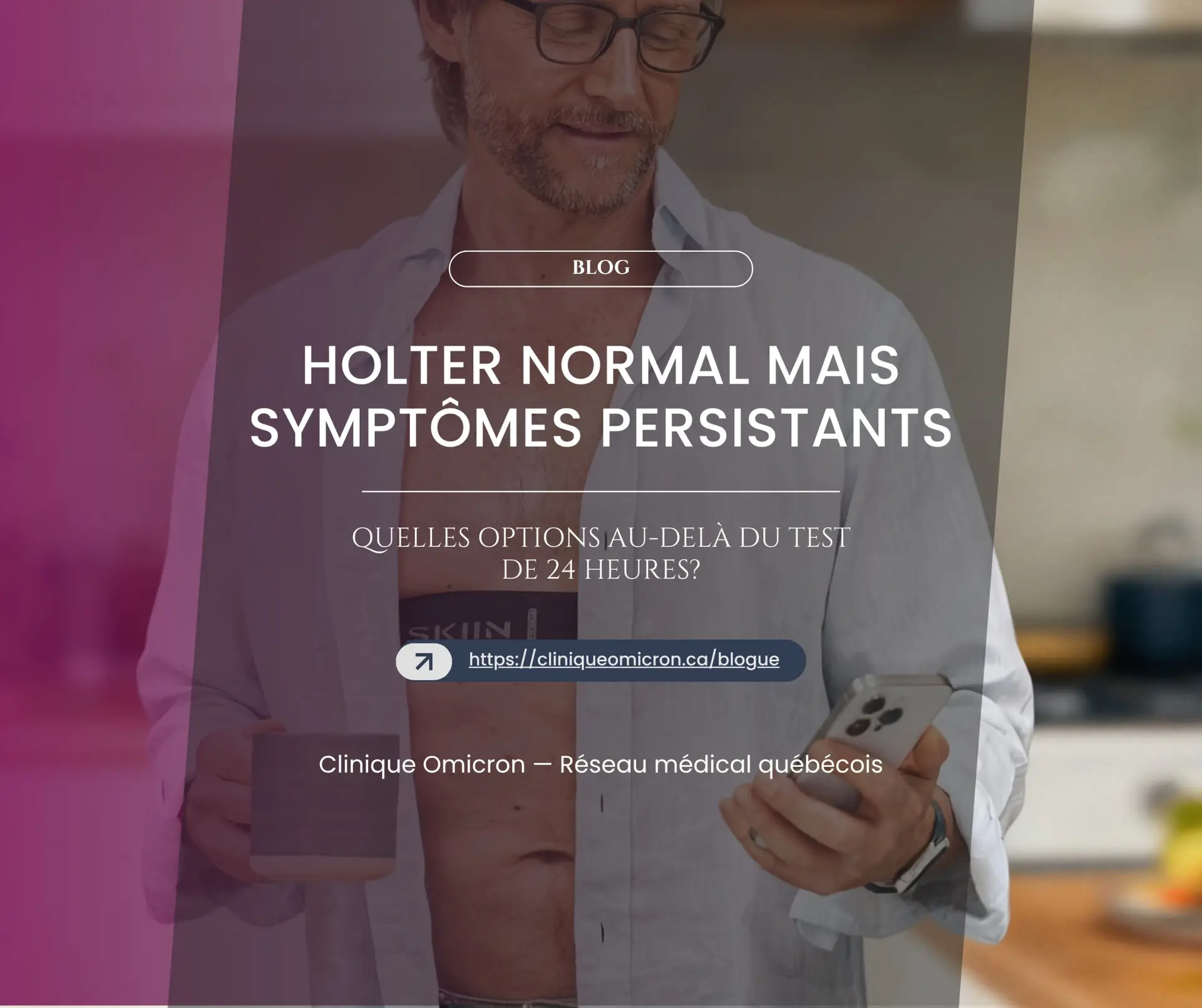
A more recent innovation, this garment incorporates ECG sensors woven directly into the fabric. With no adhesive patches or visible casing, it is worn like ordinary underwear—day or night, while sleeping or exercising—over an extended period. At our service locations in Quebec, we offer SKIIN™ technology in partnership with Myant Health, a Canadian company based in Mississauga. This garment is certified by Health Canada as a Class II medical device and enables continuous cardiac monitoring over an extended period, with analysis by a cardiologist and a report sent to the patient’s primary care physician.
The Implantable Cardiac Monitor
For the most complex cases, a small device implanted under the skin records the heart rhythm over several years. This is reserved for specific situations where a rare and serious cardiac cause is strongly suspected. This is a specialized decision made by the cardiologist.
Compare the approaches at a glance
| Tool | Typical duration | Distinctive Feature | Main limitation |
|---|---|---|---|
| Standard Holter monitor | 24 to 48 hours | Continuous recording | Short window |
| Event Coordinator | Days to Weeks | Manual activation | Missed Short Episodes |
| Adhesive ECG Patch | Several days | Lightweight, wireless | Irritation, short-term |
| Garment with Textile Sensors | Extended period | Worn day and night, without adhesive | Availability varies by service |
| Implantable monitor | Several years | Very Long-Term Monitoring | Reserved for specialized cases |
Are you experiencing unexplained symptoms despite initial test results coming back normal? Our teams can help you. Learn more about our services, explore our solutions for businesses, choose the teleconsultation or Make an appointment online.
Do not overlook non-cardiac causes
When cardiac test results come back normal, it’s worth exploring other possibilities. Several non-cardiac conditions can cause sensations that are almost indistinguishable from arrhythmias.
Common Causes You Should Know About
- Anemia—a decrease in red blood cells can cause palpitations and shortness of breath.
- Thyroid disorders—hyperthyroidism in particular.
- Nutritional deficiencies—magnesium, potassium, B vitamins.
- Chronic dehydration.
- Side effects of medications or natural health products.
- Excessive consumption of caffeine, alcohol, or stimulants.
- Anxiety disorders — which can cause very real palpitations, but are not caused by a heart condition.
- Sleep apnea—often underdiagnosed—can lead to nocturnal heart problems.
A comprehensive blood test or a sleep evaluation sometimes reveals an unexpected cause that is not directly related to the heart itself.
The Importance of Keeping a Symptom Journal
While the diagnostic process continues, keep a symptom log can greatly help your doctor assess the situation and choose the most appropriate follow-up tests.
What to Note in Each Episode
- The exact date and time.
- The duration of symptoms.
- Circumstances: meals, physical activity, rest, sleep, stress, and medication.
- The perceived intensity.
- Identified triggers and stress-relievers.
| Item to be recorded | Why It's Useful |
|---|---|
| Episode Time | Help with cross-referencing using an extended recording |
| Context (exercise, rest, meals) | Points to a possible trigger |
| Duration and Intensity | Distinguish between a brief episode and a prolonged episode |
| Soothing Factors | Provides information about the nature of the disorder |
This information helps guide further testing and interpret the results of any long-term monitoring.
Maintain confidence in the process
Living with unexplained symptoms is difficult. It’s very tempting to downplay how you feel or, conversely, to worry unnecessarily. A few landmarks help keep us on track.
- Your symptoms are real, even if the initial test results are normal.
- A normal Holter monitor does not rule out an intermittent arrhythmia: it simply indicates that no arrhythmia was detected during the recording period.
- Modern medicine has increasingly effective tools for detecting what was once invisible.
- It is perfectly reasonable to request a second opinion or a referral to a cardiologist if the problem persists.
A normal Holter test in the presence of persistent symptoms is not a dead end: it is often a step in a broader diagnostic process. Long-term cardiac monitoring—using an ECG patch, smart garment, or implantable monitor, as appropriate—significantly increases the ability to detect intermittent arrhythmias, while non-cardiac causes can be investigated at the same time.
Myths and misconceptions
«A normal Holter test means there's nothing wrong with me.»
False. A normal result simply indicates that no abnormalities were recorded during the monitoring period. An arrhythmia that occurs once a week may very well go undetected during a 24-hour recording.
«If it were serious, the Holter monitor would have picked it up.»
Nuanced. The Holter monitor detects what is happening while it is recording. Certain rare conditions actually require much longer monitoring, sometimes lasting months or years.
«My heart palpitations must be coming from my heart.»
False. Anemia, thyroid disorders, anxiety, sleep apnea, or excessive caffeine intake can cause symptoms similar to those of arrhythmias, without any underlying heart condition.
«To press my doctor on something is to contradict him.»
False. Asking questions and requesting additional tests is part of standard medical practice. It’s a collaborative process, not a challenge to the doctor’s judgment.
«A garment with sensors isn't actual medical equipment.»
Nuanced. Some of these garments are approved by Health Canada as medical devices and require evaluation by a cardiologist. The technology differs from that of a Holter monitor, but medical supervision is still required.
Frequently asked questions
Does a normal Holter test rule out an arrhythmia?
No. It indicates that no arrhythmia was recorded during the monitoring period. An intermittent arrhythmia may occur outside this time frame and go completely unrecorded.
How long can extended monitoring last?
This varies depending on the device: from a few days for an ECG patch or an event monitor, to a longer period for a sensor-equipped garment, up to several years for an implantable monitor. The choice depends on the clinical situation.
Can smart clothing replace the Holter monitor?
It does not systematically replace it: it is a useful complementary option when symptoms occur sporadically and longer-term monitoring is desirable. The doctor determines the most appropriate tool.
Could my heart palpitations be caused by something other than my heart?
Yes. Anemia, thyroid disorders, anxiety, dehydration, sleep apnea, and stimulant use are among the common non-cardiac causes. A comprehensive evaluation can help rule them out or confirm them.
Should I see a cardiologist?
If symptoms persist despite normal initial test results, a referral to a cardiologist is a reasonable option to discuss with your doctor. Only your doctor can determine whether a specialized evaluation is warranted.
What should you do if you have severe symptoms?
If you experience chest pain, loss of consciousness, or any other serious symptoms, do not wait: call 911 or go to the emergency room immediately.
Sources
- Heart + Stroke — Information on Arrhythmias and Cardiac Monitoring (coeuretavc.ca)
- National Institute for Excellence in Health and Social Services (INESSS) — Technology Assessments in Cardiology (inesss.qc.ca)
- Health Canada — Database of Licensed Medical Devices (canada.ca/sante-canada)
- Montreal Heart Institute — Patient Information (icm-mhi.org)
- Quebec Ministry of Health and Social Services (MSSS) (msss.gouv.qc.ca)
- Quebec College of Physicians (CMQ) — Professional Information (cmq.org)
Medical consultation | Clinique Omicron
Omicron Clinic
Need to consult a doctor?
In-person or via telemedicine, anywhere in Quebec.
We accept insurance. Telemedicine consultations available 7 days a week. No family doctor required.