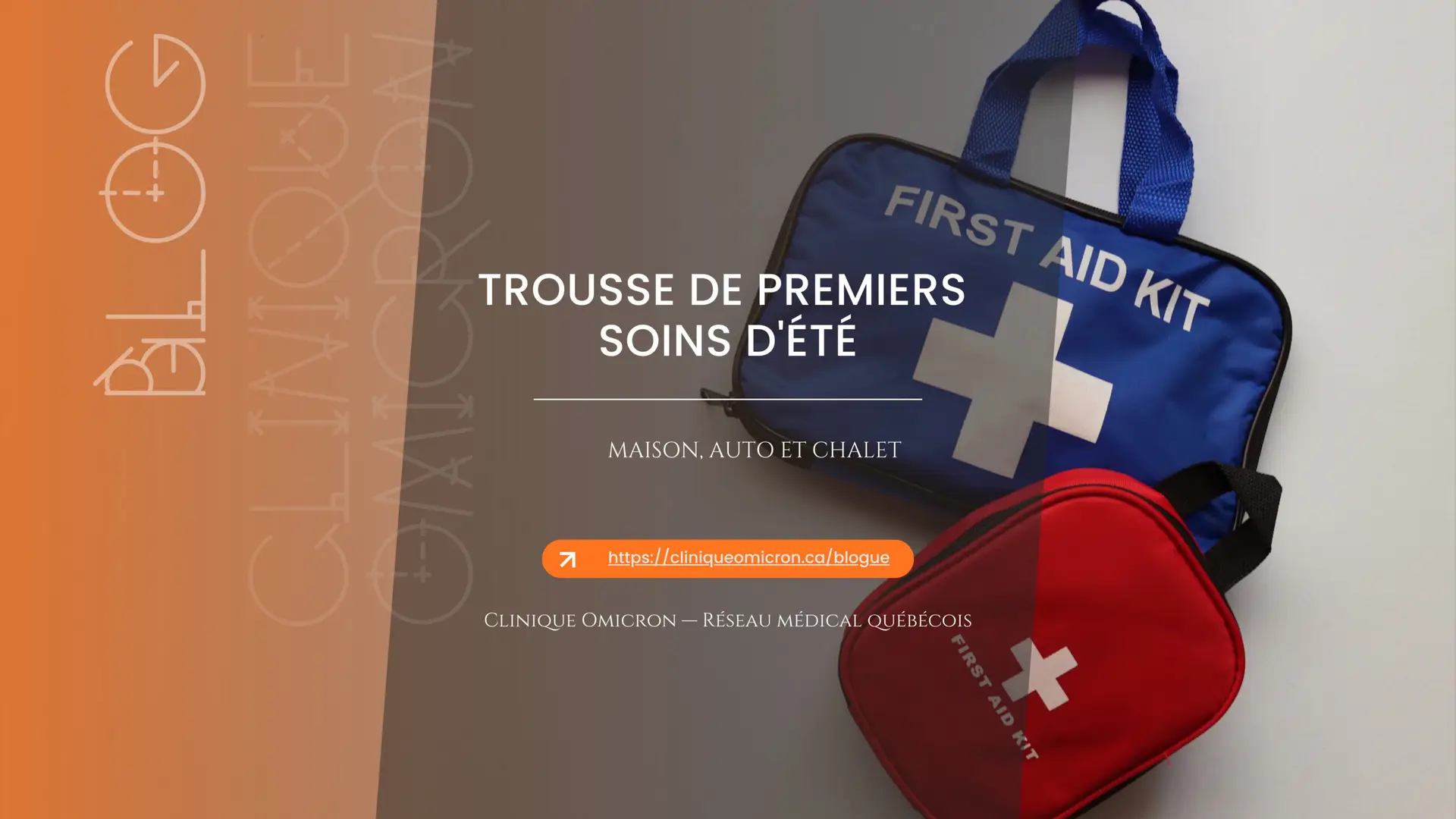

Summer brings a surge in outdoor activities—and with them, minor mishaps: scrapes, insect bites, sunburn, and blisters. Having a first-aid kit Having it ready and within reach—at home, in the car, or at the cabin—makes all the difference when it comes to dealing with those everyday minor injuries. But you still need to know what to put in it, how to adapt it to each location, and to remember to check it regularly. This article covers recommended contents, different versions depending on the location, and numbers to keep on hand.
On this page
- Why You Need a First-Aid Kit in the Summer
- Recommended content, by category
- The Car First-Aid Kit
- The Cabin Kit
- The Hiking and Outdoor Kit
- A family with children's travel kit
- Check and restock your first-aid kit
- Useful phone numbers to keep in there
- Myths and Misconceptions
- Frequently asked questions
Why You Need a First-Aid Kit in the Summer
A first-aid kit is a set of supplies that allows you to provide initial care for a minor injury or illness while waiting for the situation to resolve itself or for a professional to take over. The Canadian Red Cross and St. John Ambulance recommend having more than one: one for home and one for each place where you spend time, such as your car or vacation home.
What a first-aid kit can do—and what it can't replace
- It is used to provide quick first aid to children: cleaning and covering a wound, soothing a bug bite, and removing a splinter.
- It allows time to monitor the situation before deciding whether medical advice is needed.
- It is never a substitute for calling 911 in a serious situation or for seeking a professional evaluation if you have any doubts.
A suitable container
Choose a rigid, resealable, moisture-resistant container that is clearly labeled and stored out of the reach of young children but easy for an adult to find. A kit that’s soggy or scattered in a drawer is useless when you need it.
Recommended content, by category
The basic contents of a first-aid kit are organized into several categories: wound care, skin protection, tools, comfort items, and information. The table below lists the most useful items for summer, as recommended by the Canadian Red Cross and St. John Ambulance.
| Category | Recommended Content |
|---|---|
| Wound care | Adhesive bandages of various sizes, sterile gauze pads, a roll of gauze, medical tape, elastic bandages, antiseptic solution or wipes |
| Skin Protection | Broad-spectrum sunscreen, soothing after-sun gel, mosquito repellent, moisturizer |
| Tools | Splinter or tick remover, rounded-tip scissors, safety pins, non-porous disposable gloves, thermometer |
| Comfort and Miscellaneous | Oral rehydration solution, instant cold packs, emergency blanket, resealable bags, flashlight |
| Information | List of useful phone numbers (811, Poison Control Center, 911), list of family members' allergies and medications, first aid guide |
Two items that are often overlooked
- The splinter or tick remover : A must-have in the summer for carefully removing a splinter or a tick by pulling slowly without crushing it.
- Oral Rehydration Solution : Useful in cases of stomach flu or extreme heat, especially for children and the elderly, to replenish lost fluids and electrolytes.
Key Takeaways
- Plan to have more than one first-aid kit: one for home, one for the car, and one for the cabin.
- Bandages, gauze, tape, and antiseptics are the cornerstones of wound care.
- Sunscreen and mosquito repellent are essential in the summer.
- A pair of fine-tipped tweezers can be used for both splinters and ticks.
- The rehydration solution comes in handy during cases of stomach flu and hot weather.
- The list of useful phone numbers is an integral part of the kit.
The Car First-Aid Kit
Visit car first-aid kit is designed to handle unexpected situations on the road and long summer trips. It contains basic first-aid supplies, as well as items related to road safety and temperature fluctuations inside the vehicle.
To be added to the basic content
- Emergency blanket and flashlight with batteries.
- A bottle of water and an oral rehydration solution for hot weather.
- Reflective vest and warning triangle.
- Elastic bandage for a sprain sustained while on the go.
Be careful in the heat
A car’s interior turns into an oven in the summer. Some products, particularly creams and medications, do not hold up well in high temperatures. Store your first-aid kit out of direct sunlight and check its contents more often.
The Cabin Kit
At a cabin, you're often farther from services and sometimes have limited cell service. The kit must therefore be more comprehensive and self-sufficient, since it takes longer to travel to a service location.
What Makes the Difference
- A more generous supply of bandages, gauze pads, and gauze.
- Highly visible tick remover: wooded areas and tall grass increase the risk of tick bites.
- Plenty of mosquito repellent and soothing gel.
- A printed first-aid guide—useful when the internet is down.
- Written contact information for the nearest service location and directions to get there.
Be Aware of Ticks
After spending time outdoors, check your skin for ticks. If you find a tick attached, remove it completely with fine-tipped tweezers, then watch for a red rash that spreads over the following days and weeks. If in doubt, it’s best to have the situation evaluated.
The Hiking and Outdoor Kit
Visit outdoor kit It's designed to be lightweight and compact, since you carry it with you. You keep the essentials in a waterproof bag, focusing on items that treat the most common hiking injuries: blisters, scrapes, and sprains.
| Hiking Essentials | Item to plan for |
|---|---|
| Blisters and chafing | Blister bandages, adhesive tape |
| Minor wounds | Antiseptic wipes, bandages, gauze pads |
| Sprain or Strain | Elastic bandage |
| Insect Bites and Ticks | Mosquito repellent, fine-tipped tweezers |
| Heat and exertion | Water, rehydration solution, sunscreen |
Before You Go
- Let a family member or friend know your itinerary and your expected return time.
- Check the cell service coverage in the area and have a backup plan in case there is no coverage.
- Tailor the content to the duration and difficulty of the outing.
Are you concerned about a wound, a bite, or a symptom that’s lingering after a summer outing? Rather than waiting or making an unnecessary trip, have it checked out. You can set up a meeting or opt for a online consultation as a first step in sorting.
A family with children's travel kit
A family with young children tailors their first-aid kit to their needs. Children are more likely to get hurt while playing outside and are more vulnerable to dehydration and heatstroke.
Additions and Precautions
- Small, patterned bandages that children are more likely to accept.
- Age-appropriate thermometer.
- Oral rehydration solution, which is especially important for very young children.
- A written note listing known allergies and the action plan developed with the doctor, as well as the auto-injector if the child has one.
- Keep the kit out of children's reach, but within easy reach of adults.
The First Aid for Poisoning Response
Young children often put household products, plants, or medications in their mouths. If you suspect that a child has ingested something, do not induce vomiting; instead, contact the Quebec Poison Control Center immediately. The phone number should be included in the first-aid kit.
Check and restock your first-aid kit
Visit regular inspection That's what sets a reliable first-aid kit apart from a decorative one. A first-aid kit with expired products or missing bandages won't be of any use when you need it.
Good Maintenance Habits
- Take inventory at the start of the summer season.
- Check the expiration dates on products and replace any that have expired.
- Replace any used item immediately.
- Check the batteries in the flashlight.
- Update the list of allergies, medications, and important phone numbers.
Where to Store Each Kit
- Home : in a central location known to everyone in the household.
- Auto : Keep out of direct sunlight, in the trunk, or under a seat.
- Chalet : in a dry, designated location that is clearly marked for guests.
Useful phone numbers to keep in there
Visit Useful Phone Numbers are part of the first-aid kit, just like bandages. Printed on a laminated card, they remain legible even if the phone is dead or out of service.
| Situation | Resource |
|---|---|
| Health Advice, Non-Urgent Concern | Info-Santé 811, free and available 24/7 throughout Quebec |
| Ingestion of or exposure to a toxic substance | Quebec Poison Control Center |
| Life-threatening emergency (breathing, consciousness, severe allergy) | 911 |
Recognizing What Constitutes a 911 Emergency
- Difficulty breathing, swelling of the face or throat after a sting.
- Confusion, loss of consciousness, and very hot, dry skin suggestive of heatstroke.
- Heavy bleeding that does not stop despite sustained pressure.
Myths and Misconceptions
«One kit at home is enough»
False. Incidents often occur while traveling, on the road, or at a vacation home—far from the first-aid kit at home. First-aid organizations recommend having a first-aid kit at each summer residence.
«You can leave the car first-aid kit in the sun without any worries.»
False. The heat inside the car can cause certain products—especially creams and medications—to deteriorate. Store your first-aid kit in the shade and check its contents more often in the summer.
«You should induce vomiting after ingesting a toxic substance.»
False. Inducing vomiting can make the situation worse. The best course of action is to contact the Quebec Poison Control Center immediately; they will advise you on what to do based on the specific substance involved.
«A ready-made kit never needs to be checked»
Nuanced. A commercial kit is a good starting point, but its products expire and its items wear out with use. It requires the same maintenance as a DIY kit.
«An antiseptic replaces wound cleaning»
Nuanced. Cleaning with clean water remains the basic step for removing dirt and debris. The antiseptic complements this cleaning process; it does not replace it.
Frequently asked questions
What should a summer first-aid kit contain?
Bandages of various sizes, sterile gauze pads, adhesive tape, an antiseptic, sunscreen, insect repellent, a splinter or tick remover, a thermometer, an oral rehydration solution, disposable gloves, and a list of useful phone numbers. You can then tailor the contents to the location and the family.
Do you need a different first-aid kit for the car and the cabin?
Yes. The car kit includes road safety items and takes into account the heat inside the vehicle. The cabin kit is more comprehensive and self-sufficient, since you’re often farther from services there.
How often should you check your first-aid kit?
At least at the start of the summer season, and then every time an item is used. We check expiration dates, replace anything that’s missing, and update the list of allergies and important phone numbers.
How do you remove a tick using your first-aid kit?
Grasp the tick as close to the skin as possible with fine-tipped tweezers and pull it out slowly, without twisting or crushing it. Then clean the area and watch for any redness that spreads. If in doubt, have the situation evaluated.
When should you call the Quebec Poison Control Center?
As soon as you suspect that someone has ingested or been exposed to a toxic substance, medication, or plant, do not induce vomiting; instead, follow the instructions provided. The phone number should be included in the first-aid kit.
Does a first-aid kit replace first-aid training?
No. The kit provides the supplies, but knowing how to use them makes all the difference. First-aid training—offered by organizations such as the Canadian Red Cross and St. John Ambulance—teaches the basic skills and gives you the confidence to take action.
Sources
- Canadian Red Cross — First Aid Tips and Resources
- Saint-Jean Ambulance — First Aid and Emergency Care
- Quebec Poison Control Center — Québec.ca
- Government of Quebec — Info-Santé and Info-Social 811
- Quebec.ca — Health Tips
- Quebec National Institute of Public Health (INSPQ)
Medical consultation | Clinique Omicron
Omicron Clinic
Need to consult a doctor?
In-person or via telemedicine, anywhere in Quebec.
We accept insurance. Telemedicine consultations available 7 days a week. No family doctor required.