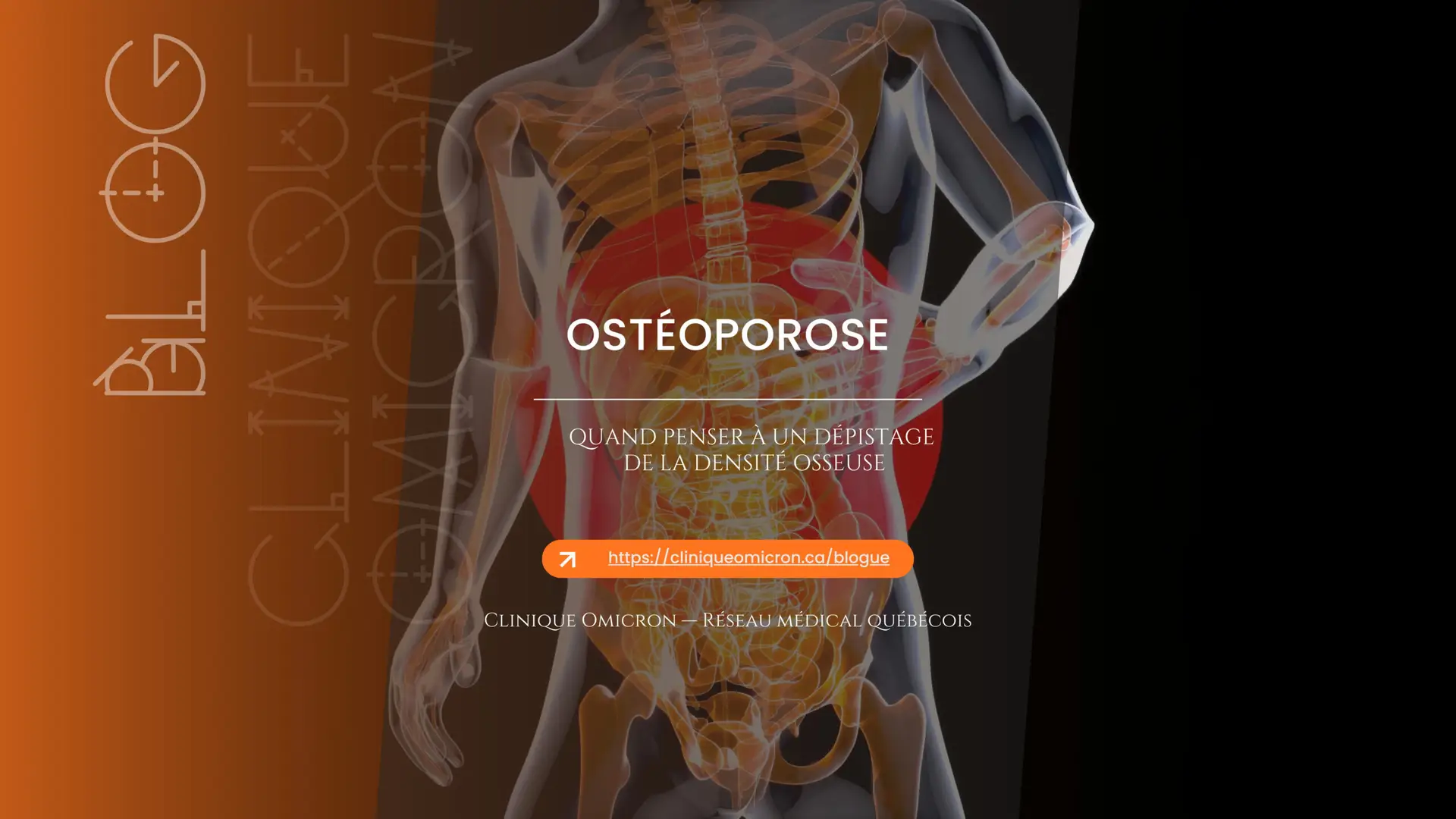

It is often called the “silent disease” because it often progresses without causing pain until the first fracture occurs. The osteoporosis screening aims to detect a loss of bone density before it causes a fracture, especially after a certain age or in the presence of risk factors. This guide explains, in plain language, what osteoporosis is, who should consider screening, what bone densitometry involves, and the role of calcium, vitamin D, physical activity, and fall prevention. Interpreting test results is always the responsibility of a healthcare professional.
On this page
- Osteoporosis: A Silent Disease
- Risk Factors You Should Be Aware Of
- Bone Densitometry (DXA): What It Involves
- Who Should Consider Screening
- Understanding a Bone Density Result
- Calcium, Vitamin D, and Diet
- Physical Activity and Bone Health
- Preventing Falls and Fractures
- Myths and misconceptions
- Frequently asked questions
Osteoporosis: A Silent Disease
The’Osteoporosis is a gradual weakening of the skeleton: bone loses density and quality, making it more porous and brittle. Bone tissue is constantly being renewed throughout life, but when bone loss exceeds bone formation, bone strength gradually decreases.
Why is she said to be quiet?
- It generally does not cause any pain as long as there is no fracture.
- Bone loss occurs gradually, over several years.
- The first sign is often a fracture that occurs after a minor impact.
- Some vertebral fractures go unnoticed and manifest as a loss of height or a hunched back.
Where it breaks most often
Fractures due to bone fragility most commonly affect the hip, wrist, and vertebrae. They occur after a fall from standing height—or even a sudden, awkward movement—whereas a strong bone would withstand the same impact. Screening is designed to prevent these types of fractures.
Risk Factors You Should Be Aware Of
Several factors increase the risk of osteoporosis. Some cannot be changed, such as age or family history; others, such as smoking or a sedentary lifestyle, can be addressed. Knowing your Risk factors helps you decide, together with a healthcare professional, whether screening should be considered.
Factors We Can't Choose
- Advancing age: The risk increases with age.
- Menopause, due to the decline in estrogen, which protected the bones.
- Family history, especially a hip fracture in a parent.
- An anterior fracture resulting from a minor impact.
- A small frame or low body weight.
Factors We Can Influence
- Smoking, which weakens bones.
- High alcohol consumption.
- An insufficient intake of calcium and vitamin D.
- A sedentary lifestyle and lack of physical activity are to blame.
Certain conditions and medications
Long-term use of corticosteroids (cortisone) is one of the most well-recognized medical factors contributing to bone loss. Other factors include certain hormonal, digestive, or inflammatory conditions, as well as some medications. A healthcare professional will review these factors in your medical record.
| Category | Examples of factors |
|---|---|
| Unmodifiable | Age, menopause, family history, previous fracture, small bone structure |
| Lifestyle-related | Tobacco, alcohol, low intake of calcium or vitamin D, a sedentary lifestyle |
| Medical | Long-term use of corticosteroids; certain hormonal, digestive, or inflammatory conditions |
To remember
- Osteoporosis weakens bones without causing pain, eventually leading to a fracture.
- Fractures due to bone fragility most commonly occur in the hip, wrist, and vertebrae.
- Age, menopause, and family history are among the major factors.
- Tobacco, alcohol, a sedentary lifestyle, and low intake of calcium or vitamin D also play a role.
- Long-term use of corticosteroids is an important medical factor.
- The decision to get tested is made in consultation with a healthcare professional.
Bone Densitometry (DXA): What It Involves
The gold standard test for measuring bone density is the’bone densitometry, often referred to as DXA (short for dual-energy X-ray absorptiometry). It is a quick and painless imaging test that uses a very low dose of X-rays to assess bone density at key locations.
How the exam works
- You remain fully clothed and lie down on a table while the device scans the area to be measured.
- The measurement is usually taken at the hip and the lumbar spine.
- The exam usually takes only a few minutes and does not require you to fast.
- The radiation dose is very low, much lower than that of many common radiological exams.
What DXA Measures
DXA provides a bone density measurement compared to reference values. It does not provide a diagnosis on its own: your healthcare provider combines this result with your risk factors to assess your risk of fracture. The test is ordered and interpreted based on your specific situation, not simply upon request.
Who Should Consider Screening
Visit screening is not intended for everyone at the same time. It is primarily intended for people whose risk of fracture warrants such a measure. The guidelines below are general; a healthcare professional determines the appropriateness and timing of the screening.
Situations in which to discuss this
- Postmenopausal women and older men, depending on risk factors.
- Anyone who has suffered a fracture as a result of a minor impact.
- People who take corticosteroids over a long period of time.
- If there is a family history of hip fractures.
- When there is a significant loss of height or a hunched posture.
A personalized decision
There is no single age that would automatically trigger screening for everyone. A healthcare professional considers age, medical history, medications, and lifestyle before deciding whether to recommend a bone density test—and, if so, how often it should be repeated.
Are you wondering if a bone density test would be appropriate for you? Make an appointment at one of our service locations in Quebec, or discuss your risk factors with a professional by teleconsultation, without having to leave your home. Employers who wish to incorporate prevention into their health program can also consult our Business Offerings.
Understanding a Bone Density Result
The result of a DXA scan is most often expressed as a T-score, which compares your bone density to that of a healthy young adult. This number helps assess your bone strength, but it should never be interpreted on its own.
| T-Score Zone | General Interpretation |
|---|---|
| Close to normal | Bone density considered normal |
| Slightly lower | Reduced bone density, sometimes called osteopenia, requires monitoring |
| Significantly reduced | May be associated with osteoporosis; consult a healthcare professional |
One figure among other factors
- The T-score is considered in conjunction with age, medical history, and other risk factors.
- The same number can have different meanings depending on the person.
- The risk of fracture is assessed overall, not based solely on the result.
- You should never come to a diagnosis on your own based on a report.
As with any test, the results are sent to the doctor who ordered the test. The doctor interprets the results, explains them, and, if necessary, recommends an appropriate course of action. To learn more about how to interpret test results in general, see our article on reviewing test results.
Calcium, Vitamin D, and Diet
There are two factors that always come up when discussing bone health: the calcium, which is its primary component, and vitamin D, which helps the intestines absorb it. Getting enough of both supports bone health, though it does not replace medical care when it is needed.
Everyone's Role
- Calcium is the building block of bone; it is found in dairy products, certain fortified beverages, green vegetables, and soft-boned fish.
- Vitamin D helps the body utilize this calcium; it is produced when the skin is exposed to sunlight and is found in certain foods and supplements.
- During the months with little sunshine in Quebec, vitamin D intake from the sun decreases significantly.
Surcharges: Never Pay Without Knowing the Details
Do not take high doses of calcium or vitamin D supplements on your own: an excess can also pose risks. Your needs and the appropriate dose should be determined by a healthcare professional. For more information, see our articles on Vitamin D, Deficiency, and Testing for It and on Blood calcium levels and how to interpret them.
Physical Activity and Bone Health
Bone responds to stress: the’physical activity Weight-bearing exercise and strength training help maintain bone density and balance. Regular physical activity works on two fronts: strengthening bones and preventing falls.
Activities That Help
- Walking and activities that involve bearing your own weight stimulate bone growth.
- Strength training supports the skeleton and posture.
- Balance exercises reduce the risk of falls.
- Consistency matters more than occasional bursts of intensity.
Before starting a new exercise program—especially after a fracture or if you know you have brittle bones—it’s best to consult a healthcare professional to determine the type of activity that’s appropriate for your situation.
Preventing Falls and Fractures
For someone with weakened bones, even a minor fall can be enough to cause a fracture. Taking steps to modify the environment and the factors contributing to falls complements bone protection.
Making Your Home Safer
- Clear walkways and secure any rugs that are slipping.
- Ensure adequate lighting, especially at night and on staircases.
- Install grab bars in the bathroom as needed.
- Wear sturdy shoes instead of slippery slippers.
Other Useful Habits
- Get your eyes checked regularly.
- Consult a healthcare professional to review which medications may cause dizziness.
- Maintain balance and strength through physical activity.
For those who are most vulnerable, in-home support can make these adjustments and follow-up easier. Learn more about all of our services, including our UVO Home Care.
Myths and misconceptions
Osteoporosis affects only women
False. Women are more commonly affected, especially after menopause, but men can also develop osteoporosis, particularly as they age or if they have certain risk factors.
If I'm not in pain, my bones are fine
False. Osteoporosis is a silent condition: it doesn't cause pain until a fracture occurs. That is precisely why screening can be beneficial for people at risk.
Getting enough calcium is enough to protect my bones
Nuanced. Getting enough calcium is helpful, but it’s not the whole story: vitamin D, physical activity, and managing risk factors are also important. Taking too many supplements does not provide any additional benefits.
Bone densitometry is an invasive test that involves radiation exposure
False. A DXA scan is quick, painless, and uses a very low dose of X-rays—much lower than that of many common X-ray exams. You remain fully clothed and lie down for a few minutes.
Osteoporosis is an inevitable part of aging; there’s nothing we can do about it
Nuanced. The risk increases with age, but several factors can be modified: physical activity, diet, smoking, alcohol, and fall prevention. Regular medical checkups also allow for intervention when necessary.
Frequently asked questions
At what age should you start thinking about osteoporosis screening?
There is no single age that applies to everyone. The decision depends on your age, menopause status, medical history, and other risk factors. A healthcare professional will determine whether a bone density test is appropriate for you and when it should be performed.
Does a bone density test hurt?
No. A DXA scan is a painless test: you remain fully clothed and lie down for a few minutes while the machine measures your bone density. It does not require you to fast, and it uses a very low dose of X-rays.
Does osteoporosis affect men as well?
Yes. It is more common in postmenopausal women, but men can also develop osteoporosis, especially as they age or if they have risk factors such as long-term use of corticosteroids.
Are calcium and vitamin D enough to prevent osteoporosis?
They help, but they aren't enough on their own. Physical activity, quitting smoking, drinking alcohol in moderation, and preventing falls are also important. The need for supplements should be discussed with a healthcare professional.
Should a fracture resulting from a minor fall be a cause for concern?
A fracture resulting from a minor impact may be a sign of bone fragility and warrants discussion with a healthcare professional. The professional will assess whether testing for osteoporosis is warranted, although this does not constitute a diagnosis in itself.
Where can I get a bone density test?
A healthcare professional can assess your risk factors and refer you for a bone density test if it is recommended. You can get started by scheduling an appointment or exploring our full range of services.
Sources
- Osteoporosis Canada
- National Institute for Excellence in Health and Social Services (INESSS)
- Canadian Rheumatology Society
- Quebec Ministry of Health and Social Services (MSSS)
- Québec.ca Portal — Osteoporosis
- Quebec National Institute of Public Health (INSPQ)
Medical consultation | Clinique Omicron
Omicron Clinic
Need to consult a doctor?
In-person or via telemedicine, anywhere in Quebec.
We accept insurance. Telemedicine consultations available 7 days a week. No family doctor required.