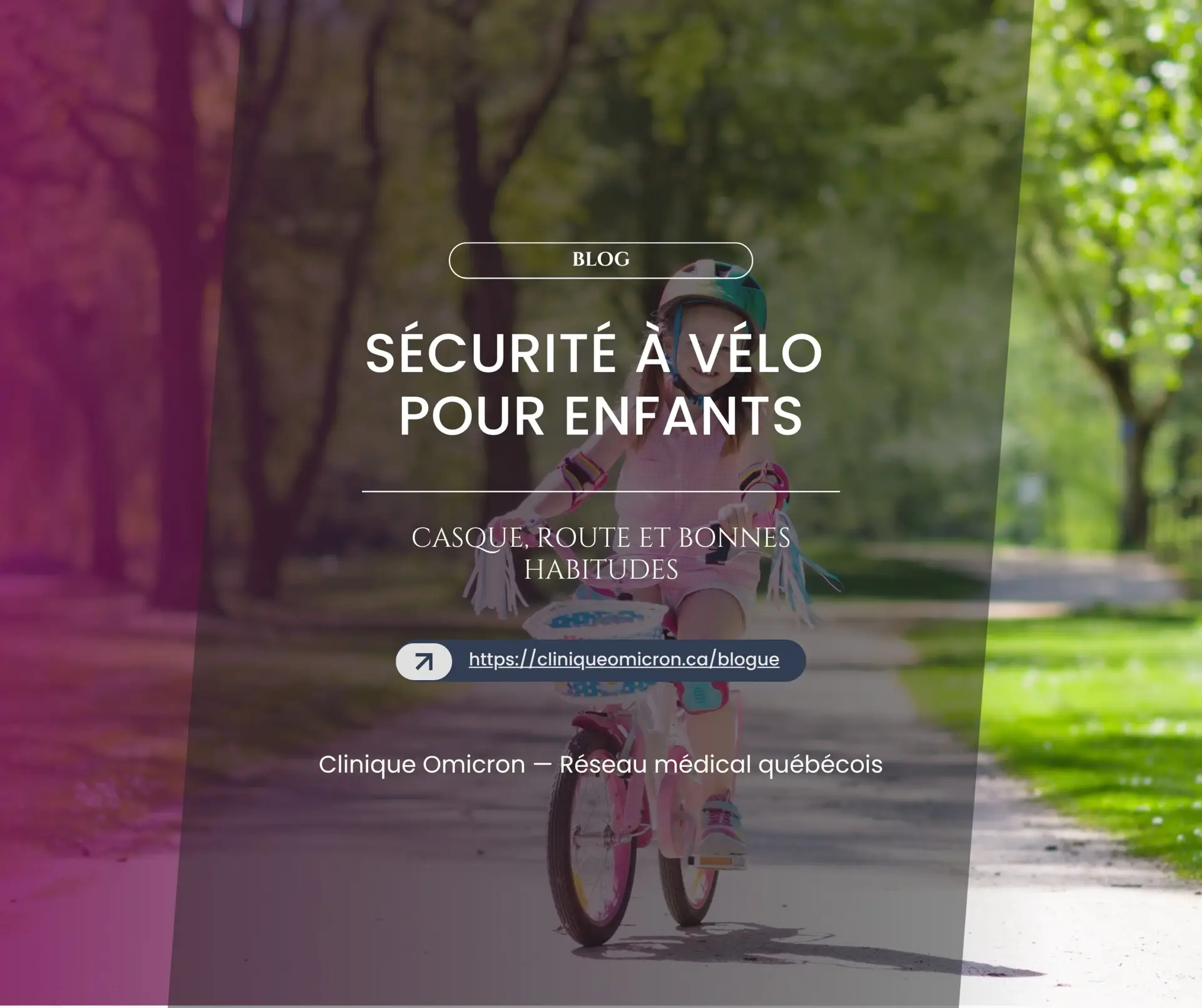

Visit bike is one of the best physical activities for children: it develops the’balance, l'endurance and the’autonomy [1]. It is also associated with a significant proportion of emergency room visits for trauma during the summer [2]. The majority of these injuries are avoidable along with a few basic rules. This article covers what really matters: helmets, traffic rules, visibility, equipment, the appropriate age, and what to do in the event of a fall.
On this page
- A helmet: a must
- Adjust the helmet properly
- Traffic Rules to Teach
- Visibility and Equipment
- At what age can you drive?
- The Stages of Learning
- If You Fall: What to Do
- Myths and Misconceptions
- Frequently asked questions
- Sources
A helmet: a must
Visit helmet is the most effective protective measure against severe head injuries by bike [1][2].
What the Research Says
- Wearing a helmet reduces the risk by more than 60 % the risk of severe head injury [1]
- In Quebec, wearing a helmet is not required required by law for cyclists in general (except in certain competitions), but it is highly recommended by Parachute Canada, the SAAQ, and the INSPQ [2][3]
- Several municipalities Quebec regulations make it mandatory in parks and on bike paths
- The recommendations are universal : children and adults alike
- Helmets are required for occupants a bicycle seat, a trailer, or a cargo bike
Key Takeaways
- Visit helmet is the most effective measure for preventing serious head injuries among children who ride bicycles [1]
- L’adjustment The fit of the helmet is just as important as wearing it: two fingers’ width between the eyebrows, V-shaped straps under the ears, and a chin strap with a one-finger gap.
- Visit traffic rules must be taught early on and reviewed every summer
- Visit visibility (light-colored clothing, reflective strips, front and rear lights at night) is essential
- L’age Whether a child can ride a bike on their own depends on their maturity—around age 10 in areas with traffic
- A a properly fitted bike and properly maintained (tuning, tires, brakes) helps prevent some falls
- After a fall In cases of head trauma, monitor for neurological signs and seek medical attention if necessary
Adjust the helmet properly
A ill-fitting helmet offers little protection. The fitting technique is simple and can be verified in just a few seconds.
4 Things to Check
- Position : 2 fingers between the eyebrows and the front edge of the helmet
- Straps : form a V just below each ear
- Chin Strap : A finger's width of space between the strap and the chin; the helmet should not tip back when the child opens his or her mouth
- Stability : The helmet does not slide back and forth or side to side when the child shakes his or her head
Choosing the Right Headset
- Certification : CSA, CPSC, or Snell, depending on the helmet
- Check the label on certification inside the helmet
- Try it Try on the helmet with your child before buying it
- Check date of manufacture — helmets deteriorate over time (5 to 10 years, depending on the model)
- Replace after any significant impact, even if there are no visible cracks
- Adjust the size as the child grows
- Avoid used helmets of unknown origin
Make Wearing a Helmet a Habit
- Model : Parents and siblings also wear their helmets
- No cycling without a helmet from the very first outing
- Check adjusting it before each outing
- Involve the child in choice the helmet (color, design) so that he'll like it
- Expand The rule applies to similar activities: skateboarding, scootering, and inline skating
- Reinforce encouraging helmet use (congratulations, stickers for the youngest children)
Traffic Rules to Teach
In Quebec, the Traffic Safety Code considers a bicycle to be a vehicle. The traffic rules must be taught gradually and reviewed each year [3].
The Basic Rules
- Drive on the right, in the direction of traffic
- Respect stops and traffic lights
- Report his intentions (arm outstretched to turn or stop)
- Check both ways before crossing an intersection
- Get off the bike at crosswalks
- Make eye contact with drivers
- Maintain a distance Safety hazard due to parked cars (risk of a door opening)
- Drive in a way that predictable and in single file when riding in a group
- Avoid headphones and the phone while on the go
Where to Ride Based on Age
- Sidewalk : generally prohibited by municipal regulations for adults; tolerated in several cities for young children—check local regulations
- Bicycle path : recommended, especially for learners
- Shared Lanes and bike lanes : Stay alert; watch your blind spots
- Small residential streets : possible as soon as the child has mastered the rules, with supervision
- Main Arteries : Should be avoided before adolescence, unless under close supervision
Visibility and Equipment
To be seen, day and night
- Light-colored clothing or reflective strips
- White lighthouse at the front and red light at the rear at night (required by the Highway Safety Code)
- Reflectors Mandatory requirements for pedals and spokes
- Bell or doorbell in good condition
- Avoid loose-fitting clothing that can get caught in the chain
- Backpack stable, with no hanging cords
The bike itself
- The Right Size Bike : Learners should sit with both feet flat on the floor; children who are comfortable doing so may rest the tips of their toes on the floor
- Tires properly inflated (pressure indicated on the sidewall of the tire)
- Functional barriers, checked regularly
- Channel lubricated and properly tensioned
- Saddle adjusted to the correct height
- Handles in good condition, non-slip
- Fender and chain guard useful for preventing injuries and stains
- Child Seats, trailers, or cargo bikes that meet the standards for young passengers
Some useful additional equipment
- Knee Pads and elbow pads for beginners or for more challenging activities (BMX, mountain biking)
- Gloves cycling gloves to get a better grip on the handlebars and protect your palms in case of a fall
- Glasses protection from the sun, wind, and insects
- Padlock sturdy to prevent theft
- A small pencil case repair kit (inner tube, tire lever, pump) for longer rides
At what age can you drive?
There is no no magic age : It depends on the the child's maturity, their ability to anticipate, to follow the rules, and the’environment (park vs. busy street). Pediatricians recommend a close supervision up to about 10 years in high-traffic areas [4].
Maturity Criteria to Be Observed
- Ability to respect always stop at stop signs and traffic lights
- Anticipation dangers (cars, pedestrians, obstacles, blind turns)
- Control cycling around corners, during emergency stops, and on hills
- Ability to report his intentions without throwing the bike off balance
- Concentration and the ability to ignore distractions
- Judgment on unforeseen situations
- Knowledge his background and ability to find his way
Typical Progression
| Approximate age | Environment | Supervision |
|---|---|---|
| 3 to 5 years old | Sidewalk, walkway, traffic-free park | Adult in the immediate vicinity |
| Ages 5 to 7 | Small parks, bike paths, residential streets | Close supervision |
| 7 to 10 years | Bike paths and low-traffic residential streets | Constant Supervision |
| Ages 10 to 12 | Residential roads and streets, short trips | Less strict supervision if maturity is demonstrated |
| Ages 12 and up | Traveling independently, possibly to school if the environment is safe | Regular reminders of the rules |
These guidelines are for reference only and should be adapted to each child’s individual profile and environment.
The Stages of Learning
Before the classic bicycle
- Tricycle and push-along ride-ons for children ages 2 to 3 to help develop motor skills
- Balance Bike (without pedals): a great way for children ages 2 to 4 to develop their sense of balance
- The balance bike facilitates often the transition to a regular bike, sometimes without using training wheels
- Small wheels : still used by some, but often less effective than a balance bike
Learning to Ride a Bike Safely
- Choose a safe environment : park, closed driveway, empty parking lot
- Start with the braking (often overlooked)
- Learn how to look far ahead, not the front wheel
- Practice the turns at low speed
- Work on the startup and the balancing stop
- Increase gradually Difficulty and Environment
- Be patient : Every child learns at their own pace
Developing driving reflexes
- Riding Together and say the following out loud («I’m looking both ways,» «I’m signaling right»)
- Do play role-playing in simulated situations
- Review at the start of each season
- Take advantage of the bicycle safety class offered by certain municipalities, schools, or organizations
- Encourage gradual responsibility (starting with a well-known, frequently traveled route)
Did your child take a fall while riding a bike, and are you concerned? Omicron Clinic offers pediatric care and medical evaluations following an injury at our locations in Quebec, with teleconsultations available for prompt referral. Make an appointment or opt for the teleconsultation.
If You Fall: What to Do
First Steps
- Secure locations (get out of traffic, signal to other road users)
- Calm the child and quickly assess the situation
- Check Breathing and the State of Consciousness
- Do not move the child if a serious injury is suspected (neck, back, deformed leg)
- Call the 911 in the event of loss of consciousness, severe bleeding, deformity, or if you are unsure
- Clean the scrapes and apply a bandage
- Apply cold on bumps or bruises
Warning Signs
- Loss of consciousness, even briefly
- Vomiting repeated
- Headaches that are serious or getting worse
- Confusion, abnormal drowsiness, unusual behavior
- Convulsions
- Challenges inability to move a limb, asymmetric weakness
- Bleeding that won't stop or a deep wound
- Deformation obvious sign of a member
- Pain thoracic or abdominal exercises
- Any blow to the head in a young child warrants an evaluation
Concussion
- A concussion may occur without loss of consciousness
- Possible symptoms: headaches, dizziness, sensitivity to light or noise, difficulty concentrating, irritability, sleep disturbances
- Monitor for 24 to 48 hours when in doubt
- Cognitive Rest and physical activity at first, followed by a gradual return to activities
- View promptly if symptoms persist or worsen
- Replace the helmet after a significant impact, even if there are no visible cracks
- Do not resume exercise or cycling while symptoms persist; ideally, consult a doctor first.
Myths and Misconceptions
«You don't need to wear a helmet in an alley or a park.»
False. Most serious falls among children occur at low speed, often near home. A helmet should be worn when every outing, even if it's very short.
«My child is too young to ride a bike with a helmet.»
False. Whenever a child uses a bicycle, a bike trailer, a child seat, or a trailer, a helmet appropriate for his size is recommended. For very young children in a child safety seat, make sure their head is properly supported and their helmet fits snugly.
«It's better to have a helmet that's too big than one that's too small.»
False. A helmet too big It moves around and doesn't absorb shock properly. You need a helmet. well-fitting at the child's current size, even if it means replacing it as the child grows. Many helmets have an adjustment dial that extends their usable life.
«Training wheels are necessary for learning.»
No. Visit balance bike (without pedals) is often more effective for developing balance, which is key to riding a bike. Small wheels can sometimes slow down the process of learning to balance.
«If there are no cracks, the helmet is still safe to use after a fall.»
False. Visit internal foam The helmet absorbs the impact by deforming. This deformation isn't always visible, but the helmet has lost some of its protective capacity. Replace the helmet after any significant impact.
Frequently asked questions
At what age can a child ride a bike alone in Quebec?
There is no age specified by law, but pediatricians recommend a close supervision Up to about 10 years old in areas with traffic. Beyond that, it depends on the child’s maturity and the environment. A familiar, well-known route with little traffic can be attempted earlier, provided there are clear guidelines.
How long does a helmet remain effective?
Most manufacturers recommend replacing it after 5 to 10 years, or after any significant impact, or if the helmet has become too small. The inner foam deteriorates over time, due to sun exposure and heat. Check the manufacturing date inside the helmet.
Is wearing a helmet mandatory in Quebec?
No, wearing a helmet is not required under provincial law for cyclists in general. However, it is highly recommended by public health authorities and required in certain competitions, parks, and bike paths, depending on municipal regulations. Several cities require it in their own regulations.
Can a child ride a bike on the sidewalk?
The general rule in most Quebec municipalities is that the Cycling on the sidewalk is prohibited. Several cities allow an exception for young children (under 10 or 12 years old, depending on the municipality). Check local regulations and stick to bike paths and low-traffic streets.
My child fell but didn't lose consciousness. Should I take him or her to the doctor?
Monitor for 24 to 48 hours Signs of a concussion: severe headache, vomiting, unusual drowsiness, confusion, and balance problems. If you have any doubts, or if the child is very young, it’s best to seek medical attention right away. Any head injury in a child under 2 years of age requires a medical evaluation.
What should you do if your child doesn't like the helmet?
Involve the child in the choice of the helmet (color, design). Set a good example by wearing your own helmet. Explain simply why («just like a seatbelt in a car»). Make the rule non-negotiable : No helmet, no bike. Over time, it becomes second nature.
Sources
- Parachute Canada. Bicycle Safety and Helmet Tips.
- INSPQ — Quebec National Institute of Public Health. Bicycle-Related Injuries in Quebec.
- SAAQ — Quebec Automobile Insurance Corporation. Cyclists and Road Safety.
- Canadian Paediatric Society. Recommendations on Children's Bicycle Safety.
- Vélo Québec. Learning to Ride Safely in Quebec.
- Ministry of Health and Social Services (MSSS). Child Injury Prevention.
- Quebec Ministry of Transportation and Sustainable Mobility. Traffic Safety Code and Cyclists.
Medical consultation | Clinique Omicron
Omicron Clinic
Need to consult a doctor?
In-person or via telemedicine, anywhere in Quebec.
We accept insurance. Telemedicine consultations available 7 days a week. No family doctor required.