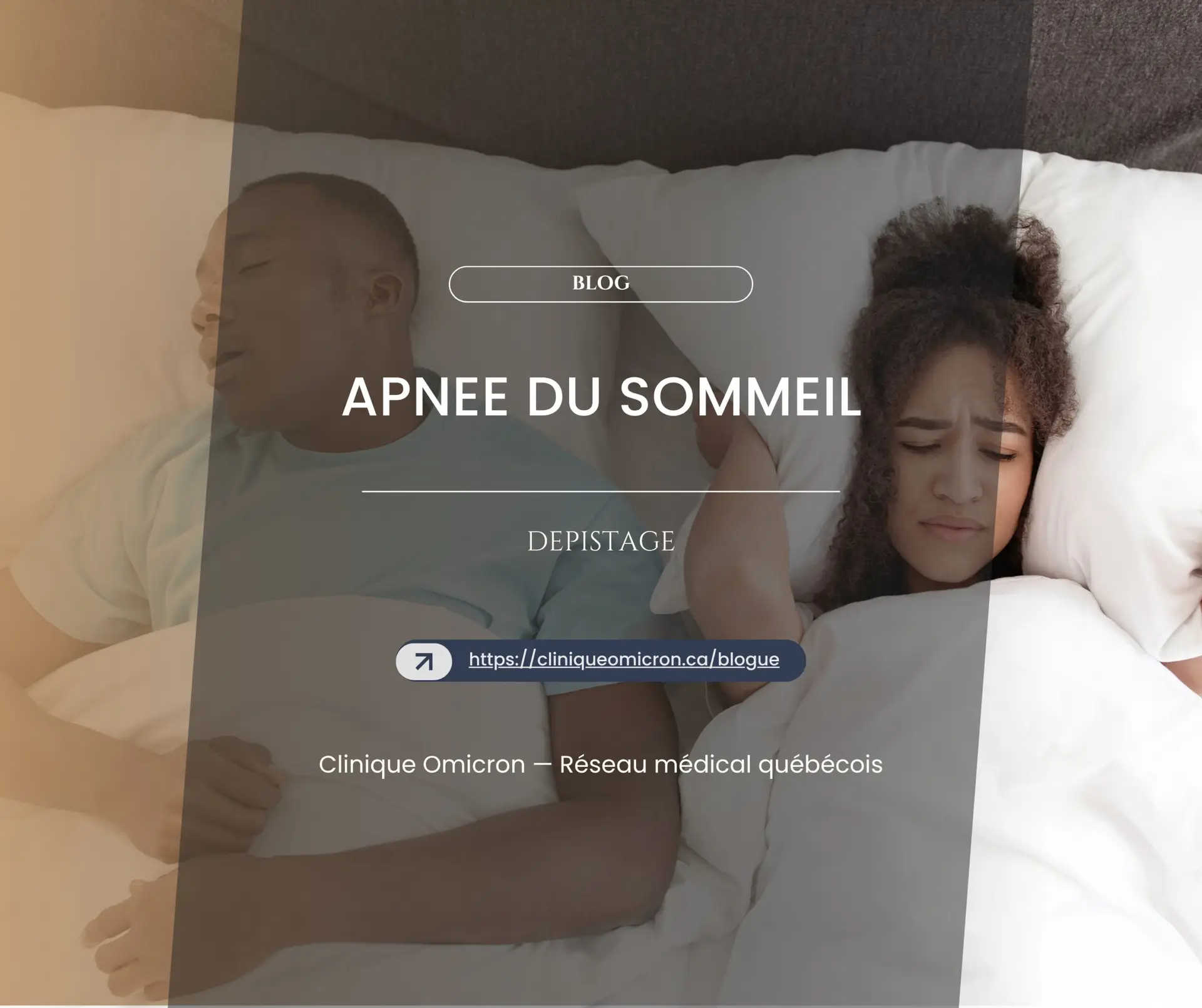

L’apnée du sommeil est un trouble respiratoire qui survient la nuit, souvent sans que la personne en soit consciente. Des milliers de Québécois en souffrent sans le savoir. La fatigue chronique, les maux de tête matinaux et le ronflement bruyant signalés par un partenaire de lit sont parfois les seuls indices. Pourtant, non traitée, l’apnée du sommeil augmente le risque de maladies cardiovasculaires, de diabète et d’accidents de la route liés à la somnolence.
Cette page explique ce qu’est l’apnée du sommeil, comment la reconnaître, comment elle est dépistée et quelles options de traitement sont disponibles au Québec.
Qu’est-ce que l’apnée du sommeil ?
L’apnée du sommeil se définit par des arrêts répétés de la respiration pendant le sommeil, d’une durée d’au moins dix secondes, survenant plusieurs fois par heure. Ces pauses respiratoires perturbent la qualité du sommeil et privent le cerveau et les organes d’un apport adéquat en oxygène.
There are three main forms:
- L’apnée obstructive du sommeil (AOS) — the most common. It occurs when the throat muscles relax too much during sleep, partially or completely blocking the upper airway.
- L’apnée centrale du sommeil — plus rare. Le cerveau n’envoie pas les bons signaux aux muscles respiratoires. Souvent associée à des maladies cardiaques ou neurologiques.
- L’apnée mixte — a combination of the two previous forms.
On classe la sévérité en fonction de l’index d’apnées-hypopnées (IAH) : légère, modérée ou sévère selon le nombre d’événements respiratoires par heure de sommeil.
Who is at risk?
L’apnée obstructive du sommeil peut toucher n’importe qui, mais certains facteurs augmentent le risque :
- Male sex (men are more affected, although the risk increases in women after menopause)
- Overweight or obesity, especially with fat accumulation in the neck and throat area
- Anatomy of the upper airway: thick neck, receded jaw, enlarged tonsils
- Consommation d’alcool ou de sédatifs, qui relâchent davantage les muscles de la gorge
- Smoking
- Histoire familiale d’apnée du sommeil
- Chronic nasal congestion or deviated septum
- Certain medical conditions: hypothyroidism, PCOS, acromegaly
Children can also be affected, often in connection with enlarged tonsils or adenoids.
Symptoms to recognize
La difficulté avec l’apnée du sommeil, c’est que la personne atteinte dort pendant les épisodes et n’en a souvent aucun souvenir. Ce sont fréquemment les partenaires de lit ou les membres de la famille qui alertent en premier.
Nighttime symptoms
- Loud and irregular snoring, sometimes interrupted by silences (pauses)
- Breaths observed by a third party
- Réveils brusques avec sensation d’étouffement ou de suffocation
- Restless sleep, frequent position changes
- Nocturies (besoin d’uriner plusieurs fois par nuit)
- Excessive nighttime transpiration
- Bruxism (teeth grinding)
Daytime symptoms
- Significant fatigue upon waking, even after a full night's sleep
- Somnolence excessive en journée — tendance à s’endormir au volant, au bureau, devant la télévision
- Morning headaches
- Difficulty concentrating, memory problems
- Irritabilité, sautes d’humeur
- Dry mouth upon waking
Les conséquences d’une apnée non traitée
L’apnée du sommeil n’est pas un simple inconfort. Non prise en charge, elle est associée à des risques sérieux pour la santé :
- Hypertension artérielle — les baisses répétées d’oxygène stimulent le système nerveux sympathique et font augmenter la pression artérielle
- Maladies cardiovasculaires, incluant les arythmies cardiaques, l’insuffisance cardiaque et un risque accru d’infarctus et d’AVC
- Diabète de type 2 — la résistance à l’insuline est aggravée par la privation de sommeil et les hypoxies nocturnes répétées
- Road accidents — drowsy driving is a direct consequence of insufficient restorative sleep
- Depression and anxiety — chronic sleep disorders have a direct impact on mental health
Comment l’apnée du sommeil est-elle dépistée ?
Initial medical consultation
Le point de départ est une consultation avec un médecin, qui évaluera vos symptômes à l’aide de questionnaires standardisés (comme l’échelle de somnolence d’Epworth ou le questionnaire STOP-Bang). Un examen physique de la gorge, du nez et du cou complète l’évaluation.
Home overnight respiratory polygraphy
Dans de nombreux cas au Québec, le dépistage se fait avec un appareil portable que la personne utilise chez elle pendant une nuit. Cet appareil mesure le flux d’air, les mouvements thoraciques, la saturation en oxygène et la fréquence cardiaque. Il est moins complet qu’une polysomnographie en laboratoire, mais suffit souvent pour confirmer un diagnostic d’apnée obstructive modérée à sévère.
In-lab polysomnography
L’examen de référence est la polysomnographie réalisée dans une clinique du sommeil. Elle enregistre en détail le sommeil, la respiration, l’activité cérébrale (EEG) et les mouvements musculaires. Elle est recommandée quand le diagnostic est incertain, quand on suspecte une apnée centrale, ou quand une titration CPAP doit être réalisée simultanément. Les délais d’attente dans le système public québécois peuvent être longs — des options privées existent.
Available treatments
Le traitement de référence de l’apnée obstructive modérée à sévère est l’appareil à pression positive continue (CPAP, ou PPC en français). Porté la nuit, un masque nasal ou facial est relié à une petite machine qui maintient les voies aériennes ouvertes grâce à un flux d’air continu. Bien toléré une fois l’adaptation faite, il supprime les apnées, améliore la saturation en oxygène et restaure la qualité du sommeil. Les effets sur la fatigue, la concentration et la pression artérielle peuvent être remarquables.
Au Québec, la RAMQ couvre partiellement les appareils CPAP pour les personnes dont le diagnostic est confirmé et qui rencontrent certains critères. Des conditions précises s’appliquent — votre médecin peut vous informer de votre admissibilité.
Pour les apnées légères à modérées, une orthèse sur mesure fabriquée par un dentiste ou un orthodontiste peut repositionner la mâchoire et la langue vers l’avant pendant le sommeil, réduisant ainsi l’obstruction. Elle est moins efficace que le CPAP pour les apnées sévères, mais mieux tolérée par certaines personnes.
La perte de poids, quand elle est possible et cliniquement pertinente, peut réduire significativement la sévérité de l’apnée. Éviter l’alcool et les sédatifs en soirée, dormir sur le côté plutôt que sur le dos, et traiter la congestion nasale chronique sont des mesures complémentaires utiles.
Dans des cas sélectionnés, des interventions chirurgicales sur les structures des voies aériennes supérieures (amygdalectomie, uvulopalatopharyngoplastie, chirurgie nasale, avancement maxillo-mandibulaire) peuvent être envisagées, surtout quand une anomalie anatomique précise est identifiée ou quand le CPAP est impossible à tolérer. La chirurgie n’est pas recommandée en première ligne pour la majorité des patients.
Sleep apnea and mental health
La fatigue chronique, les troubles de la concentration et les réveils nocturnes répétés ont un impact direct sur l’humeur et la santé mentale. La dépression et l’apnée du sommeil coexistent fréquemment — parfois dans les deux sens : la dépression perturbe le sommeil, et l’apnée non traitée aggrave la dépression. Si vous présentez des symptômes des deux conditions, il est important de les aborder toutes les deux avec votre médecin.
Sleep apnea and driving
La somnolence excessive liée à l’apnée du sommeil non traitée représente un risque réel pour la sécurité routière. Au Québec, la Société de l’assurance automobile du Québec (SAAQ) exige que les médecins signalent les patients dont la condition médicale peut affecter l’aptitude à conduire. Un diagnostic d’apnée sévère non traitée peut entraîner des restrictions temporaires du permis de conduire jusqu’à ce qu’un traitement efficace soit en place.
When to see a doctor
Consult a health professional if you or your partner notice:
- Loud, regular snoring
- Breathing pauses during sleep
- Une fatigue persistante malgré un nombre suffisant d’heures de sommeil
- Excessive daytime sleepiness that interferes with your functioning
- Frequent headaches upon waking
- Des réveils avec une sensation d’étouffement
Ne minimisez pas ces symptômes. L’apnée du sommeil est une condition traitable — et le traitement peut transformer la qualité de vie.
Our doctors can assess your symptoms, complete a screening questionnaire with you, and refer you to appropriate tests or specialists. A teleconsultation is available if you wish to discuss your situation from home—our service points in Quebec offer access to healthcare tailored to your daily life.
Teleconsultation in Quebec — Private Online Doctor | Omicron Clinic
Omicron Clinic
Need to consult a doctor?
En clinique ou en télémédecine, partout au Québec.
Reçus pour assurances. Téléconsultation 7 j/7. Sans médecin de famille requis.