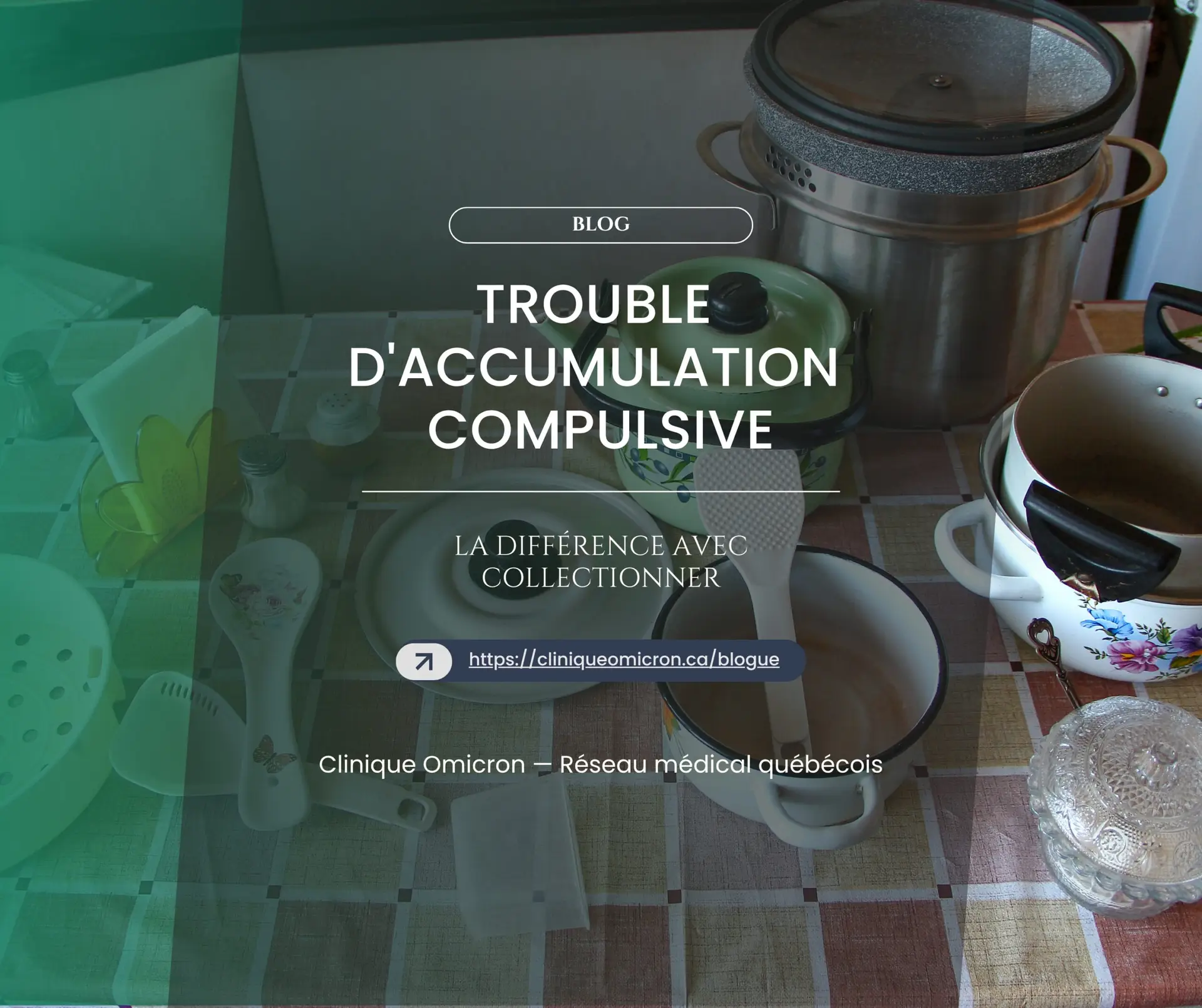

A few stacks of newspapers in the living room don't make a Hoarding disorder. Mais quand l’entassement envahit progressivement les pièces, rend les surfaces inutilisables, met la sécurité en jeu et isole la personne, on parle d’une condition clinique reconnue depuis 2013 dans le DSM-5 the Compulsive hoarding disorder (CHOD), also called Syllogomania or hoarding disorder This article explains its definition, what distinguishes it from collection, its risks, its causes, and the resources available in Quebec to support affected individuals and their loved ones.
On this page
- Définition clinique du TAC
- Différence avec le fait de collectionner
- Risques pour la santé et la sécurité
- Causes and associated conditions
- What assistance is available
- Comment réagir comme proche
- Ressources au Québec
- Mythes et idées reçues
- Frequently asked questions
- Sources
Définition clinique du TAC
According to the DSM-5 [1], le trouble d’accumulation se caractérise par quatre éléments essentiels :
Les critères diagnostiques
- A difficulté persistante to get rid of or part with possessions, regardless of their value
- A détresse marquée à l’idée de jeter ces objets
- A accumulation who clutters living spaces to the point of compromising their use
- A suffering or dysfunction significant social, professional, or security
Which makes it a recognized clinical condition
- Sa official reconnaissance in the DSM-5 (2013) and then the ICD-11 (2022) made it a full diagnostic entity [2]
- Visit prévalence is estimated to be between 2 and 6% of the adult population
- Le trouble débute souvent à l’adolescence ou au début de l’âge adulte, but becomes clinically significant after 40 to 50 years of age
- The évolue lentement et tend à s’aggraver avec l’âge sans intervention
- He's’accompany souvent d’une grande honte et d’un repli social
- The touche both men and women, all socio-economic levels
À retenir
- Visit Compulsive hoarding disorder is a condition recognized in the DSM-5 since 2013 [1]
- Il se distingue d’un simple « désordre » par l’impact fonctionnel et la détresse
- The n’a rien à voir with laziness or a lack of willpower
- The can associate à d’autres conditions (TOC, dépression, anxiété, TDAH, autisme, traumatismes)
- Visit TCC spécifique au TAC (Steketee et Frost) est l’approche la mieux documentée [3]
- Force fries without accompaniment generally worsens the problem
- Several resources available in Quebec: Info-Social 811, CLSC, Order of Psychologists, specialized programs [4]
Différence avec le fait de collectionner
Collectionner et accumuler ne sont pas la même chose, même quand les espaces sont remplis d’objets. Le critère central reste l’Functional impact And the détresse.
Caractéristiques de la collection
- Selected items with a specific theme
- Organisés, classified, inventoried, sometimes
- Exposés with care, accessible, highlighted
- Source of fierté and shared pleasure with loved ones
- Living space that remain functional
- Échanges et discussions avec d’autres collectionneurs
Caractéristiques de l’accumulation pathologique
- Objets entassés without organization, without theme
- Difficulté persistent in separating from these objects, regardless of their value
- Source of shame, dissimulée à l’entourage
- Les pièces de vie sont encombrées to the point where they can no longer be used normally
- Reply Social, isolation, refusal to receive visitors
- Détresse à l’idée de jeter, anxiété marquée, indécision
Tableau récapitulatif
| Aspect | Collection | Accumulation |
|---|---|---|
| Object Selection | Thématique, ciblé | Sans thème, indifférencié |
| Organization | Ranking, inventory | Pile |
| Affect | Fierté, plaisir | Honte, anxiété |
| Living space | Stay functional | Becomes unusable |
| Social relationship | Échanges, partage | Repli, isolement |
| Possibilité de se séparer | Présente | Très limitée, détresse marquée |
Risques pour la santé et la sécurité
Visit TAC n’est pas seulement un problème esthétique ou de propreté. Il comporte des risques réels for physical, mental, and social health, particularly among seniors and vulnerable individuals [2].
The main risks
- Increased risk of’fire (combustible materials, blocked exits, electrical overload)
- Falls, especially among seniors
- Sanitary conditions deteriorated, infestations (rodents, insects, mold)
- Difficulté d’accès des services d’urgence (ambulance, pompiers) en cas d’événement aigu
- Social isolation, depression, anxiety
- Family conflicts, ruptures de liens, risque d’éviction du domicile
- Problèmes Respiratory issues related to dust, mold, and confinement
- Aggravation difficulty managing chronic illnesses (inability to find medications, to cook adequately)
- Risk reporting to municipal authorities or protection services
Pourquoi les aînés sont plus vulnérables
- Visit TAC tend à s’aggraver avec l’âge, en l’absence d’intervention
- Visit chutes are more frequent and more severe in the elderly
- Visit capacités physiques et cognitives diminuent, rendant l’organisation des objets plus difficile
- Visit loss of independence accentue l’encombrement
- Isolation Social and increased risk of depression
- Visit maintien à domicile can become difficult or impossible
Causes and associated conditions
Visit TAC may appear alone or s’associer à d’autres conditions. There are also neurobiological components related to prise de décision et à l’attachement émotionnel aux objets [3].
Conditions fréquemment associées
- Obsessive-compulsive disorder (OCD) and other anxiety disorders
- Depression Major or chronic depressive symptoms
- Anxiety Generalized social anxiety
- ADHD (trouble du déficit de l’attention avec ou sans hyperactivité)
- Autism spectrum disorder
- Séquelles d’événements traumatisants (deuils non résolus, traumatismes complexes)
- Démence early neurocognitive disorders, to differentiate or combine
- Difficultés d’exécutivité (planification, organisation, prise de décision)
Understanding attachment to objects
- Beaucoup de personnes touchées assigning a meaning specific to objects: memories, potential, identity
- L’anxiété de jeter dépasse largement la valeur réelle de l’objet
- Visit fear of regret or missing takes up a lot of space
- Visit difficulté à décider ce qui mérite d’être gardé est centrale
- The Sorting imposé par autrui réactive souvent l’anxiété et renforce le comportement
Facteurs déclencheurs ou aggravants
- Mourning and significant losses
- Ruptures, Separations, divorce
- Diseases chronicles, hospitalizations
- Retirement, loss of social role
- Précarité économique afraid of missing out
- Isolation Socializing and a decrease in family contact
- Antécédents familiaux d’accumulation
What assistance is available
Visit TAC is treated. Several approaches have proven effective, especially when combined and sustained over time. The Collaboration between professionals, the person and their environment are essential [3].
Les principaux outils thérapeutiques
- Cognitive Behavioral Therapy (CBT) spécifique au TAC selon le protocole de Steketee et Frost, l’approche la mieux documentée [3]
- Médication in some cases, notably SSRIs and treatments for comorbidities (OCD, depression, anxiety)
- Support d’un travailleur social ou psychologue pour accompagner sur la durée
- Programs specializing (for example, the Morbid Insalubrity Center in Montreal)
- Approach motivationnelle pour soutenir l’engagement de la personne dans la démarche
- Groups support (in-person or online) for those affected and their loved ones
- Respectful implication close relations, trained in non-confrontational support
À quoi ressemble une TCC pour le TAC
- Évaluation détaillée des pièces, du niveau d’encombrement, des fonctions affectées
- Repérage Thoughts, beliefs, and emotions associated with objects
- Exposition progressive sorting and separation
- Entraînement to decision making and problem solving
- Work sur les habitudes d’acquisition (achats compulsifs, gratuités, dons reçus)
- Maintenance Progress and relapse prevention
- Le travail s’étale habituellement sur several months, sometimes more, and requires patience
Place de la médication
- Visit médication n’est pas la première ligne de traitement à elle seule
- Elle peut être useful in the presence of significant comorbidities (depression, OCD, severe anxiety)
- Visit SSRIS are the most studied, in combination with CBT
- Visit décision is handled on a case-by-case basis, in collaboration with the doctor or psychiatrist
- A réévaluation regular monitoring of profits and side effects is essential
Comment réagir comme proche
For Neighbors, l’accumulation est souvent une source de conflit, d’inquiétude et d’impuissance. Quelques repères help to better support, without worsening the situation.
What helps
- Reconnaître qu’il s’agit d’une condition de santé, pas d’un défaut moral
- Address the subject with respect, without threats or ultimatums
- Emphasize sur la sécurité et la qualité de vie plutôt que sur l’apparence
- Proposer de l’aide concrète (rendez-vous, accompagnement, information)
- Respect The person's pace, accept small progress
- Request Advice for professionals before any massive sorting
- Take care to oneself as close, to seek support
Ce qui aggrave généralement la situation
- Force un tri massif sans accompagnement (déclencheur fréquent d’aggravation et de honte)
- Throw hiding the person's objects
- To reproach the situation, to infantilize, to make humiliating comparisons
- Impose an unrealistic tidying up deadline
- Insist on «will» as the sole explanation
- Cut links without support or alternative
When to alert quickly
- Risk imminent d’incendie ou d’effondrement
- Présence d’enfants ou de personnes vulnérables dans le domicile
- Injuries recurrent, repeated falls
- Infestations major, serious sanitary conditions
- Détresse important to the person, suicidal thoughts
- Risk d’éviction imminent
In case of’idées suicidaires or significant distress, resources are available at all times in Quebec: 1 866 APPELLE (1-866-277-3553) for suicide prevention and Info-Social 811, option 2, for 24-hour psychosocial support.
Ressources au Québec
Several resources peuvent intervenir au Québec, selon la gravité, l’âge et les conditions associées [4].
Premières portes d’entrée
- Info-Social 811, option 2 — 24-hour psychosocial support
- CLSC — access to a social worker, a psychologist, home services
- Family doctor Medical consultation — initial evaluation, orientation, comorbidity management
- Ordre des psychologues du Québec Directory to find a CBT-trained psychologist [5]
- Programs specializing such as the Center for Morbid Insalubrity in Montreal
- Organisms community (caregivers, mental health, seniors)
Actors who can intervene depending on the situation
- Social worker du CLSC : évaluation globale, soutien à long terme, lien avec d’autres ressources
- Ergothérapeute : évaluation de la sécurité et de l’autonomie au domicile
- Psychologist trained in CBT for ADHD
- Psychiatrist for complex cases or in the presence of significant comorbidities
- Doctor for the management of physical comorbidities and coordination
- Municipal inspectors ou services d’incendie en cas de risque imminent
- Public curator or other devices in case of proven loss of decision-making capacity
Vous ou un proche vivez avec une accumulation qui inquiète ? Clinique Omicron offre une première évaluation médicale en santé mentale et l’orientation vers les ressources appropriées à nos points de service au Québec, avec téléconsultation possible pour la première discussion. Make an appointment or opt for the teleconsultation to start the process.
Mythes et idées reçues
« C’est juste de la paresse ou un manque de volonté »
False. Le TAC est une condition reconnue dans le DSM-5 et la CIM-11. Il implique des mécanismes cognitifs, émotionnels et parfois neurobiologiques. Réduire le problème à la volonté empêche les personnes concernées de chercher de l’aide et renforce la honte.
« Il suffit de faire un grand ménage »
False. Le « grand ménage » imposé est rarement durable. Sans travail sur les pensées, les émotions et les habitudes d’acquisition, l’accumulation revient. La démarche thérapeutique vise précisément à travailler ces dimensions dans la durée.
« Le TAC concerne seulement les aînés »
False. Le trouble commence souvent à l’adolescence ou au début de l’âge adulte. Il devient toutefois plus visible et plus invalidant après 40 à 50 ans, en raison de l’accumulation prolongée et de la diminution des capacités d’organisation avec l’âge.
« Ce n’est pas un vrai problème de santé »
False. Le TAC est associé à un risque accru de chutes, d’incendies, d’infestations, d’isolement social, de dépression et même de perte de logement. Son impact sur la santé physique, mentale et sociale est documenté. Il mérite une attention clinique comme toute autre condition de santé mentale.
« Une fois qu’on commence à accumuler, on ne peut plus s’en sortir »
False. L’évolution dépend beaucoup de l’accès aux soins et du soutien reçu. Plusieurs personnes améliorent leur situation grâce à la TCC, à la médication des comorbidités et à un accompagnement social soutenu. Les progrès peuvent être lents, mais ils sont réels.
Frequently asked questions
À partir de quand parle-t-on de trouble d’accumulation ?
It's not about the number of objects, but the’impact. Quand l’accumulation rend les pièces inutilisables, met en jeu la sécurité, isole socialement et génère une détresse, on entre dans le cadre clinique du TAC. Un avis médical ou psychologique permet de poser le diagnostic.
Le TAC est-il lié au TOC ?
Le TAC a longtemps été considéré comme un sous-type de TOC. Depuis le DSM-5, il est reconnu comme un trouble distinct, mais peut coexister avec un TOC ou d’autres conditions. Les approches thérapeutiques sont proches mais adaptées à la spécificité du TAC.
How long does the treatment last?
La TCC du TAC s’étale habituellement sur plusieurs mois, parfois plus, selon la sévérité, l’engagement de la personne et la présence de comorbidités. Le travail vise des changements durables, et non un « grand ménage » unique. Le soutien social et thérapeutique est souvent prolongé.
Y a-t-il un médicament spécifique du TAC ?
Il n’existe pas, à ce jour, de médicament approuvé spécifiquement pour le TAC. Les ISRS et certains autres traitements peuvent être utilisés en présence de comorbidités (TOC, dépression, anxiété). La décision médicamenteuse est individualisée.
What to do if the person refuses help?
C’est une situation fréquente. Maintenir le lien, éviter la confrontation et privilégier les arguments de sécurité et de qualité de vie aide souvent à faire évoluer la situation. Les professionnels peuvent guider l’entourage sur la meilleure manière d’aborder le sujet. En cas de danger imminent, il faut alerter les services concernés (incendie, services municipaux, ligne 811).
Est-ce que les enfants peuvent développer un TAC ?
Des comportements d’accumulation peuvent apparaître dès l’enfance ou l’adolescence, mais le diagnostic formel se fait plutôt chez l’adulte. La présence de ces comportements chez un enfant ou un adolescent justifie une évaluation pour explorer un éventuel TAC en construction, un TOC, un TDAH ou d’autres conditions associées.
Sources
- American Psychiatric Association. DSM-5 — Trouble d’accumulation compulsive (Hoarding Disorder).
- Organisation mondiale de la Santé (OMS). CIM-11 — Hoarding disorder.
- Steketee G., Frost RO. Treatment for Hoarding Disorder, Oxford University Press.
- Ministère de la Santé et des Services sociaux du Québec. Services en santé mentale et soutien psychosocial.
- Ordre des psychologues du Québec. Directory of psychologists and information on care.
- INESSS — Institut national d’excellence en santé et en services sociaux. Guides et avis en santé mentale.
- Société canadienne de gériatrie. Troubles d’accumulation et aînés.
Medical consultation | Clinique Omicron
Omicron Clinic
Need to consult a doctor?
En clinique ou en télémédecine, partout au Québec.
Reçus pour assurances. Téléconsultation 7 j/7. Sans médecin de famille requis.