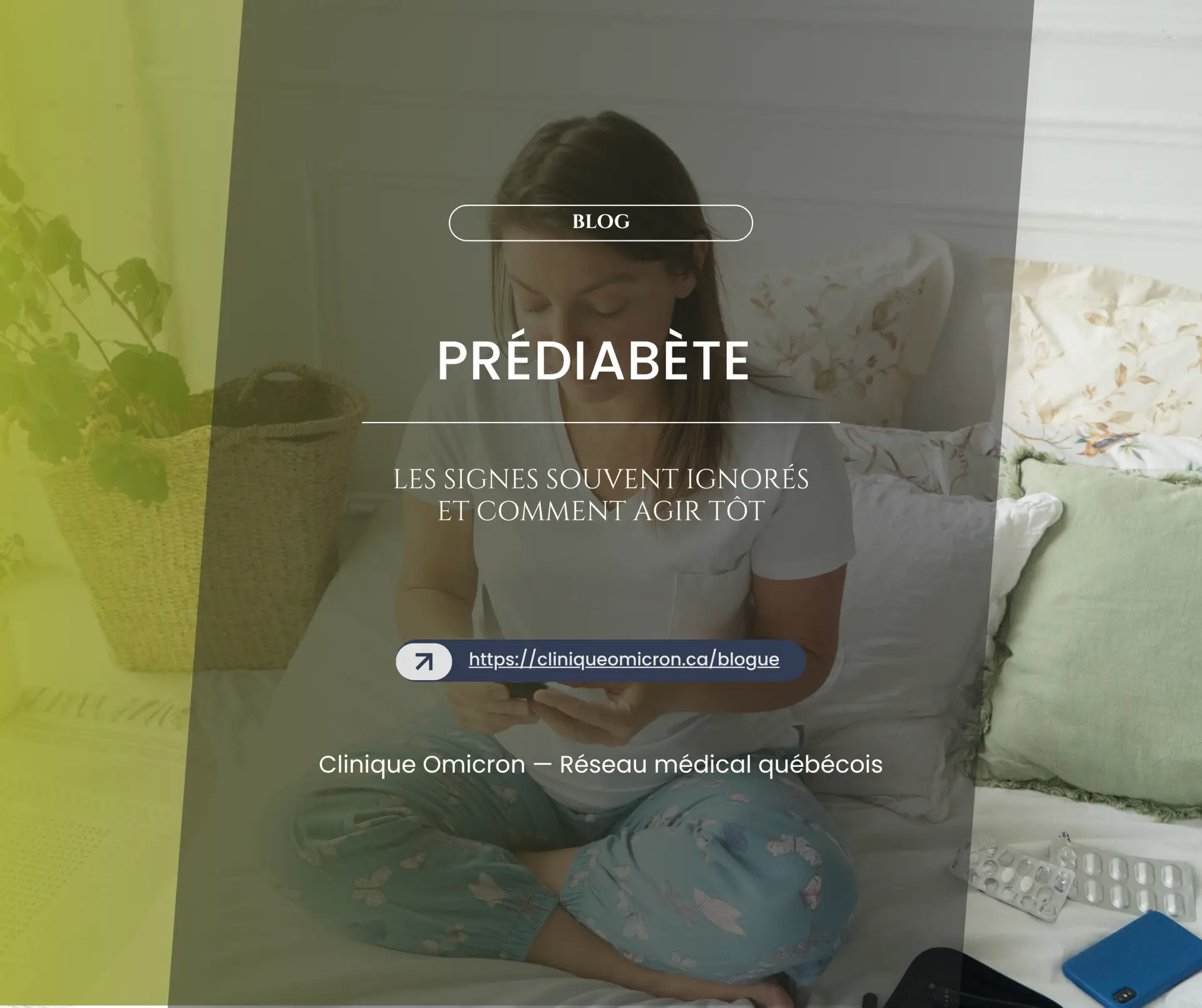

Un Québécois sur quatre vivrait avec un prédiabète sans le savoir. Ce chiffre, issu des données de l’Institut national de santé publique du Québec, est frappant précisément parce qu’il parle de gens qui se sentent bien. Pas fatigués de façon particulière, pas assoiffés en permanence, pas en surpoids nécessairement. Juste des gens dont la glycémie a commencé à dériver sans que personne ne le remarque.
Le prédiabète n’est pas une maladie à proprement parler. C’est une zone grise métabolique, réversible dans beaucoup de cas, à condition d’être détectée à temps.
Ce que signifie avoir un prédiabète
Le prédiabète désigne un état dans lequel la glycémie à jeun est plus élevée que la normale sans atteindre encore le seuil diagnostique du diabète de type 2. La valeur de référence se situe entre 6,1 et 6,9 mmol/L selon les critères canadiens, ou entre 5,6 et 6,9 mmol/L selon d’autres classifications utilisées en clinique. Le médecin ou l’IPS interprète toujours ces résultats dans leur contexte global, en tenant compte des autres paramètres du bilan de santé.
Ce qui se passe dans l’organisme, c’est une résistance croissante à l’insuline. Le pancréas continue de produire de l’insuline, mais les cellules y répondent moins bien. Pour compenser, il en produit davantage. Ce mécanisme de compensation peut tenir des années, mais il s’épuise progressivement. Sans changement de trajectoire, environ 15 à 30 % des personnes avec un prédiabète développent un diabète de type 2 dans les cinq ans (Diabète Canada, 2023).
Ce qui distingue le prédiabète du diabète, c’est précisément cette fenêtre d’action. Le diabète de type 2, une fois installé, ne se guérit pas : il se gère. Le prédiabète, lui, peut encore reculer.
Pourquoi les signes passent inaperçus
C’est là que réside le problème central. Le prédiabète ne fait pas mal. Il n’interrompt pas le sommeil, ne gêne pas le travail, ne déclenche aucune alarme évidente. Les quelques signes qui peuvent y être associés sont tellement banals qu’on les attribue à autre chose.
Une fatigue après les repas, par exemple. Ou des fringales sucrées en milieu d’après-midi. Une prise de poids progressive autour de l’abdomen. Des infections qui prennent un peu plus de temps à guérir. Une vision légèrement floue par moments. Rien de tout ça ne pousse spontanément à consulter, surtout quand on n’a pas de médecin de famille qui fait le tour de la situation une fois par an.
C’est précisément pour cette raison que plus de 1,5 million de Québécois sans médecin de famille (MSSS, 2024) passent à travers les mailles. Sans bilan glycémique régulier, le prédiabète évolue en silence pendant des années avant qu’un diagnostic soit posé, souvent à un stade où le diabète est déjà là.
La prise de sang reste le seul outil fiable. La glycémie à jeun ou le test d’hémoglobine glyquée (HbA1c) détectent l’anomalie bien avant que le moindre symptôme n’apparaisse.
Qui est à risque
Certains facteurs augmentent significativement la probabilité d’être en prédiabète. L’âge est l’un d’eux : le risque grimpe de façon notable après 40 ans, et encore davantage après 45. Le surpoids abdominal, soit un tour de taille supérieur à 102 cm chez l’homme et 88 cm chez la femme, est un indicateur fort. Les antécédents familiaux de diabète de type 2 au premier degré comptent aussi, tout comme un mode de vie sédentaire, des antécédents de diabète gestationnel, un syndrome des ovaires polykystiques ou encore une hypertension artérielle connue.
Certaines origines ethniques, notamment les personnes d’origine sud-asiatique, latino-américaine, africaine ou autochtone, présentent un risque plus élevé à poids corporel équivalent, une réalité que les recommandations cliniques canadiennes reconnaissent explicitement (Diabète Canada, 2023).
Le tabagisme, la consommation régulière d’alcool et les troubles du sommeil chroniques figurent également parmi les facteurs associés à une résistance accrue à l’insuline. Ces éléments entrent dans l’évaluation globale du risque métabolique lors d’une consultation médicale.
How is the diagnosis made
Deux tests permettent de détecter un prédiabète. La glycémie à jeun mesure le taux de sucre dans le sang après un jeûne d’au moins 8 heures. C’est l’examen de première ligne, inclus dans la plupart des bilans de santé annuels. Le test d’HbA1c, lui, reflète la moyenne de la glycémie sur les deux à trois derniers mois. Il présente l’avantage de ne pas nécessiter de jeûne et donne une image plus représentative de l’état glycémique habituel.
Les deux tests peuvent être prescrits ensemble pour croiser les résultats. Dans certains cas, un test de tolérance au glucose par voie orale peut compléter le bilan, notamment si les valeurs se situent dans une zone limite.
Un résultat hors norme à un seul test ne suffit généralement pas à poser un diagnostic. Le médecin ou l’IPS répète habituellement la mesure avant de confirmer l’état de prédiabète et de proposer un plan de suivi.
Ce que ça change de le savoir tôt
La détection précoce du prédiabète change concrètement le cours des choses. Des modifications du mode de vie suffisent dans beaucoup de cas à ramener la glycémie dans les valeurs normales. Une alimentation équilibrée pauvre en sucres ajoutés et en aliments ultra-transformés, une activité physique régulière d’intensité modérée, comme 150 minutes de marche rapide par semaine, et une perte de poids de 5 à 7 % du poids corporel permettent de réduire de façon significative le risque de progression vers le diabète de type 2 (Programme de prévention du diabète, États-Unis, 2022 ; données corroborées par des études canadiennes).
Ce n’est pas une question de régime draconien. C’est une question de cap. Et ce cap est beaucoup plus facile à corriger à ce stade qu’une fois le diabète installé, avec ses complications cardiovasculaires, rénales et neurologiques à long terme.
La surveillance régulière fait partie intégrante du suivi. Une personne en prédiabète bénéficie généralement d’un bilan glycémique annuel pour suivre l’évolution et ajuster l’approche si nécessaire.
Questions fréquentes sur le prédiabète
Le prédiabète peut-il disparaître complètement ?
Oui, dans beaucoup de cas. Des changements d’habitudes de vie permettent de ramener la glycémie dans les valeurs normales. C’est l’une des rares conditions métaboliques où une intervention précoce peut inverser la tendance de façon durable.
Faut-il prendre des médicaments si on a un prédiabète ?
Pas nécessairement. La grande majorité des prises en charge au stade de prédiabète reposent sur des modifications du mode de vie. Dans certains profils à risque très élevé, un médecin peut discuter d’options médicamenteuses, mais cette décision appartient entièrement au professionnel de santé qui connaît le dossier complet du patient.
Peut-on avoir un prédiabète sans être en surpoids ?
Oui. Le surpoids est un facteur de risque important, mais pas une condition obligatoire. Des personnes avec un poids normal peuvent présenter une résistance à l’insuline, notamment en raison de la génétique, d’un mode de vie sédentaire ou de l’origine ethnique.
Le prédiabète augmente-t-il le risque de maladies cardiovasculaires ?
Oui. Même avant de progresser vers le diabète, l’état de prédiabète est associé à un risque cardiovasculaire plus élevé. C’est une des raisons pour lesquelles la prise en charge précoce dépasse la seule question du sucre et touche à la santé globale.
Quel test demander à son médecin ?
La glycémie à jeun et le test d’hémoglobine glyquée (HbA1c) sont les deux examens standards. Les deux se font par prise de sang. Le médecin ou l’IPS détermine lequel est le plus approprié selon la situation clinique.
When to consult a healthcare professional
Si vous avez 40 ans ou plus, si vous avez un ou plusieurs facteurs de risque mentionnés dans cet article, ou si votre dernier bilan glycémique remonte à plus de deux ans, une consultation médicale s’impose pour évaluer votre situation. La démarche est simple : une prise de sang à jeun avec mesure de la glycémie ou du HbA1c suffit à établir où vous en êtes.
Un médecin ou une infirmière praticienne spécialisée peut interpréter les résultats, évaluer votre profil de risque global et vous orienter vers les ressources appropriées si nécessaire. Cette évaluation ne nécessite pas d’avoir un médecin de famille attitré. Une consultation en clinique médicale ou en teleconsultation at one of our Omicron Clinic in Quebec provides fast access, with no waiting lists.
Teleconsultation in Quebec — Private Online Doctor | Omicron Clinic
Omicron Clinic
Need to consult a doctor?
En clinique ou en télémédecine, partout au Québec.
Reçus pour assurances. Téléconsultation 7 j/7. Sans médecin de famille requis.