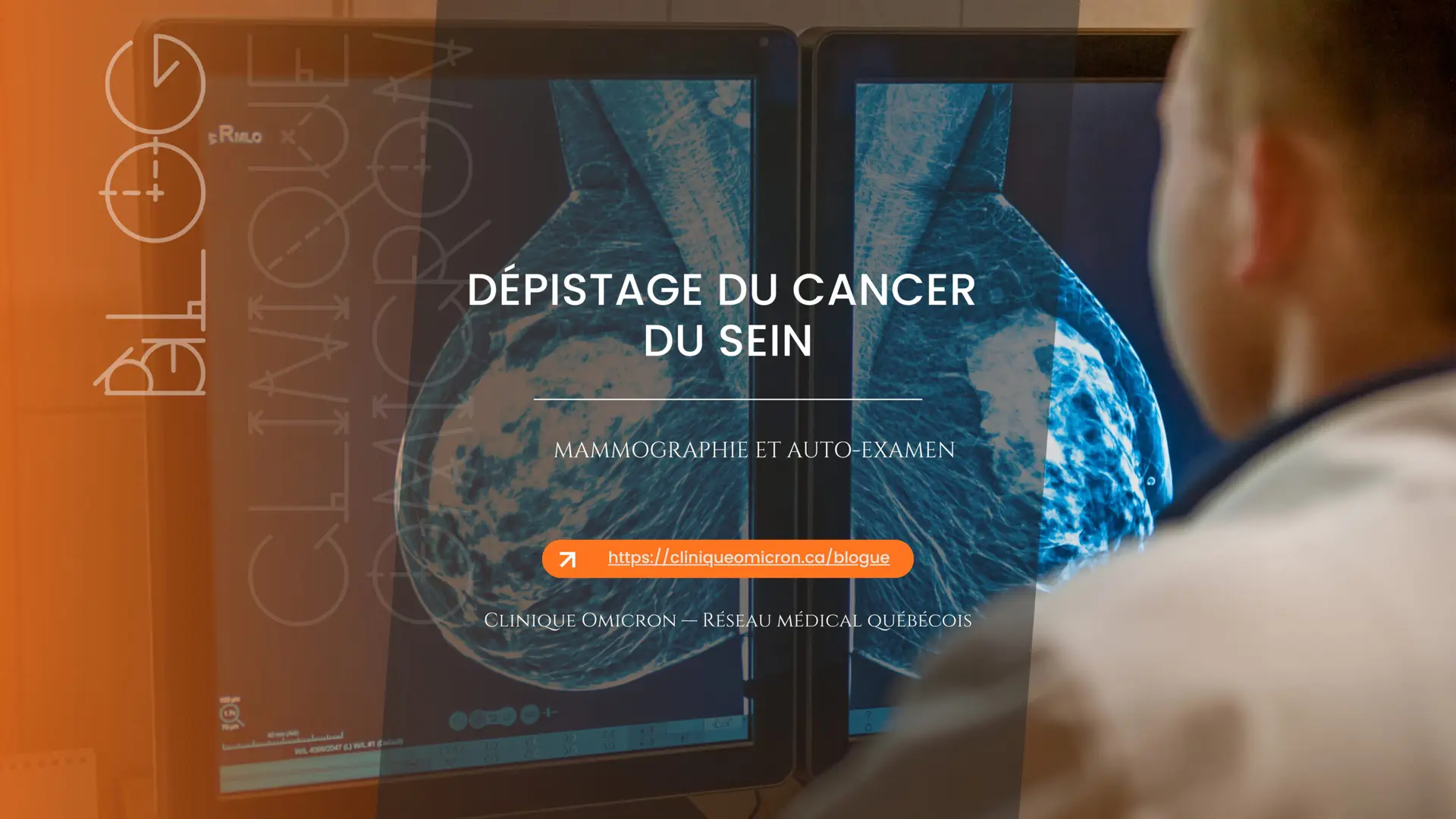

Visit breast cancer screening aims to detect a tumor before it causes symptoms, at a time when treatment options are generally more numerous. In Quebec, it relies on two complementary measures: screening mammography, offered through an organized program, and daily breast self-examination. This article provides an overview of risk factors, how the screening program works, breast self-examination, and signs that warrant a medical consultation. It is intended for women; a separate article addresses breast cancer in men.
On this page
- Understanding Risk Factors
- The Mammography Screening Program
- What a Mammogram Reveals
- Understanding Your Breasts and Breast Self-Examination
- Signs that warrant a consultation
- Breast Density: An Often-Overlooked Factor
- Myths and misconceptions
- Frequently asked questions
- Sources
Understanding Risk Factors
Breast cancer is the most common cancer among women in Canada. Talking about Risk factors does not mean predicting who will develop the disease: these are factors that, statistically, increase or decrease the probability, without ever determining it. Many people with the disease had no known risk factors, and many people who have several of them will never develop cancer.
Factors that cannot be changed
- Age: The risk increases gradually over the years.
- Gender: The vast majority of cases affect women.
- A personal history of breast cancer or certain breast conditions.
- Family history, especially among first-degree relatives (mother, sister, daughter).
- Certain inherited genetic mutations, such as BRCA1 and BRCA2.
- Previous exposure to chest radiation therapy.
Lifestyle Factors
- Alcohol consumption, which has a well-established link to breast cancer.
- Being overweight, especially after menopause.
- A sedentary lifestyle; regular physical activity is associated with a reduced risk.
- Some cases of long-term hormone therapy should be discussed with a doctor.
None of these factors, on its own, is sufficient to make a diagnosis or assess your personal situation. A healthcare professional can assess your level of risk and guide you toward the right management strategy.
To remember
- Screening aims to detect the disease before symptoms appear.
- Risk factors affect probability; they do not establish a diagnosis.
- Age and family history are among the main nonmodifiable factors.
- Alcohol, being overweight, and a sedentary lifestyle are factors that we can influence.
- The majority of cases occur without any obvious risk factors.
- Only a professional can assess your individual risk.
The Mammography Screening Program
Quebec has adopted a organized program a breast cancer screening program overseen by the Ministry of Health and Social Services. Its goal is to provide eligible women with screening mammograms at regular intervals, including invitations, structured follow-up, and quality control of the exams.
Who is the organized screening program intended for?
The program is primarily aimed at women in a specific age group, for whom the benefits of routine screening are most clearly demonstrated. Outside of this age group, or in the presence of specific risk factors, the decision to undergo a mammogram is made on a case-by-case basis with a doctor. The exact age at which screening begins, the recommended frequency, and the screening procedures may change; it is best to confirm the current guidelines with an official source or a healthcare professional.
Screening or investigation: two distinct approaches
A screening mammogram is intended for people without symptoms. When a symptom is present, or when a result requires further evaluation, it is referred to as a diagnostic mammogram, which is often supplemented by other tests. The table below summarizes these differences.
| Element | Screening Mammography | Diagnostic Mammography |
|---|---|---|
| Situation | No symptoms | Symptom or result to be specified |
| Objective | Detecting an anomaly early on | Describe a known anomaly |
| Frame | Organized Program | By prescription only |
| Related Exams | Usually alone | Ultrasound, other tests as needed |
Do you have questions about your care, or would you like to have a symptom evaluated? Our professionals can guide you. Make an appointment At one of our service locations in Quebec, choose a online consultation, or explore our solutions for companies in employee health and safety.
What a Mammogram Reveals
Visit Mammography is a low-dose mammogram. It can detect abnormalities that are too small to be felt during a breast exam, such as microcalcifications or small masses. It is the screening tool with the strongest research evidence of effectiveness for the general population.
Benefits and Limitations
- Early detection, in many cases before symptoms appear.
- A quick examination, performed by trained staff.
- Possible false positives: a result that requires further testing even though there is no cancer.
- Possible false negatives: Mammograms do not detect everything, which is why it is important to remain alert to any changes.
Understanding a Result
A result that requires further testing does not necessarily mean that cancer is present: in most cases, follow-up tests provide reassuring results. Conversely, a normal result does not rule out the need to seek medical advice if a change occurs between two tests. The interpretation of a result is always the responsibility of a healthcare professional.
Understanding Your Breasts and Breast Self-Examination
Current recommendations place less emphasis on a rigid self-examination technique and more on the awareness of her breasts : knowing what they look like and how they usually feel, so you can notice any changes. This vigilance is not a substitute for a mammogram; it complements it.
A simple approach, without getting too caught up in it
- Examine your breasts, for example, in front of a mirror, with your arms at your sides and then raised.
- Feel the area with your fingertips, keeping them flat, and cover the entire breast and underarm.
- Figure out what's normal for you: breasts vary from person to person.
- Keep your cycle in mind: your skin texture may change depending on where you are in your cycle.
What Knowing One's Breasts Is Not
Learning to examine your breasts is not a diagnostic tool and should not become a source of anxiety. The goal is simply to recognize any unusual changes and discuss them with a healthcare professional right away, rather than trying to interpret any abnormalities on your own.
Signs that warrant a consultation
Some changes These symptoms warrant evaluation by a doctor—not because they necessarily indicate cancer (most have a benign explanation), but because they need to be checked out. Here are the main ones you should be aware of.
Changes to Be Evaluated
| Type of change | Examples |
|---|---|
| Mass | A new lump in the breast or under the armpit, or an area that feels firmer |
| Discharge | Nipple discharge, especially spontaneous or blood-tinged discharge |
| Skin | Redness, thickening, «orange peel» appearance, dimpling |
| Nipple | Retraction, change in direction, persistent scabs |
| Shape | Changes in the size or shape of a breast |
| Pain | Persistent and unusual localized pain |
The vast majority of these symptoms are due to benign causes. However, any new and persistent change should be discussed with a healthcare professional, who will determine whether further testing is necessary.
Breast Density: An Often-Overlooked Factor
Visit breast density describes the proportion of glandular and fibrous tissue relative to fatty tissue, as seen on a mammogram. A dense breast is neither abnormal nor a disease: it is a common characteristic, particularly among younger women.
Why She Matters
- Dense tissue appears white on a mammogram, as do certain abnormalities, which can make interpretation more difficult.
- A high density is also associated with a slight increase in risk.
- Depending on the situation, the doctor may decide that a follow-up examination is necessary.
If your breast density is mentioned in a report, this is not a cause for concern, but it is something you should discuss with your healthcare provider so that your follow-up care can be adjusted as needed.
Myths and misconceptions
«Since there's no family history, I'm not at risk.»
False. Most people diagnosed with breast cancer have no family history of the disease. The absence of a family history does not exempt you from the screening recommended for your age group.
«Mammograms expose patients to too much radiation.»
Nuanced. Mammography uses a low dose of X-rays. For the population targeted by the screening program, the expected benefits generally outweigh the risks, but the decision should be made in consultation with a doctor based on your individual situation.
«Self-examination is enough to protect yourself.»
False. Knowing your breasts helps you notice changes, but it does not detect abnormalities that are too small to feel. It complements a mammogram; it does not replace it.
«A lump in the breast must be cancer.»
False. Most breast lumps are benign, such as cysts or changes related to the menstrual cycle. However, any new, persistent lump should be evaluated by a healthcare professional.
«A normal mammogram result protects me forever.»
Nuanced. A normal result is reassuring, but cancer can develop between screenings. Stay alert for any changes and follow the recommended screening intervals.
Frequently asked questions
At what age should breast cancer screening begin?
The program is designed for a specific age group, but the starting age and frequency may vary depending on your risk. Check the current guidelines from an official source and discuss your situation with a doctor.
Is a mammogram painful?
The exam involves compressing the breast for a few seconds, which may be uncomfortable, but it is brief. The sensation varies from person to person and depending on the stage of the menstrual cycle.
Should I do a self-exam every month?
Today, the focus is on knowing your breasts rather than on a strict monthly routine. The important thing is to notice any unusual changes and talk to a healthcare professional about them.
What should I do if I feel a lump?
Any new, persistent lump should be evaluated by a doctor. Most are benign, but only a healthcare professional can confirm this, if necessary through additional tests.
Does having dense breast tissue mean I'm going to get cancer?
No. Breast density is common and is not a disease. It can have a moderate impact on your risk and on the interpretation of your mammogram; discuss this with your doctor.
Can men be affected?
Yes, but that's rare. This article focuses on screening for women; the situation for men is covered in a separate article on breast cancer in men.
Sources
- Canadian Cancer Society — Breast Cancer
- Quebec Breast Cancer Screening Program (PQDCS) — Québec.ca
- National Institute for Excellence in Health and Social Services (INESSS)
- Quebec Breast Cancer Foundation — Information and Resources
- Quebec National Institute of Public Health (INSPQ) — Breast Cancer Screening
- Government of Quebec — Screening and Medical Tests
Medical consultation | Clinique Omicron
Omicron Clinic
Need to consult a doctor?
In-person or via telemedicine, anywhere in Quebec.
We accept insurance. Telemedicine consultations available 7 days a week. No family doctor required.