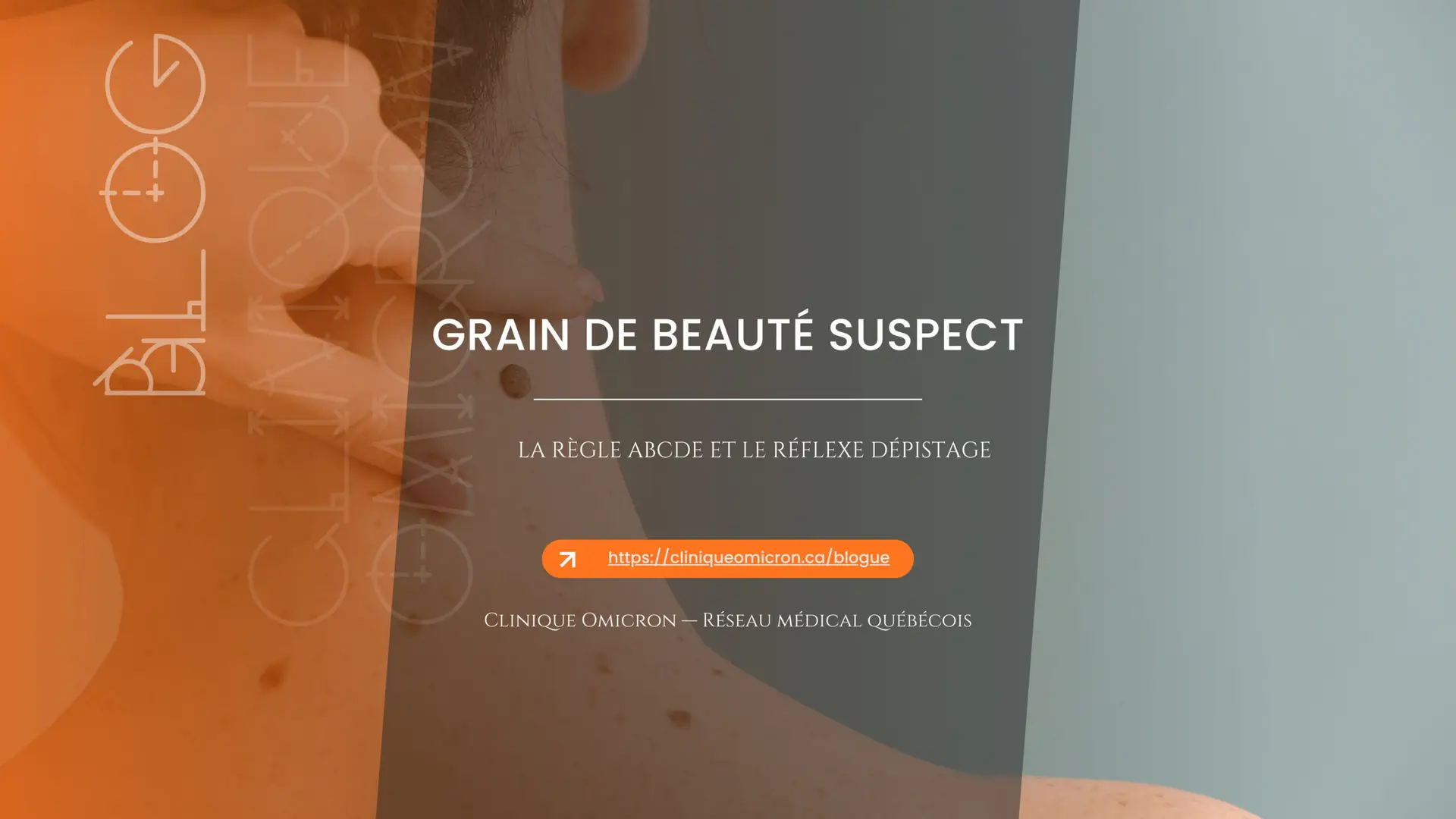

In the summer, we expose our skin to the sun more, and it’s often the season when we notice a spot or a bump that wasn’t there before. Knowing how to recognize a suspicious mole It helps you respond at the right time, without giving in to worry or dismissing a change as insignificant. Most moles are completely harmless and will remain so. However, a few simple guidelines—summarized by the ABCDE rule—can help you identify which moles warrant a closer look. This article explains this rule, the difference between a normal mole and a suspicious one, risk factors, self-examination, and when to see a doctor.
On this page
- Normal or Suspicious Mole
- The ABCDE Rule in Detail
- Risk Factors for Melanoma
- Step-by-Step Guide to Skin Self-Examination
- When to Schedule an Appointment for an Exam
- Daily Sun Protection
- Stay vigilant all year round
- Myths and misconceptions
- Frequently asked questions
Normal or Suspicious Mole
A mole, or nevus, is a cluster of pigment cells. Most adults have several of them, which appear either during childhood or in adulthood. A typical, harmless mole is fairly regular in shape, uniform in color, and stable over time. It is the change—rather than its appearance at any given moment—that draws attention.
What Characterizes a Common Mole
- Generally round or oval in shape, with sharp edges.
- A fairly uniform color, often in shades of brown.
- A stable and modest size that does not change from month to month.
- A resemblance to the person's other moles.
What Can Make a Mole Look Suspicious
A mole warrants closer attention when it stands out from the others, changes in appearance, or exhibits one or more of the signs of the ABCDE rule, detailed below. A lesion that bleeds, itches, forms a scab, or does not heal also warrants medical attention. None of these signs constitutes a diagnosis; they are simply reasonable grounds for having your skin evaluated by a healthcare professional.
The ABCDE Rule in Detail
Visit ABCDE rule is a mnemonic device promoted by cancer organizations to help the public identify moles that should be examined. Each letter represents a specific characteristic. The presence of just one of these characteristics is sufficient to warrant an evaluation; this is not a checklist, but an invitation to seek medical advice.
The Five Letters
| Letter | Meaning | Sign to Watch For |
|---|---|---|
| A — Asymmetry | The two halves are different | One half is nothing like the other |
| B — Edges | Border of the lesion | Irregular, poorly defined, or jagged edges |
| C — Color | Color of the lesion | Multiple colors or uneven shades |
| D — Diameter | Size of the lesion | A growth that is getting larger or an unusually large lesion |
| E — Evolution | Change Over Time | Any change in shape, color, size, or feel |
How to Use It Without Panicking
- The letter E, for "evolution," is often the most telling: a recent change is the most useful indicator.
- A mole that stands out distinctly from all the others also draws attention; it’s sometimes called the “ugly duckling.”.
- The ABCDE rule is not a substitute for a professional examination: it simply helps you decide whether to see a professional.
- No app or online photo can provide a diagnosis; only a medical evaluation can.
To remember
- ABCDE stands for Asymmetry, Borders, Color, Diameter, and Evolution.
- Even just one of these signs is reason enough to have the lesion examined.
- Change over time is the most important benchmark.
- Most moles remain benign throughout a person's life.
- The rule is a tool for monitoring, never a diagnosis.
- When in doubt, an assessment by a healthcare professional is the deciding factor.
Risk Factors for Melanoma
Visit melanoma is a type of skin cancer that develops from pigment-producing cells. Certain factors increase the risk, though none of them make the disease inevitable or guarantee protection. Knowing these factors helps you determine how closely you should monitor your skin.
Factors That Are Often Cited
- Significant exposure to ultraviolet rays, whether from the sun or tanning beds.
- A history of severe sunburn, especially during childhood.
- Fair skin, freckles, and blond or red hair.
- A large number of moles or atypical moles.
- A personal or family history of skin cancer.
- A weakened immune system.
What these factors imply
Having one or more of these risk factors does not mean you will develop melanoma, and not having them does not guarantee complete protection. These factors simply serve as a reminder to protect your skin from the sun and to monitor any changes a little more closely. If you recognize several of these risk factors in yourself, you should talk to a healthcare professional to develop a follow-up plan tailored to your situation.
To remember
- Melanoma develops from the skin's pigment cells.
- Exposure to ultraviolet radiation is a major, modifiable risk factor.
- Fair skin, numerous moles, and a family history of skin cancer are also factors.
- No single factor guarantees that the disease will develop, nor does any single factor provide complete protection against it.
- A combination of several factors calls for increased vigilance.
- Discuss an appropriate follow-up plan with a healthcare professional.
A mole that's changing, a lesion that won't heal, or a concern that's on your mind? Instead of waiting, have it checked out. You can make an appointment appointment at one of our service locations in Quebec, choose a online consultation as a first instinct, or discover our business services.
Step-by-Step Guide to Skin Self-Examination
The’skin self-exam involves regularly examining your entire body to identify anything that appears, changes, or looks out of place. Done at regular intervals, it helps you get to know your skin and notice changes sooner. It is not a substitute for a professional examination, but it is a natural complement to it.
A simple method
- Choose good lighting and a large mirror, and use a hand mirror to check hard-to-see areas.
- Examine the face, neck, ears, and scalp, parting the hair.
- Use the hand mirror to examine your chest, stomach, then your back and buttocks.
- Check your arms, armpits, hands, between your fingers, and under your fingernails.
- Check the legs, the backs of the knees, the feet, between the toes, and the soles of the feet.
- Make a note of anything new or different, including a dated photo if necessary, so you can compare it later.
Areas That Are Often Overlooked
- The scalp—it's hard to see without parting the hair.
- The back and the backs of the legs—a loved one can help check these areas.
- The soles of the feet, between the toes, and under the toenails.
Taking baseline photos helps provide an objective view of how a mole changes from one checkup to the next. If a change persists, it’s best to seek a professional opinion rather than trying to reassure yourself.
When to Schedule an Appointment for an Exam
Knowledge When to Seek Medical Attention Avoid both unnecessary waiting and excessive worry. When in doubt, having a lesion checked costs nothing and often provides peace of mind. It’s always better to have a mole examined—even if it turns out to be nothing—than to ignore a real change.
Reasons for consultation
- A mole that meets one or more of the ABCDE criteria.
- A lesion that bleeds, itches, forms a scab, hurts, or won't heal.
- A mole that's clearly different from all the others.
- A recent change in shape, color, size, or texture.
- A persistent concern, even without any obvious signs.
What to Expect During the Evaluation
The healthcare professional examines the lesion—sometimes using a magnifying instrument—and asks questions about its progression and medical history. Depending on the situation, they may reassure the patient, recommend monitoring, or refer them for further evaluation. The process is usually quick and painless. A teleconsultation can serve as an initial point of contact to describe the situation and determine whether an in-person examination is necessary.
Daily Sun Protection
The best way to reduce the risks associated with moles is through sun protection. Exposure to ultraviolet rays is the main modifiable risk factor for skin cancer. Protecting yourself in the summer—and throughout the rest of the year—is a simple and effective way to stay healthy.
The Actions That Matter
- Seek out shade, especially during the hours when the sun is at its strongest, usually around midday.
- Wear clothing that covers your skin, a wide-brimmed hat, and UV-protective sunglasses.
- Apply a broad-spectrum sunscreen with an SPF of at least 30 generously and reapply it regularly.
- Avoid tanning beds, which expose the skin to intense ultraviolet rays.
- Check the UV index to adjust your outdoor activities accordingly.
For more information, see our article on the Sun protection and choosing the right SPF for your skin type explains how to choose and apply sunscreen properly. And if sun exposure has already caused a sunburn, our article on How to Relieve a Sunburn provides practical guidance.
Stay vigilant all year round
While summer naturally brings up the topic of the sun and skin, the beauty marks, ...they, however, deserve constant attention. Ultraviolet rays are present even outside of the summer months, and a change can occur at any time. Making self-exams part of your routine prevents you from thinking about them only during the summer.
Establishing Good Habits
- Set a regular reminder for self-examination, such as at the change of seasons.
- Protect your skin from the sun all year round, not just during summer activities.
- Keep in mind that snow and water reflect sunlight and increase your exposure.
- Don't put off a doctor's appointment just because summer is over: any concern is a valid reason, no matter the season.
Myths and misconceptions
«A mole that itches must be dangerous.»
Nuanced. Itching can have many harmless causes, such as irritation. But a mole that itches, bleeds, or changes in appearance should be examined by a healthcare professional. The symptom alone does not indicate anything; it is the evaluation that matters.
«Only people with fair skin develop melanoma.»
False. The risk is higher for people with fair skin, but melanoma can affect people of all skin tones. In fact, people with dark skin are sometimes diagnosed later. Everyone needs to be vigilant.
«A photo app can diagnose a mole»
False. No consumer app can replace an examination by a professional. These tools can give a false sense of security or cause unfounded anxiety. When in doubt, consult a professional rather than relying on an automated analysis.
«No sunburn, no risk to the skin»
False. UV-related damage accumulates without necessarily resulting in a visible sunburn. Repeated exposure matters, even without a sunburn. Protection is still important in all circumstances.
«Tanning beds are safer than the sun.»
False. Tanning beds emit intense ultraviolet rays and are associated with an increased risk of skin cancer. They are not a safe alternative to sun exposure.
Frequently asked questions
What does the ABCDE rule mean?
ABCDE is a mnemonic device for identifying a mole that should be examined: Asymmetry, Irregular borders, Uneven color, Increasing diameter, and Changes over time. Even just one of these signs is reason enough to consult a healthcare professional.
How often should you perform a skin self-exam?
Regular self-exams—for example, once a month or at the start of each season—help you get to know your skin and spot changes early. People with multiple risk factors should talk to a healthcare professional to determine a suitable schedule.
Is it cause for concern if a new mole appears in adulthood?
New moles can still appear in adulthood and are not necessarily a cause for concern. What should raise concern is a lesion that stands out clearly from the others or that changes rapidly. If you have any doubts, a healthcare professional can evaluate it.
Does the ABCDE rule replace a doctor's visit?
No. The ABCDE rule is a screening tool for the general public to help them decide whether to seek medical attention. It does not provide a diagnosis. Only an examination by a healthcare professional can truly assess a skin lesion.
Can I have a mole examined during a telemedicine consultation?
A telemedicine consultation can serve as an initial point of contact to describe the situation, ask questions, and determine whether an in-person examination is necessary. Depending on the situation, the healthcare professional may refer you for a more thorough evaluation that requires a direct examination of the skin.
When should you seek immediate medical attention?
If you notice a mole that is changing rapidly, a lesion that bleeds or won't heal, or if you have persistent concerns, it's best not to wait and to have the situation evaluated by a healthcare professional.
Sources
- Canadian Cancer Society — Melanoma: Signs and Symptoms
- Canadian Dermatology Association — Skin Cancer
- Quebec National Institute of Public Health (INSPQ) — Ultraviolet Radiation
- Quebec Cancer Foundation — Skin Cancer
- Health Canada — Sunscreens and UV Protection
- Government of Quebec — Protecting Yourself from the Sun
Medical consultation | Clinique Omicron
Omicron Clinic
Need to consult a doctor?
In-person or via telemedicine, anywhere in Quebec.
We accept insurance. Telemedicine consultations available 7 days a week. No family doctor required.