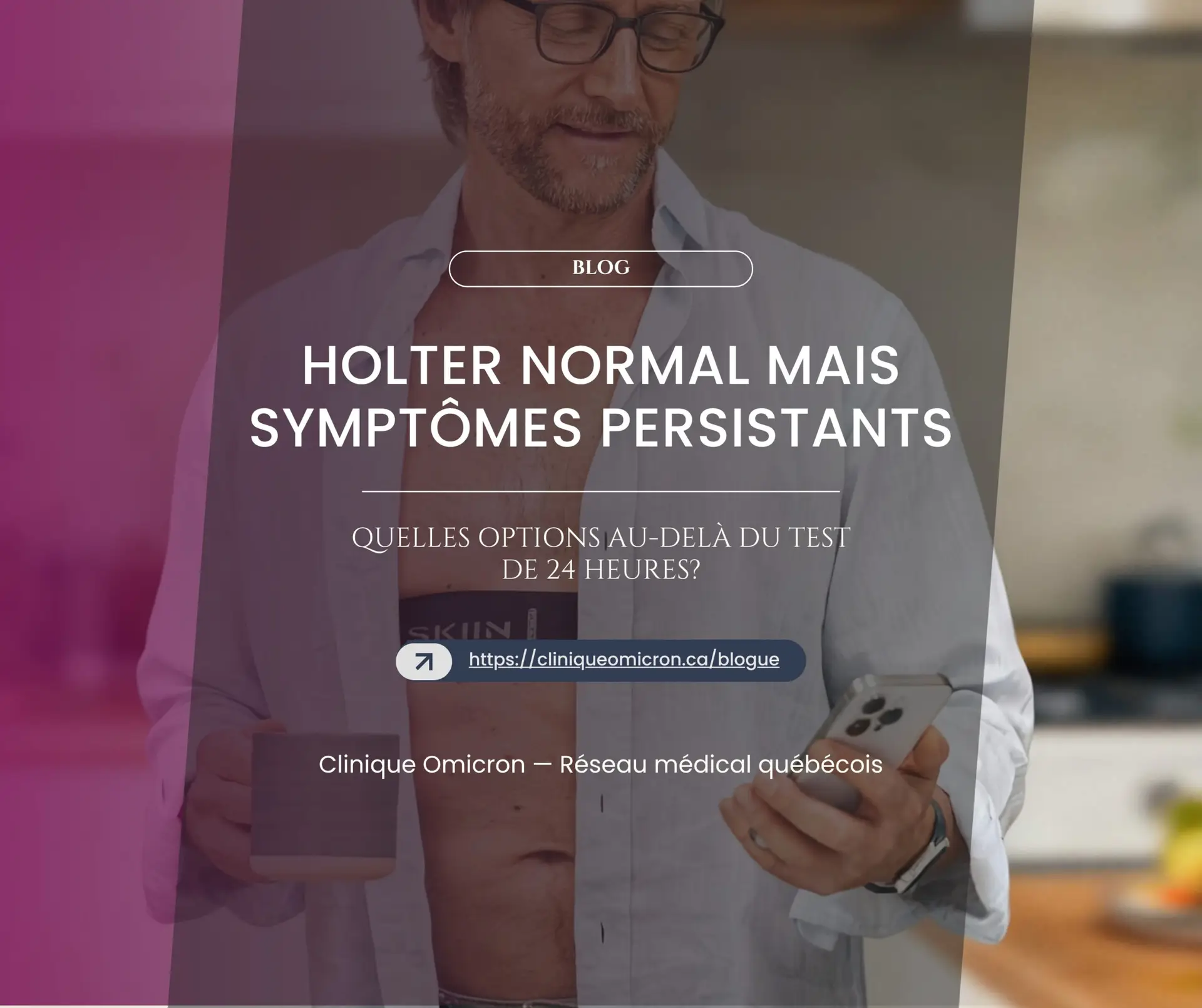

When a doctor suspects an arrhythmia, the gold standard test for decades has been the 24-hour Holter monitor : a small device connected to adhesive electrodes that records the heart rhythm for a full day. But this short time frame poses an obvious problem—if the arrhythmia does not occur during those 24 hours, it goes undetected. New approaches now allow for extended monitoring over several days using wearable devices. This article explains the difference between these two tests and why your doctor might recommend one over the other.
On this page
- What is a 24-hour Holter monitor?
- Why 24 Hours Might Not Be Enough
- Long-term cardiac monitoring: a modern alternative
- Smart clothing: a comfortable and seamless option
- Which test for which patient?
- How to Take These Exams in Quebec
- Myths and Misconceptions
- Frequently asked questions
What is a 24-hour Holter monitor?
The Holter monitor is a ambulatory electrocardiogram. Specifically, it is a portable device connected to several electrodes attached to the chest, which continuously records the heart’s electrical activity for a period generally ranging from 24 to 48 hours.
What is it used for?
- Investigate palpitations, dizziness, or fainting spells.
- Detect atrial fibrillation or other arrhythmias.
- To evaluate the effectiveness of an antiarrhythmic treatment.
- Check that a pacemaker is working properly.
It is a reliable and well-established test. Its main limitation, however, is its short recording duration, which covers only a tiny fraction of the time.
Key Takeaways
- A Holter monitor is a continuous ECG.
- He usually records for 24 to 48 hours.
- It is used to investigate palpitations and arrhythmias.
- He also evaluates treatments and stimulators.
- It is a reliable and widely recognized test.
- Its short duration is its main limitation.
Why 24 Hours Might Not Be Enough
Many arrhythmias are intermittent or paroxysmal: they occur in episodes, sometimes several days or weeks apart. A person may experience palpitations over the weekend and have no symptoms in the days that follow.
The Diagnostic Trap
If the Holter monitor is worn during a symptom-free period, the recording will be normal—which does not mean there is no arrhythmia, simply that it did not occur during that time frame. This situation causes a great deal of frustration: the patient continues to experience symptoms, but the test results come back normal, and the diagnosis is delayed, sometimes for months.
Key Takeaways
- Many arrhythmias occur in episodes.
- Episodes may occur days or weeks apart.
- A Holter monitor worn outside of an episode shows a normal recording.
- A normal ECG does not rule out arrhythmia.
- Diagnosis may be delayed.
- This is a common pitfall in cardiology.
Long-term cardiac monitoring: a modern alternative
Visit extended monitoring involves recording the heart rhythm over an extended period rather than just a single day. The goal is simple: to increase the likelihood of detecting an episode of intermittent arrhythmia.
Possible Approaches
- Adhesive ECG patch worn for several days.
- A patient-activated event monitor triggered when symptoms occur.
- An implantable monitor for the most complex cases.
- Smart clothing with textile sensors—a more recent innovation.
| Approach | Typical duration | Character |
|---|---|---|
| 24-48-hour Holter monitor | 1 to 2 days | Standard, short-term |
| Adhesive ECG Patch | Several days | Lightweight, wireless |
| Event Monitor | Days to Weeks | Manual activation |
| Garment with Textile Sensors | Extended period | Adhesive-free, for everyday wear |
| Implantable monitor | Months to Years | Invasive, complex cases |
A normal initial cardiac test despite persistent symptoms? Our teams can assess whether long-term monitoring is warranted. Learn more about our services, explore our solutions for businesses, choose the teleconsultation or Make an appointment online.
Smart clothing: a comfortable and seamless option
Visit smart clothing incorporate ECG sensors directly into the fabric. No adhesive, no visible casing: the patient wears the garment like ordinary underwear—day and night, while sleeping and during physical activity.
SKIIN™ Technology at Our Service Locations
At our service locations in Quebec, we offer—in partnership with Myant Health, a Canadian company based in Mississauga—SKIIN™ technology, a smart garment approved by Health Canada as a Class II medical device. This technology enables continuous heart rhythm monitoring over an extended period, followed by analysis by a cardiologist.
Clinical Benefits
- Better tolerance: no skin irritation caused by adhesives.
- Discreet: invisible under everyday clothing.
- Continuity: recording during sleep, exercise, and everyday activities.
- Increased likelihood of detecting intermittent arrhythmias.
- Contextual documentation: An episode can be linked to a specific time of day.
Which test for which patient?
The choice between a 24-hour Holter monitor and long-term monitoring depends on the clinical context. Your doctor will always determine the appropriate test, based on the nature and frequency of your symptoms.
When a short-term Holter monitor may be sufficient
A 24- to 48-hour Holter monitor may be sufficient when symptoms are frequent—or even daily—or when the goal is to confirm a suspected arrhythmia.
When long-term monitoring is being considered
- Symptoms are rare or unpredictable.
- An initial Holter test came back normal despite persistent symptoms.
- Paroxysmal atrial fibrillation is suspected.
- The patient suffered a stroke whose cause remains unexplained (cryptogenic stroke).
- Comfort and how long they can be worn are important considerations.
How to Take These Exams in Quebec
Cardiology in Quebec generally operates through medical guidance. Your family doctor or a cardiologist will determine whether a heart rhythm test is necessary and will order it.
At our service locations in Quebec, we offer in-person and telemedicine cardiac evaluations, as well as access to long-term monitoring via smart clothing when clinically appropriate. The decision is always made by your treating healthcare professional.
Myths and Misconceptions
«A 24-hour Holter monitor is always sufficient.»
False. The Holter monitor only records what happens while it is being worn. For rare or unpredictable symptoms, its short duration is often insufficient.
«If the Holter is normal, there's nothing wrong with me.»
False. A normal trace simply indicates that no arrhythmia occurred during the recording; it does not mean that none exist at other times.
«Long-term monitoring is always preferable.»
Nuanced. It all depends on the context. For everyday symptoms, a short Holter monitor may be sufficient. Long-term monitoring is especially useful for rare episodes.
«Smart clothing is less reliable than a Holter monitor.»
Nuanced. Devices approved as medical devices are evaluated by a cardiologist. They serve a different purpose: to record data for longer periods of time and more comfortably.
«I can choose the type of exam I want to take.»
False. The choice of test is a medical decision based on your symptoms, medical history, and the degree of clinical suspicion.
Frequently asked questions
What is the difference between a Holter monitor and long-term monitoring?
A Holter monitor records the heart rhythm over 24 to 48 hours, while prolonged monitoring lasts several days or longer. The longer the monitoring period, the greater the likelihood of detecting an intermittent arrhythmia.
Why is my Holter monitor reading normal even though I have symptoms?
Because the arrhythmia probably did not occur during the recording period. A normal trace does not rule it out; it merely indicates that it was not detected during that time frame.
Is smart clothing more comfortable than a Holter monitor?
For many patients, yes. It is worn without adhesive or a case, which reduces skin irritation and allows for extended use while sleeping and during physical activity.
Who decides what kind of exam to take?
The family doctor or the cardiologist. The choice depends on the frequency of symptoms, medical history, and the degree of clinical suspicion. No single test is universally better than another.
How can I take these exams in Quebec?
Access requires a referral from a doctor. After an evaluation, the doctor prescribes the appropriate test. At our service locations in Quebec, these evaluations are available in person and via telemedicine.
What should you do if you have severe symptoms?
Any acute chest pain, loss of consciousness, or severe symptom requires calling 911 or going to the emergency room immediately. No screening test can replace emergency care.
Sources
- Heart + Stroke — Heart Rhythm Tests and Arrhythmias (coeuretavc.ca)
- National Institute of Excellence in Health and Social Services (INESSS) — Cardiology Technologies (inesss.qc.ca)
- Health Canada — Database of Licensed Medical Devices (canada.ca/sante-canada)
- Montreal Heart Institute — Patient Information (icm-mhi.org)
- Quebec Ministry of Health and Social Services (MSSS) (msss.gouv.qc.ca)
- Quebec College of Physicians (CMQ) — Professional Information (cmq.org)
Medical consultation | Clinique Omicron
Omicron Clinic
Need to consult a doctor?
In-person or via telemedicine, anywhere in Quebec.
We accept insurance. Telemedicine consultations available 7 days a week. No family doctor required.