
Every summer, water brings families together around Quebec’s lakes, swimming pools, and other bodies of water. But behind these moments of relaxation lies a risk that is often misunderstood. The drowning prevention is based on a fact that few people know: drowning is silent, happens quickly, and almost never looks like it does in the movies. Understanding this phenomenon and adopting a few simple habits can make all the difference, especially when it comes to children. Here’s what every family should know to enjoy the water safely.
On this page
- Drowning is silent and happens quickly
- Active Supervision of Children
- Residential Pool Safety
- Life jackets
- Swimming in Lakes and Rivers
- Alcohol, Drugs, and Swimming
- Basic First Aid and When to Call 911
- Myths and Misconceptions
- Frequently asked questions
Drowning is silent and happens quickly
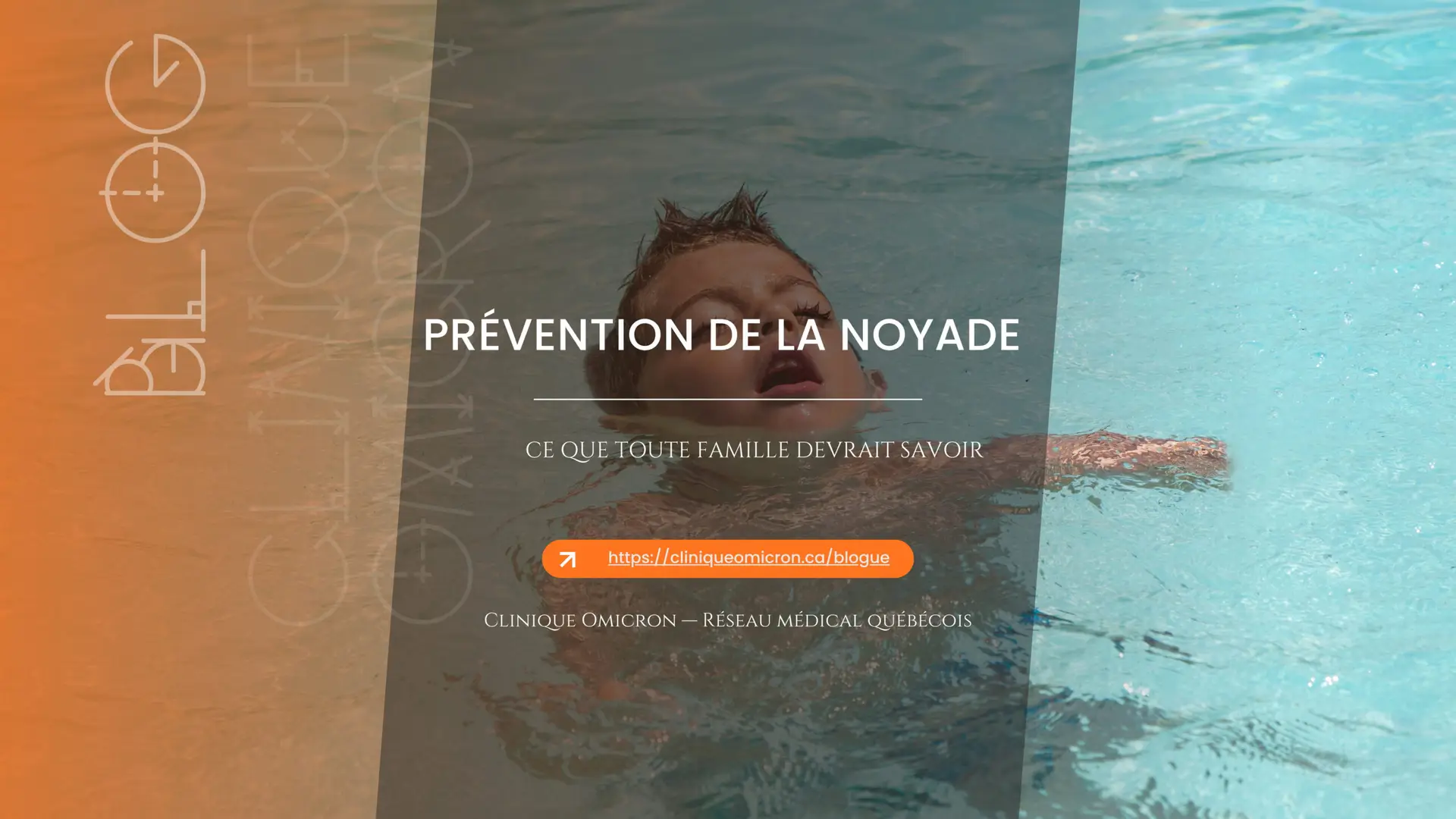
The common image of a person shouting and waving their arms is misleading. In real life, the drowning It often happens silently and in a matter of seconds, without splashing or cries for help. A person in distress in the water uses their energy and breath to try to breathe, not to scream. This is what makes the situation particularly dangerous for young children, who can slip beneath the surface without anyone noticing.
Real Signs of Distress in the Water
- With his head submerged in the water and his mouth at the surface.
- Glassy eyes, a blank or closed gaze.
- The body is upright, with no effective leg movement.
- Attempts to swim in place that don't get you anywhere.
- No sound: The person cannot call for help.
Why Children Are More Vulnerable
Toddlers have a higher center of gravity and less strength to pull themselves up. Even shallow water can be dangerous, and just a few moments of inattention can be enough. According to water safety organizations, a significant proportion of incidents involving young children occur during a brief lapse in supervision, often at home or at a relative’s house.
Active Supervision of Children
The most effective preventive measure remains the active monitoring. It’s not just a matter of being present, but of keeping your eyes constantly on the child who is in the water or near the water. The Lifesaving Society sums up this idea with the rule of direct and uninterrupted eye contact.
The Eye Contact Rule
- Keep your eyes on the child, not on your phone or a conversation.
- Stay within arm's reach of young children and non-swimmers.
- Designate an adult to take turns supervising, with no gray areas.
- Never rely on an older child to watch over a younger one.
- Avoid combining supervision with distracting activities such as reading or barbecuing.
Avoiding «ambiguity» regarding responsibility
During a gathering, people often assume that someone else is keeping watch. This unspoken assumption creates dangerous blind spots. The solution is to clearly designate one person in charge, define their watch period, and explicitly hand off responsibility. A symbolic item, such as an armband or wristband given to the adult on duty, helps everyone know who is on watch at all times.
Monitoring Levels by Age
| Group | Recommended distance | Caution Required |
|---|---|---|
| Toddlers (ages 0–4) | Within arm's reach | Constant eye contact |
| Children (ages 5–9) | In the immediate vicinity | Continuous, close monitoring |
| Non-swimmers (all ages) | Within arm's reach | Constant eye contact |
| Beginner Swimmers | In the same area | Regular visual inspection |
Key Takeaways
- Drowning usually happens silently and occurs in a matter of seconds.
- Young children are the most vulnerable, even in shallow water.
- Active supervision means keeping a constant eye on the child.
- Stay within arm's reach of young children and non-swimmers.
- Clearly designate a responsible adult; do not leave it to be implied.
- Cell phones and distractions are the main enemies of alertness.
Is there a health issue on your mind before summer? You can set up a meeting at one of our service locations in Quebec, or choose a online consultation to quickly get advice from a healthcare professional. Organizations and camps that want to equip their teams with prevention tools can also consult our Business Offerings.
Residential Pool Safety
Visit residential pool is a place of fun, but also a place where many accidents involving young children occur. In Quebec, regulations govern the installation and safety of residential swimming pools to limit children’s unsupervised access to the pool. Beyond legal requirements, several physical measures help reduce the risk.
Protective barriers
- A compliant fence surrounds the pond on all sides.
- It is quite tall and has no footholds that would allow someone to climb it.
- The gaps between the bars are too small for a child to fit through.
- It separates the pool from the house and the play areas.
The gate and the latch
- The door closes and locks automatically.
- The latch is placed out of reach of young children.
- The door opens toward the outside of the pool.
- The mechanism is checked regularly to ensure that it is working properly.
Supplementary Measures
A pool alarm or an alarm on a door leading to the yard can alert adults to unexpected entry. These devices are useful, but they are never a substitute for a physical barrier or supervision. Also, put away floating toys after swimming—they attract children to the water. To find out the requirements that apply to your property, consult the official information from the Government of Quebec or your municipality.
| Safety barrier | Role | Does it replace monitoring? |
|---|---|---|
| Fence in Compliance | Prevent Unsupervised Access | No |
| Self-closing gate | Close the access automatically | No |
| Pool or door alarm | Report Unexpected Access | No |
| Active Monitoring of an Adult | Respond immediately | Essential Measure |
Life jackets
Visit life jacket, also known as a personal flotation device, is a valuable safety aid, especially on boats, in open water, and for children who cannot swim. However, it’s important to choose the right model and wear it correctly. A poorly fitting life jacket can give a false sense of security.
How to Choose and Wear a Vest Properly
- Choose an approved life jacket that is appropriate for the person's weight and height.
- Make sure it is securely fastened and properly adjusted, with no excessive play.
- For a child, it should not ride up over the ears when you pull on the shoulders.
- Always wear it when on a boat or near deep water.
- Check it for wear and tear before each season.
Life jackets, arm floats, and swim rings: different uses
Inflatable armbands, foam noodles, and floating mats are toys, not safety devices. They can deflate, slip, or drift away, and do not keep the head above water. Only an approved, properly fitted life jacket provides reliable buoyancy. Never let a child rely solely on an inflatable toy to stay afloat.
Swimming in Lakes and Rivers
Visit open-water swimming poses different risks than a swimming pool. The bottom is uneven, the depth changes rapidly, the water temperature can be low, and currents are sometimes invisible from the shore. Proper preparation significantly reduces the danger.
The Dangers Specific to Open Water
- Currents and eddies, especially near dams and river mouths.
- The thermal shock caused by cold water, which takes your breath away.
- Unknown objects on the seafloor and submerged objects that make diving risky.
- Fatigue sets in faster than it does in the pool.
- Reduced visibility makes it difficult to locate a person in distress.
Swim More Safely
- Whenever possible, choose areas supervised by lifeguards.
- Enter the water gradually to allow your body to adjust.
- Never swim alone, and keep a companion within your field of vision.
- Avoid diving headfirst into water where you don't know how deep it is.
- Keep an eye on the weather and get out of the water at the first sign of a storm.
Alcohol, Drugs, and Swimming
L’alcohol is a factor associated with a significant proportion of drownings among adolescents and adults. It impairs judgment, slows reflexes, reduces coordination, and distorts the perception of cold and depth. The same effects apply to cannabis and other substances.
Why the mixture is dangerous
- Judgment declines and risky behavior increases.
- Survival instincts slow down when faced with difficulty.
- The sensation of cold is masked, which increases the risk of hypothermia.
- Supervision of children is becoming less reliable.
The rule is simple: Do not drink before or while swimming, operating a boat, or supervising children near the water. The designated adult supervisor must be fully available and sober.
Basic First Aid and When to Call 911
Knowing the steps for first aid can save a life while waiting for emergency responders. The goal is not to replace formal training, but to know how to react quickly and call for help without hesitation. The Canadian Red Cross and the Lifesaving Society offer courses to teach these techniques.
The Emergency Response Chain
- Get the person out of the water without putting yourself in danger.
- Call 911 or have someone call 911 immediately.
- Check to see if the person is breathing and conscious.
- Begin cardiopulmonary resuscitation if you are trained and the person is not breathing.
- Stay with the person and follow the emergency responders' instructions.
When to Call 911 Immediately
- A person was pulled from the water unconscious or not breathing.
- A person has swallowed water and is experiencing a persistent cough or difficulty breathing.
- There is confusion, unusual drowsiness, or chest pain following an incident in the water.
- Do you have any doubts about the condition of a person you have rescued?.
Even after getting out of the water without any apparent issues, respiratory symptoms that develop or worsen in the hours that follow warrant a medical evaluation. If in doubt, consult a healthcare professional.
Myths and Misconceptions
«A person who is drowning screams and waves their arms around.»
False. Drowning usually happens silently. The person cannot scream or wave their arms effectively, because all their energy is focused on trying to breathe. That is why constant visual supervision is essential.
«Arm floats are enough for a child who can't swim.»
False. Arm bands and floats are toys. They can slip off or deflate and do not keep the head above water. Only an approved, properly fitted life jacket provides reliable buoyancy, and it is no substitute for adult supervision.
«Knowing how to swim eliminates any risk of drowning.»
Nuanced. Knowing how to swim reduces the risk, but does not eliminate it. Fatigue, currents, cold water, alcohol, or feeling unwell can put even a good swimmer in danger. Caution is always advised, regardless of age.
«A pool fence makes supervision unnecessary»
False. A properly installed fence and gate reduce unsupervised access, but no safety measure can replace an attentive adult. Physical safeguards and active supervision complement each other; they are not substitutes for one another.
«Shallow water isn't dangerous.»
It's true that we should be wary of it. Even shallow water can be dangerous for a young child. Caution is also needed around wading pools, buckets, and small bodies of water.
Frequently asked questions
At what age can a child start learning to swim?
Learning to swim can start early, often with water familiarization classes. While learning to swim is beneficial, it is never a substitute for active supervision. Check with recognized organizations such as the Canadian Red Cross or the Lifesaving Society.
How long does one have to look away before an incident occurs?
Drowning can happen in a matter of seconds and without a sound. That is why supervision must be continuous, without interruptions for phone calls or conversations—especially when young children are present.
Should I see a doctor after swallowing water?
If a person has a persistent cough, difficulty breathing, unusual drowsiness, or confusion after a water-related incident, seek medical attention immediately and call 911 if in doubt. An evaluation by a healthcare professional is recommended if symptoms appear or worsen.
Is a pool alarm required?
Requirements vary depending on applicable regulations and your municipality. There are regulations governing residential swimming pools in Quebec, and it is advisable to check the official information from the Quebec government to find out what applies to your pool.
Is a life jacket necessary if my child knows how to swim?
Yes, especially when boating and in open water. Even a child who can swim can be caught off guard by a current, fatigue, or cold water. Wearing an approved, properly fitted life jacket provides significant protection.
Where can I take a first aid or rescue training course?
The Canadian Red Cross and the Lifesaving Society offer accredited training in first aid, CPR, and water rescue. These courses are open to the general public and are highly recommended for families.
Sources
- Life Saving Society (Quebec) — Water Safety and Drowning Prevention
- Canadian Red Cross — Swimming and Water Safety
- Quebec National Institute of Public Health (INSPQ) — Injury Prevention
- Québec.ca — Safety and Regulations for Residential Pools
- Quebec.ca — Water Safety
Medical consultation | Clinique Omicron
Omicron Clinic
Need to consult a doctor?
In-person or via telemedicine, anywhere in Quebec.
We accept insurance. Telemedicine consultations available 7 days a week. No family doctor required.