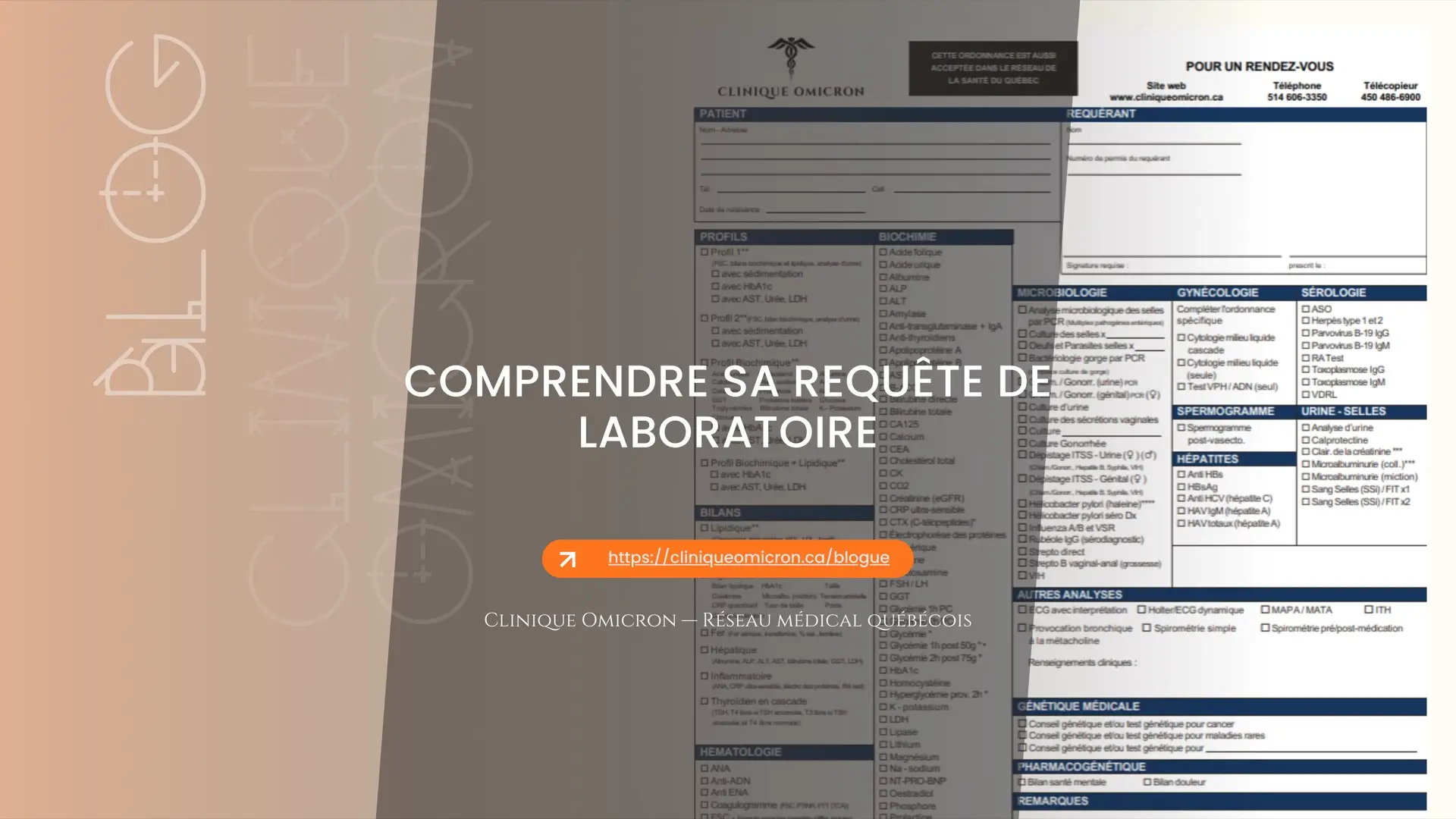

A sheet of paper handed out at the end of the consultation, covered with acronyms in capital letters, with boxes checked and a signature. The lab request is the document that specifies what samples will be collected, where, and under what conditions—and almost no one knows how to read it. The result: wasted trips, samples that have to be collected again, and delayed results because the recipient’s field was left blank.
On this page
- What Is a Request?
- Read the most common acronyms
- On an empty stomach or not: the question that keeps coming up
- Validity Period and Expiration Date
- Where to get a blood sample drawn
- Receiving and Understanding the Results
- Errors That Require You to Retake the Test
- Myths and misconceptions
- Frequently asked questions
What Is a Request?
A query is a order for laboratory tests. It must be signed by a licensed professional—a doctor, nurse practitioner, and in some cases a pharmacist or other professional, depending on their scope of practice. Without it, no laboratory will draw blood.
The Five Components of a Request
- Patient Identification — name, date of birth, health insurance number. A mistake here brings everything to a halt.
- Prescriber — name, license number, contact information: that's where the results will be sent.
- Requested Analyses — checked or written.
- Clinical Information — the reason for the request. It guides the interpretation and sometimes determines the scope of coverage.
- Date and Signature — the starting point of validity.
Read the most common acronyms
Knowing what is required allows you to ask the right question before you go, rather than after the sample is collected.
| Acronym | What Is Measured | Frequently asked about |
|---|---|---|
| FSC or complete blood count | Red blood cells, white blood cells, platelets | Fatigue, infection, anemia |
| TSH | Thyroid Function | Fatigue, weight fluctuations, monitoring |
| Creatinine, eGFR | Renal function | Monitoring and Adjustment of Medications |
| ALT, AST, GGT | Liver enzymes | Liver, treatment follow-up |
| Lipid profile | Cholesterol and Triglycerides | Cardiovascular risk |
| HbA1c | Average blood glucose level over the past few months | Diabetes and Prediabetes |
| Ferritin | Iron reserves | Anemia, fatigue |
| INR | Coagulation | Anticoagulant Monitoring |
| SMU-DCA | Urine Analysis and Culture | Urinary tract infection |
| Public Service Announcement | Prostate Antigen | Follow-up or screening under discussion |
To remember
- A request is a court order: without it, no collection can take place.
- Fasting applies only to certain tests—assuming it applies to all of them leads to skipping meals unnecessarily.
- A request has a validity period and may expire before it is served.
- Clinical information is not merely for show: it guides interpretation and, at times, coverage.
- The results are sent to the prescribing physician, not automatically to the patient.
- An abnormal result is not a diagnosis—it is just one piece of information among many.
On an empty stomach or not: the question that keeps coming up
This is the leading cause of unnecessary travel. The fast applies only to some of the analyses, and its duration varies.
| Type of Analysis | Fasting |
|---|---|
| Fasting blood glucose, lipid profile | Generally required |
| Complete blood count, TSH, ferritin | Generally not required |
| Certain hormones | A specified time for blood draw rather than fasting |
| Urinalysis | Guidelines for sample collection rather than fasting |
Two important points to avoid mistakes: Water is generally allowed during fasting, and you should never stop taking a medication for a blood test unless your prescribing doctor has instructed you to do so. The safest approach is to ask the clinic when you schedule your appointment, specifying the tests listed on the request form.
It's easier to plan a blood draw when you know where to go. The appointment scheduling at our service locations in Quebec covers routine blood draws, the online consultation allows you to discuss a request or results with a professional, and our offers for businesses provides details on workplace health assessments.
Validity Period and Expiration Date
A request does not last indefinitely. The prescriber often specifies a duration or deadline, and sometimes a frequency if the test needs to be repeated—for example, «every three months for one year.».
- Unless otherwise specified, the standard processing time applies, depending on the laboratory; it’s better to ask for clarification than to make an assumption.
- An expired request requires you to submit a new one, which often means rescheduling an appointment.
- A looping query is executed multiple times: don't discard it after the first run.
- A lost request can often be reissued by the clinic without a new appointment—all you have to do is ask.
Where to get a blood sample drawn
| Location | What You Need to Know |
|---|---|
| Public Health Screening Center | Covered; appointments often required, varying turnaround times |
| Private clinic | Faster access; coverage rules depend on the analysis and the prescriber’s status |
| At home | For people with limited mobility; special conditions |
| Hospital | Usually as part of follow-up care or a hospital stay |
A point that is often overlooked: Some specialized tests are not performed at every facility and are sent to a reference laboratory, which extends the time it takes to get results without anyone being notified.
Receiving and Understanding the Results
The results are sent to the prescriber. It is he who interprets them and decides what to do next. A person can also access them on their own, but access does not equate to interpretation.
What «out of the ordinary» means
Reference ranges describe the interval within which the majority of a population falls—not the boundary between health and disease. A value slightly above the range may be insignificant for one person but significant for another. These ranges vary depending on the laboratory, age, sex, and time of sample collection, which makes comparisons between two laboratories misleading.
No news is bad news
Just because you haven’t received a call doesn’t mean everything is fine: a result might get lost, arrive after you’ve switched doctors, or be sitting in an inbox. It’s best to ask right from the start how and when the results will be communicated, and to follow up if the expected timeframe has passed.
Errors That Require You to Retake the Test
- Failure to observe the fast when it was required—or to have done so unnecessarily and shown up in a weakened state.
- Showing up at the wrong time for a test where timing is critical, such as certain hormone tests or drug level measurements.
- Collecting a urine sample without instructions, which contaminates the sample.
- Forgetting Your Health Insurance Card or the query itself.
- Do not report a medication or supplement that affects the result—biotin, for example, can skew certain test results.
- Have blood drawn after starting an antibiotic for a culture that was supposed to have preceded it.
Myths and misconceptions
«You must always be on an empty stomach.»
False. Only certain tests require it. Unnecessary fasting is common and difficult, especially for people with diabetes or the elderly.
«I can request any test»
Nuanced. A test must be clinically justified. Some tests are available in the private sector without a medical indication, but an isolated result without context causes more anxiety than it provides information.
«An abnormal reading means I'm sick.»
False. A test result must be interpreted in conjunction with the patient's symptoms, medical history, and other test results. On its own, it does not provide a definitive conclusion.
«My request is valid indefinitely.»
False. It has an expiration date, and an expired request requires you to start the process over.
«All the laboratories report the same figures.»
False. The methods and reference ranges vary. For follow-up testing, it is best to use the same laboratory so that the results remain comparable.
Frequently asked questions
Can I have my tests done at a lab other than the one listed?
In most cases, yes, provided that the laboratory performs the requested tests and accepts the request. Coverage terms may vary.
How long does it take to get the results?
From a few hours for routine tests to several days for cultures and specialized tests sent to other facilities.
Can I check my results myself?
You have the right to access your health information, and some results are available on the government portal. This does not replace the prescriber’s interpretation.
Do I need an appointment for a blood draw?
Most often, yes, within the public healthcare system. Some private clinics accept walk-in patients, depending on their policies.
Should I stop taking my medication beforehand?
Never on your own initiative. Some dosages must be taken at a specific time relative to a meal; only the prescribing physician can provide these instructions.
What should I do if I've lost my application?
Contact the clinic that issued it: it can often be reissued without the need for another appointment.
Sources
- Government of Quebec — Health System and Services
- Quebec Health Insurance Board
- National Institute of Excellence in Health and Social Services
- Collège des médecins du Québec
- Order of Nurses of Quebec
- Quebec Commission on Access to Information
Omicron Clinic
Need to consult a doctor?
In-person or via telemedicine, anywhere in Quebec.
We accept insurance. Telemedicine consultations available 7 days a week. No family doctor required.