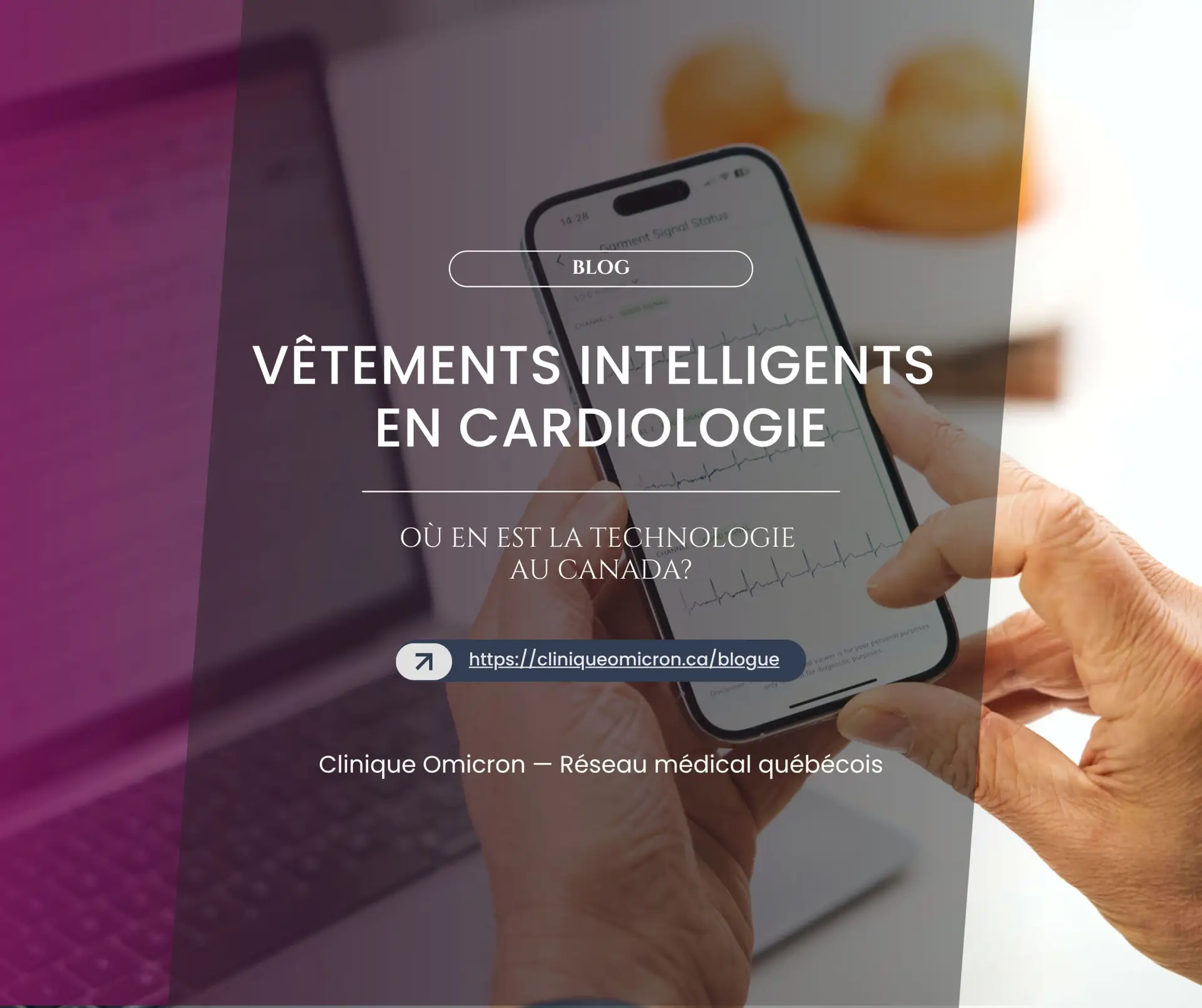

Cardiology has long relied on one-time tests: an electrocardiogram lasting a few seconds, a 24-hour Holter monitor, or an echocardiogram. These approaches remain essential, but they share a limitation: they provide a snapshot of the heart’s activity at a given moment, often far removed from the actual conditions of daily life. In recent years, the smart clothing Textile-based sensors are a game-changer, enabling continuous and comfortable data recording over an extended period. This article provides an overview of this technology and the Canadian innovation behind it.
On this page
- What is a smart garment with textile sensors?
- Clinical Benefits
- What are its clinical applications?
- Canadian Innovation: Myant Health
- Arrival in Quebec
- What Technology Can't Replace
- Toward a More Proactive Approach to Medicine
- Myths and Misconceptions
- Frequently asked questions
What is a smart garment with textile sensors?
A smart clothing In cardiology, this is most often a tank top or chest strap with woven-in textile sensors capable of measuring the heart’s electrical signal. The fabric itself serves as the interface between the body and the technology—without adhesives, conductive gel, or a visible device.
The advances that make this possible
- Conductive textiles: fibers capable of transmitting an electrical signal while remaining washable and comfortable.
- Miniaturized sensors integrated directly into the fabric of the garment.
- Wireless connectivity with a mobile app and a secure cloud service.
- Analysis algorithms capable of filtering out noise, identifying abnormal episodes, and providing a reading that a cardiologist can use.
A Break from Ad Hoc Review
Whereas a conventional test captures a snapshot of activity, the smart garment monitors the heart over time and in its natural setting. This continuity is precisely what makes it valuable when symptoms are sporadic or unpredictable.
Key Takeaways
- The fabric serves as an interface, without any adhesive or casing.
- The ECG sensors are woven into the fabric of the garment.
- Data is transmitted to an application and a secure service.
- Algorithms filter and prepare the plots.
- A cardiologist interprets the recordings.
- This approach complements the ad hoc review without replacing it.
Clinical Benefits
Compared to a traditional Holter monitor, the smart garment offers several tangible benefits, especially when symptoms are intermittent and difficult to detect within a short time frame.
Four Main Benefits
- Long-lasting comfort—no adhesives, no skin irritation, no bulky casing. The garment can be worn while sleeping, exercising, and during daily activities.
- Extended recording duration — rather than 24 or 48 hours, the recording takes place over a significantly longer period, which increases the likelihood of detecting an intermittent arrhythmia.
- Discretion — invisible under everyday clothing, it allows you to continue your social and professional life without having to explain a visible device.
- Contextual data—data is collected under real-world conditions: sleep, exercise, rest, stress, and diet, providing a more representative picture.
Smart Clothing vs. Holter Monitors: A Comparison
| Criteria | Standard Holter monitor | Smart Clothing |
|---|---|---|
| Recording Duration | 24 to 48 hours | Extended period |
| Comfort | Housing and wires | Worn as underwear |
| Adhesives | Adhesive Electrodes | No adhesive |
| Discretion | Visible | Invisible under clothing |
| Conditions Recorded | Time-Limited | Real-Life Daily Life |
Key Takeaways
- Comfort encourages long-term, consistent wear.
- A longer monitoring period increases the chances of detecting a rare arrhythmia.
- Discretion minimizes the impact on daily life.
- The data reflect actual conditions.
- Sleep and exercise are documented.
- The tool is intended to complement the Holter monitor, not to serve as a systematic replacement for it.
What are its clinical applications?
Clothing equipped with ECG sensors does not replace all cardiac tests. It is particularly useful in specific situations where long-term monitoring provides real added value.
Common indications
- Screening for intermittent arrhythmias: paroxysmal atrial fibrillation, sporadic tachycardias, frequent premature beats.
- Post-event monitoring: following a cryptogenic stroke, a heart attack, catheter ablation, or cardioversion.
- Evaluation of Unexplained Palpitations: When Initial Tests Come Back Normal but Symptoms Persist.
- Remote monitoring: for patients in remote areas or for whom frequent travel is difficult.
- Longitudinal follow-up in certain chronic conditions.
One tool among many
The decision to continue monitoring is always a medical one, based on the nature of the symptoms, the patient’s medical history, and the degree of clinical suspicion. The smart garment is one option among many, but it does not automatically replace them.
Are you currently under cardiological care or experiencing unexplained symptoms? Our teams can assess whether long-term monitoring is appropriate. Learn more about our services, explore our solutions for businesses, choose the teleconsultation or Make an appointment online.
Canadian Innovation: Myant Health
Myant Health is a Canadian company based in Mississauga, Ontario, and a pioneer in the field of textile computing. Its flagship cardiology product, the SKIIN™ smart garment, incorporates textile ECG sensors capable of continuously recording the heart's electrical activity.
Features of SKIIN™ Technology
- Approved by Health Canada as a Class II medical device.
- Certified to ISO 13485:2016 for manufacturing quality.
- Complies with PHIPA and PIPEDA standards for the protection of health information.
- Designed and manufactured in Canada.
Data Sovereignty: An Asset
The Canadian perspective is particularly interesting: health data continues to be processed domestically, within a regulatory framework that aligns with Quebec’s privacy protection requirements (Bill 25). This data sovereignty is increasingly valued by both patients and clinicians as continuous monitoring becomes more widespread.
Arrival in Quebec
Initially rolled out in Ontario across several clinical networks, SKIIN™ technology is now expanding into Quebec. At our service locations in Quebec, we are partnering with Myant Health to offer access to this long-term cardiac monitoring for patients for whom a medical evaluation demonstrates a clinical indication.
The Typical Process
- Initial medical evaluation, in person or via teleconsultation.
- The physician's determination of the clinical appropriateness of prolonged monitoring.
- Delivery of the smart garment and guidance on how to use it.
- Continuous recording during the recommended period.
- Analysis of the recordings by a cardiologist.
- Report forwarded to the attending physician and appropriate clinical follow-up.
| Step | Location / Actor | Result |
|---|---|---|
| Initial Assessment | In-person or telemedicine consultation | Decision on Relevance |
| Clothing Drop-Off | Service location | User Support |
| Recording | Home and Daily Life | Continuous data |
| Analysis | Cardiologist | Structured Report |
| Tracking | Primary Care Physician | Tailored Clinical Plan |
What Technology Can't Replace
It is important to specify the limits of these devices. No matter how effective they may be, they are no substitute for several fundamental aspects of cardiac care.
- The medical consultation and the cardiologist's expertise.
- Other cardiac imaging tests: ultrasound, MRI, and nuclear medicine scans.
- The Comprehensive Clinical Evaluation: Medical History, Physical Examination, and Review of Past Medical History.
- Cardiac emergencies, which require immediate hospital care.
These garments serve as a complementary tool—one that can be invaluable in certain situations—and their use is part of a comprehensive medical approach rather than a substitute for it.
Toward a More Proactive Approach to Medicine
The emergence of smart clothing is part of a long-term trend : the shift from reactive medicine—where action is taken when a symptom appears—to proactive medicine, where continuous monitoring is used for early detection.
This development is particularly relevant in cardiology, where early detection of an arrhythmia such as atrial fibrillation can help prevent serious complications. For patients in Quebec, access to these technologies offers an additional option in the diagnostic process, which should be discussed with their doctor based on their individual situation.
Myths and Misconceptions
«A garment with sensors is just a connected gadget.»
False. Some of these technologies are approved by Health Canada as medical devices and are analyzed by a cardiologist. This clearly distinguishes them from consumer watches and wristbands.
«Smart clothing replaces the Holter monitor and the cardiologist.»
False. This is a supplementary tool. It is not a substitute for a medical consultation, cardiac imaging, or a comprehensive clinical evaluation.
«The longer the recording, the better—in any case.»
Nuanced. Prolonged monitoring increases the likelihood of detecting an intermittent arrhythmia, but its usefulness depends on the clinical situation. The physician determines the appropriate duration.
«My health data inevitably ends up abroad.»
Nuanced. With a solution designed and operated in Canada, data can be processed domestically, within a framework that complies with Bill 25. The exact terms depend on the provider and should be verified.
«If I don't have any symptoms, this kind of monitoring is pointless.»
Nuanced. Monitoring is particularly useful for specific indications, including certain post-event follow-ups. It is not a general screening measure: its use is based on an individualized medical decision.
Frequently asked questions
Is smart clothing as reliable as a Holter monitor?
Devices approved as medical devices are evaluated by a cardiologist. They serve a different purpose than a Holter monitor: they record data over a longer period of time and under real-world conditions. The doctor chooses the device best suited to the situation.
Can you wear it while sleeping and exercising?
Yes. That is precisely one of its advantages: it is worn as undergarment while sleeping, exercising, and going about daily activities, which allows for monitoring of the heart under a variety of conditions.
Is my health information protected?
With a solution designed and operated in Canada, data can be processed domestically within a framework that complies with Bill 25. The specific terms depend on the provider and the clinical agreement and can be explained to you before monitoring begins.
Who is eligible for this monitoring?
It is intended, in particular, for patients with suspected intermittent arrhythmias, those requiring post-event follow-up, or those experiencing unexplained palpitations after normal short-term tests. The indication is determined by the physician following an evaluation.
How is the data analyzed?
The continuous recordings are analyzed by a cardiologist, who prepares a report that is sent to the patient's primary care physician. The primary care physician then provides clinical follow-up based on the results.
What should you do in the event of a cardiac emergency?
No monitoring device can replace emergency services. If you experience chest pain, loss of consciousness, or any other serious symptoms, call 911 or go to the emergency room immediately.
Sources
- Health Canada — Database of Licensed Medical Devices (canada.ca/sante-canada)
- Heart + Stroke — Atrial Fibrillation and Arrhythmias (coeuretavc.ca)
- National Institute of Excellence in Health and Social Services (INESSS) — Cardiology Technologies (inesss.qc.ca)
- Quebec Access to Information Commission (CAI) — Act 25 and Health Information (cai.gouv.qc.ca)
- Montreal Heart Institute — Patient Information (icm-mhi.org)
- Quebec College of Physicians (CMQ) — Professional Information (cmq.org)
Medical consultation | Clinique Omicron
Omicron Clinic
Need to consult a doctor?
In-person or via telemedicine, anywhere in Quebec.
We accept insurance. Telemedicine consultations available 7 days a week. No family doctor required.