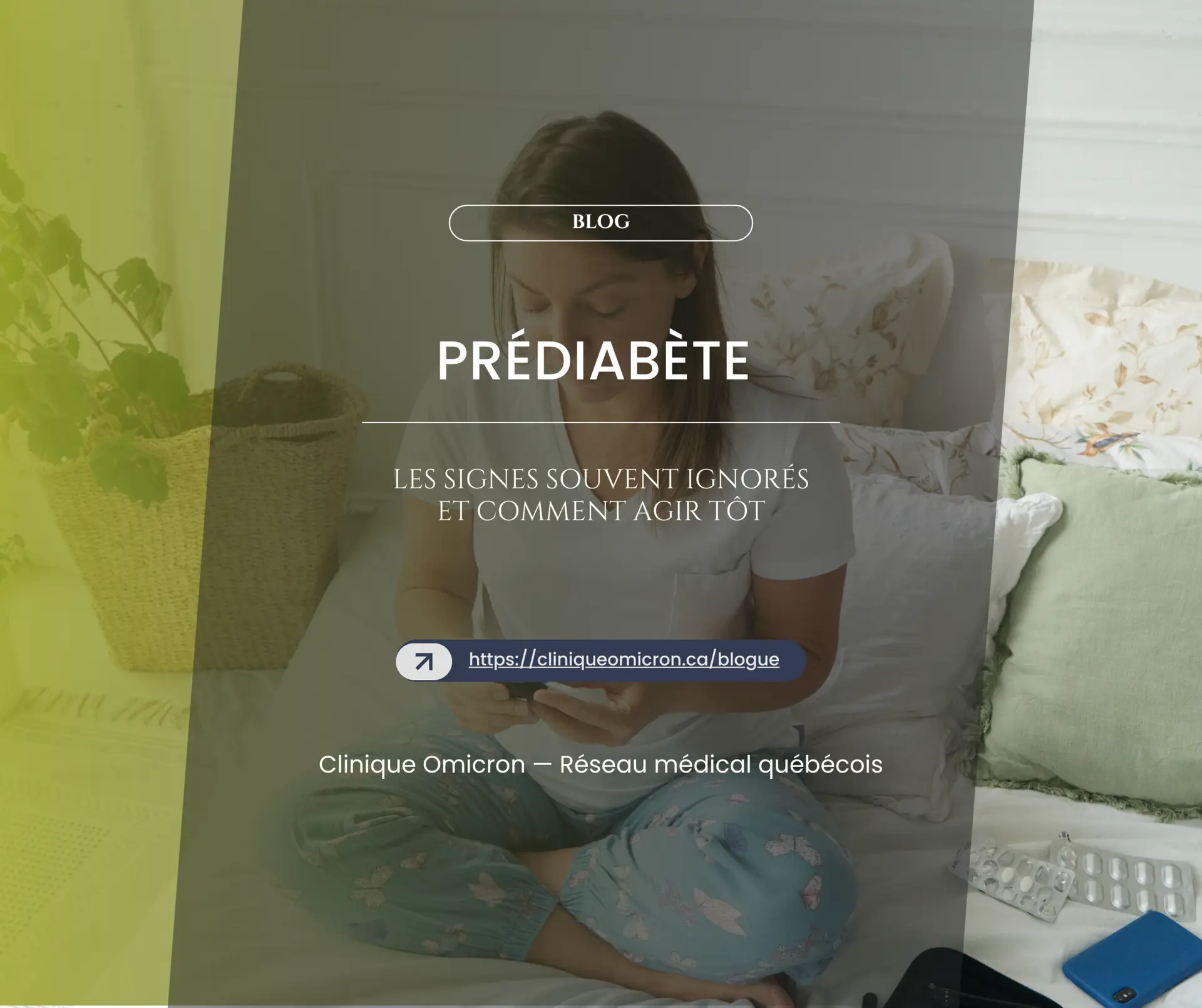

One in four Quebecers is believed to be living with prediabetes without knowing it. This figure, based on data from the Institut national de santé publique du Québec, is striking precisely because it refers to people who feel fine. They aren’t particularly tired, aren’t constantly thirsty, and aren’t necessarily overweight. They’re just people whose blood sugar levels have started to drift out of control without anyone noticing.
Prediabetes is not a disease in the strict sense of the word. It is a metabolic gray area that is reversible in many cases, provided it is detected early enough.
What a prediabetes diagnosis means
Prediabetes refers to a condition in which fasting blood glucose levels are higher than normal but have not yet reached the diagnostic threshold for type 2 diabetes. The reference range is between 6.1 and 6.9 mmol/L according to Canadian criteria, or between 5.6 and 6.9 mmol/L according to other classifications used in clinical practice. The doctor or IPS always interprets these results within their overall context, taking into account the other parameters from the health assessment.
What happens in the body is a growing resistance to insulin. The pancreas continues to produce insulin, but the cells respond less effectively to it. To compensate, the pancreas produces more insulin. This compensatory mechanism can last for years, but it gradually wears out. Without a change in course, approximately 15 to 30 % of people with prediabetes will develop type 2 diabetes within five years (Diabetes Canada, 2023).
What distinguishes prediabetes from diabetes is precisely this window of opportunity. Once type 2 diabetes has developed, it cannot be cured—it can only be managed. Prediabetes, on the other hand, can still be reversed.
Why do the signs go unnoticed
That is where the central problem lies. Prediabetes doesn’t cause any pain. It doesn’t disrupt sleep, interfere with work, or set off any obvious warning signs. The few symptoms that may be associated with it are so common that people attribute them to something else.
Feeling tired after meals, for example. Or mid-afternoon sugar cravings. Gradual weight gain around the abdomen. Infections that take a little longer to clear up. Slightly blurry vision at times. None of these symptoms are enough on their own to prompt a visit to the doctor, especially when you don’t have a family doctor who checks in on your overall health once a year.
It is precisely for this reason that more than 1.5 million Quebecers without a family doctor (MSSS, 2024) fall through the cracks. Without regular blood sugar testing, prediabetes progresses silently for years before a diagnosis is made—often at a stage when diabetes has already set in.
A blood test remains the only reliable method. A fasting blood glucose test or a glycated hemoglobin (HbA1c) test can detect the condition long before any symptoms appear.
Who is at risk
Certain factors significantly increase the likelihood of having prediabetes. Age is one of them: the risk rises significantly after age 40, and even more so after age 45. Abdominal obesity—defined as a waist circumference greater than 102 cm in men and 88 cm in women—is a strong indicator. A family history of type 2 diabetes in first-degree relatives is also a factor, as are a sedentary lifestyle, a history of gestational diabetes, polycystic ovary syndrome, or known high blood pressure.
Certain ethnic groups—including people of South Asian, Latin American, African, or Indigenous descent—are at higher risk even at the same body weight, a fact that Canadian clinical guidelines explicitly acknowledge (Diabetes Canada, 2023).
Smoking, regular alcohol consumption, and chronic sleep disorders are also among the factors associated with increased insulin resistance. These factors are taken into account in the overall assessment of metabolic risk during a medical consultation.
How is the diagnosis made
There are two tests that can detect prediabetes. The fasting blood glucose test measures blood sugar levels after fasting for at least 8 hours. This is the first-line test and is included in most annual physicals. The HbA1c test, on the other hand, reflects the average blood glucose level over the past two to three months. It has the advantage of not requiring fasting and provides a more representative picture of typical blood glucose levels.
The two tests can be prescribed together to cross-reference results. In some cases, an oral glucose tolerance test may complete the assessment, particularly if the values are in a borderline range.
An abnormal result from a single test is generally not enough to make a diagnosis. The doctor or healthcare professional usually repeats the test before confirming a diagnosis of prediabetes and recommending a follow-up plan.
What difference does it make to know it early
Early detection of prediabetes makes a real difference. In many cases, lifestyle changes alone are enough to bring blood sugar levels back to normal. A balanced diet low in added sugars and ultra-processed foods, regular moderate-intensity physical activity—such as 150 minutes of brisk walking per week— and weight loss of 5 to 7 % of body weight can significantly reduce the risk of progression to type 2 diabetes (Diabetes Prevention Program, United States, 2022; findings supported by Canadian studies).
It’s not a matter of a strict diet. It’s a matter of direction. And that direction is much easier to correct at this stage than once diabetes has set in, with its long-term cardiovascular, renal, and neurological complications.
Regular monitoring is an integral part of follow-up care. A person with prediabetes typically undergoes an annual blood glucose screening to track progress and adjust the treatment plan as needed.
Frequently Asked Questions About Prediabetes
Can prediabetes disappear completely?
Yes, in many cases. Changes in lifestyle can help bring blood sugar levels back to normal. It is one of the few metabolic conditions where early intervention can reverse the trend in a lasting way.
Should I take medication if I have prediabetes?
Not necessarily. The vast majority of treatments for prediabetes are based on lifestyle changes. For certain patients at very high risk, a doctor may discuss medication options, but this decision rests entirely with the healthcare professional who is familiar with the patient’s complete medical history.
Can you have prediabetes without being overweight?
Yes. Being overweight is a major risk factor, but it is not a prerequisite. People of normal weight can develop insulin resistance, particularly due to genetics, a sedentary lifestyle, or ethnic background.
Does prediabetes increase the risk of cardiovascular disease?
Yes. Even before progressing to diabetes, prediabetes is associated with a higher risk of cardiovascular disease. This is one of the reasons why early management goes beyond just blood sugar levels and addresses overall health.
What tests should I ask my doctor for?
Fasting blood glucose and the glycated hemoglobin (HbA1c) test are the two standard tests. Both are performed via a blood draw. The doctor or clinical nurse specialist determines which is most appropriate based on the clinical situation.
When to consult a healthcare professional
If you are 40 years old or older, if you have one or more of the risk factors mentioned in this article, or if your last blood sugar test was more than two years ago, you should see a doctor to assess your situation. The process is simple: a fasting blood test to measure your blood sugar or HbA1c is all it takes to determine where you stand.
A doctor or a specialized nurse practitioner can interpret the results, assess your overall risk profile, and refer you to the appropriate resources if necessary. This assessment does not require you to have a primary care physician. A consultation at a medical clinic or at a teleconsultation at one of the service locations of Omicron Clinic In Quebec, this allows for quick access without a waiting list.
Teleconsultation in Quebec — Private Online Doctor | Omicron Clinic
Omicron Clinic
Need to consult a doctor?
In-person or via telemedicine, anywhere in Quebec.
We accept insurance. Telemedicine consultations available 7 days a week. No family doctor required.