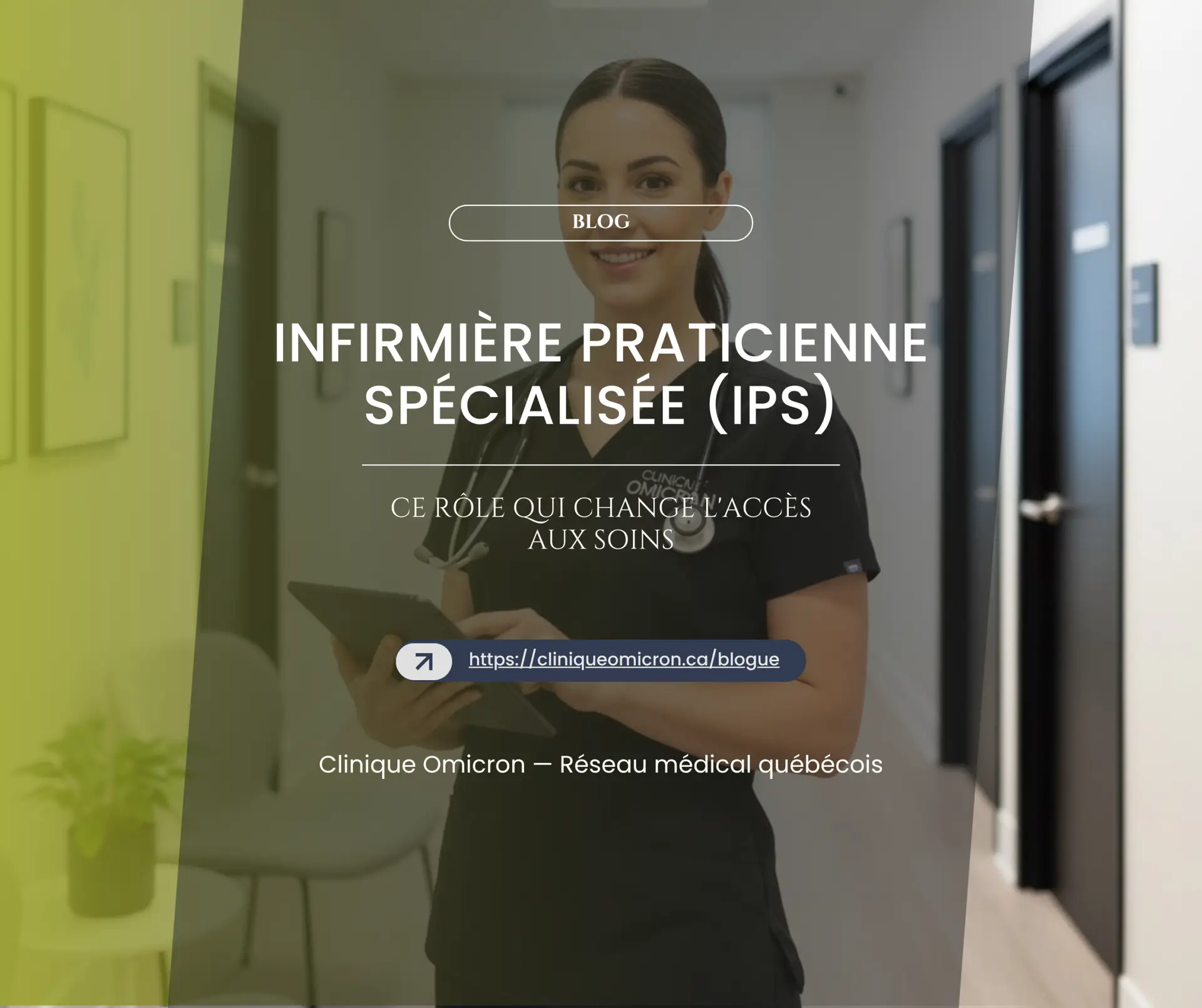

Many Quebecers still don't know exactly what a specialized nurse practitioner is, or what she can do for them. This is understandable: the role developed relatively recently in Quebec and remains little known to the general public, even though it represents one of the most significant advances in the organization of primary care in the last decade.
In Quebec, there were over 1,000 IPSs in practice in 2024, a number that continues to grow (OIIQ, 2024). Each of them can manage hundreds of patients who would not otherwise have access to structured medical follow-up.
What is an IPS
A specialized nurse practitioner is a nurse who has completed post-graduate training in advanced nursing practice, including a clinical specialization. In Quebec, the recognized specializations are in primary care, adult care, pediatrics, neonatal care and care of the elderly. It is the primary care IPS that is involved in the majority of general and family medicine settings.
The IPS exercises an advanced practice that enables him or her to make diagnoses, prescribe medications, order laboratory and imaging tests, and initiate treatments in his or her field of expertise, all autonomously within the regulatory framework established by the OIIQ and the CMQ.
What an IPS can actually do
In practice, the primary care PHN can carry out complete check-ups, prescribe and interpret blood tests, diagnose and treat common illnesses such as infections, stable chronic diseases and mental health disorders, prescribe contraceptives, carry out Pap tests, and monitor pregnancies in collaboration with a physician. She can prescribe time off work, write prescriptions for commonly-used medicines and refer patients to specialists.
For patients without a family doctor, the IPS is often the most accessible gateway to structured, ongoing medical care. In a hybrid medical clinic, she works in collaboration with doctors to offer comprehensive care.
The limits of advanced nursing practice
IPS's scope of practice is well-defined, but has its limits. Certain complex medical procedures, surgeries and high-risk drug prescriptions are the exclusive responsibility of the physician. In practice, situations beyond the scope of the IPS are dealt with in collaboration with a physician, either within the same clinic or by referral. This complementarity is at the heart of the collaborative care model.
Frequently asked questions about IPS
Is a consultation with an IPS covered by RAMQ?
Yes, consultations with an SPI practicing in the public network are covered by RAMQ. In private clinics, terms and conditions vary depending on the practice setting of the IPS.
Is the quality of care provided by an IPS comparable to that of a doctor?
According to published studies, the quality of care provided by an IPS is comparable to that of a doctor, in terms of the care they provide within their field of practice. Graduate training and advanced clinical experience are guarantees of competence in the fields covered.
Can I choose to be looked after exclusively by an IPS?
Yes, for the care that falls within its field of practice. The IPS works independently, and coordinates care for more complex situations, calling on medical collaboration when necessary.
When to consult an IPS
If you don't have a family doctor, need preventive care, a prescription refill, a check-up or an assessment for common symptoms, a consultation with an IPS is a fully valid option.
Clinique Omicron has specialized nurse practitioners at its points of service in Quebec and Ontario. teleconsultation anywhere in the province. To make an appointment, visit cliniqueomicron.ca.
Nursing services - Clinique Omicron.
Omicron Clinic
Need to consult a doctor?
In-person or via telemedicine, anywhere in Quebec.
We accept insurance. Telemedicine consultations available 7 days a week. No family doctor required.